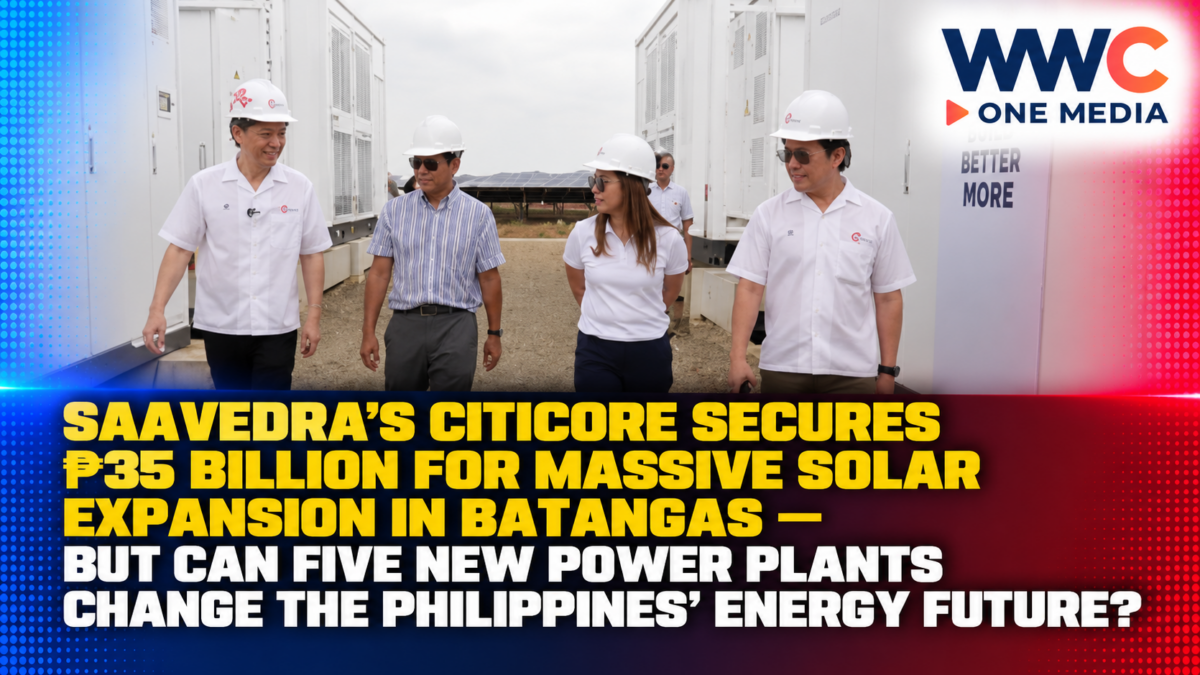
MANILA, PHILIPPINES — Edgar Saavedra-backed Citicore Renewable Energy Corporation (CREC) has secured ₱35.014 billion in financing from three of the Philippines’ major banks to develop five large-scale solar power projects in Batangas, marking a significant milestone in the company’s ambition to become one of the country’s leading renewable energy producers.
The financing agreement, signed on October 22, 2026, will support the development of 900 megawatts-peak (MWp) of solar generating capacity and 120 megawatt-hours (MWh) of battery energy storage.
Once operational, the projects are expected to produce approximately 1,300 gigawatt-hours of electricity annually, equivalent to the estimated consumption of around 550,000 Filipino households.
The development comes as the Philippines works to expand its domestic electricity supply, reduce dependence on imported fossil fuels and increase renewable energy generation.
But the financing announcement is only the beginning.
With billions of pesos committed, five projects to deliver and an ambitious five-gigawatt growth target, can Citicore transform financial backing into reliable electricity—or will construction risks, grid constraints and rising costs put its solar ambitions to the test?
THREE MAJOR BANKS COMMIT ₱35.014 BILLION
Citicore’s latest financing agreement involves three Philippine banking institutions:
- Bank of the Philippine Islands (BPI)
- Land Bank of the Philippines (LANDBANK)
- Development Bank of the Philippines (DBP)
Each lender is providing approximately ₱11.68 billion under the syndicated financing arrangement.
The total facility amounts to ₱35.014 billion, making it Citicore’s largest syndicated financing package to date.
A syndicated loan allows several financial institutions to finance a major project while sharing the lending exposure.
This arrangement is commonly used for capital-intensive infrastructure developments that require substantial funding.
For Citicore, the deal provides financing to support construction of the planned solar plants and associated battery facilities.
However, the amount should not be described as an outright government grant or free cash received by the company.
It is debt financing that carries repayment and contractual obligations.
The publicly available announcement does not disclose the facility’s interest rate, repayment tenor or detailed allocation among the five projects.
FIVE SOLAR PROJECTS PLANNED FOR BATANGAS
The financing will support five solar power developments located in Batangas.
The portfolio consists of two larger solar facilities with planned capacity of 300 MWp each and three smaller facilities with capacity of 100 MWp each.
The three 100-MWp projects will each be paired with a 40-MWh battery energy-storage system.
Together, the five projects will provide:
- 900 MWp of planned solar generating capacity.
- 120 MWh of battery energy-storage capacity.
- Approximately 1,300 GWh of projected annual electricity generation.
These figures represent the planned capacity and output once the facilities are commissioned and operating.
They are not additional electricity already being delivered to the Philippine grid.
WHAT DOES 900 MWp REALLY MEAN?
The 900-MWp figure describes the combined peak-rated capacity of the new solar installations under specified test conditions.
Solar panels do not generate their full rated output at every hour of the day.
Electricity production changes with sunlight, cloud cover, temperature, system availability and other factors.
A 900-MWp solar portfolio therefore does not deliver 900 megawatts continuously throughout a 24-hour period.
Citicore’s projected annual production of 1,300 GWh is a more useful estimate of the amount of electricity the facilities could contribute over a year.
Actual generation will depend on the projects’ final equipment, operating conditions and performance.
PROJECTED OUTPUT COULD EQUAL THE DEMAND OF 550,000 HOUSEHOLDS
Citicore estimates that the five solar facilities could generate enough electricity annually to match the consumption of approximately 550,000 Filipino households.
The figure illustrates the scale of the proposed development.
But it is important to understand what it means.
The estimate does not establish that 550,000 individual households will receive direct electricity connections from the new solar farms.
Electricity produced by utility-scale power plants generally enters the interconnected power system, where it contributes to overall supply.
The household figure is an energy-equivalent comparison based on assumed consumption.
It is not a count of confirmed customers.
The actual contribution to electricity supply will be measurable only when the projects begin commercial operations.
BATTERY STORAGE WILL HELP MANAGE SOLAR GENERATION
One of the most important features of the expansion is the inclusion of battery energy-storage systems.
Each of the three 100-MWp solar facilities will integrate a battery system with 40 MWh of storage capacity.
The three installations will provide a combined 120 MWh.
Battery storage can help manage changes in solar generation, store electricity for later use and support grid operations.
For example, batteries may absorb surplus electricity during favorable generating conditions and discharge it when needed.
However, 120 MWh is an energy-storage measurement, not the same as 120 MW of continuous power output.
The duration for which the batteries can discharge electricity depends on their rated power.
Citicore has not publicly disclosed those power ratings in the reports reviewed.
It would therefore be inaccurate to claim that the battery systems can supply the entire 900-MWp solar portfolio’s rated output through the night.
CITICORE BUILDS ON AN EXISTING BATANGAS ENERGY HUB
The newly financed projects will expand Citicore’s existing solar and storage portfolio in Batangas.
According to the company’s October announcement, its operations in the province already include approximately 374 MWp of solar capacity and 560 MWh of battery storage.
Another 198 MWp of solar projects is nearing completion.
If the additional 900 MWp is completed, the company’s reported Batangas solar portfolio could reach approximately 1,472 MWp.
This total includes existing capacity, projects nearing completion and the newly financed developments.
It should not be presented as entirely operational today.
Citicore says concentrating multiple projects in the same province helps coordinate construction and potentially improve development efficiency.
Such clustering can support shared logistics and project management.
But actual savings from the strategy have not been independently quantified in the announcement.
GREEN ENERGY AUCTION AWARDS SUPPORT THE INVESTMENT
Another important factor is the Department of Energy’s Green Energy Auction Program.
Citicore says all five projects secured offtake allocations under the fourth Green Energy Auction, commonly known as GEA-4.
The auction program helps renewable energy developers obtain a framework for selling electricity under long-term arrangements.
This can improve revenue visibility and make major infrastructure projects more attractive to lenders.
In international industry reporting, pv magazine notes that the GEA-4 framework provides for long-term electricity supply agreements beginning when the projects enter commercial operation.
However, an auction award is not the same as an operating power plant.
Developers must still satisfy the relevant conditions, complete construction, obtain the necessary approvals and connect their facilities to the grid.
The individual tariffs and detailed project commissioning schedules were not disclosed in the financing announcement.
WHY BANKS ARE SUPPORTING THE SOLAR EXPANSION
The involvement of BPI, LANDBANK and DBP illustrates the role of financial institutions in funding large renewable energy developments.
Solar projects typically require substantial investment before they begin earning revenue from electricity sales.
The costs can include land development, solar modules, inverters, battery systems, engineering, construction and grid connections.
Project financing helps spread these expenditures over a longer period.
LANDBANK president and CEO Lynette Ortiz described the financing as an investment in clean energy infrastructure and long-term economic development.
The involvement of two government-owned banks also demonstrates their participation in renewable energy financing.
However, the loans remain financial transactions subject to lender risk assessments and repayment obligations.
The agreement should not be treated as proof that the projects are financially risk-free.
EDGAR SAAVEDRA’S FIVE-GIGAWATT AMBITION
Citicore chairman Edgar Saavedra has outlined an ambitious strategy to expand the company’s renewable energy portfolio.
Earlier in October, the company reported reaching approximately one gigawatt of installed capacity and reiterated an objective of reaching five gigawatts within five years.
The company also aims to develop additional capacity in successive stages, building toward its second and third gigawatts.
The newly financed Batangas projects represent a major part of that planned growth.
However, a five-gigawatt target remains a business objective rather than confirmed operating capacity.
The company will need to continue securing financing, developing sites, obtaining approvals and connecting facilities to the grid.
The pace of these activities will determine whether its target can be achieved.
CITICORE HAS BEEN EXPANDING BEYOND BATANGAS
The Batangas financing is part of a wider renewable energy development pipeline.
Earlier reporting by GMA News and The Philippine Star indicated that Citicore planned approximately US$2 billion in capital expenditures for 2026.
The company identified major project development areas including Batangas, Quezon and other Philippine provinces.
The broader strategy involves solar power, battery storage and related renewable energy investments.
Citicore has also discussed using financing proceeds and transactions involving its energy real estate investment trust to support further expansion.
However, the ₱35.014-billion Batangas facility should not be automatically added to every earlier capital spending announcement as though each represented completely separate spending.
They may refer to overlapping projects or financing requirements.
Careful financial analysis must distinguish project budgets, loan facilities, equity funding and actual construction expenditures.
HOW THE PROJECTS COULD SUPPORT PHILIPPINE ENERGY SECURITY
The Philippines remains vulnerable to fluctuations in international fossil-fuel markets.
Imported coal, oil and other fuels can expose the country to global prices, exchange-rate movements and shipping disruptions.
Increasing domestic renewable generation can help diversify the electricity supply mix.
Solar installations use sunlight rather than imported fuel to generate power.
Once operational, these facilities can contribute electricity without needing regular fuel imports for generation.
But renewable power also introduces challenges involving intermittency and system integration.
Battery storage, transmission investments and complementary sources of electricity are important for maintaining a reliable power system.
The Citicore projects could strengthen the country’s generation portfolio, but their impact will depend on successful integration into the grid.
WILL THE SOLAR PROJECTS LOWER ELECTRICITY BILLS?
One of the questions Filipino consumers may ask is whether an additional 900 MWp of solar capacity will reduce electricity prices.
More renewable generation can potentially affect the cost and composition of electricity supply.
However, the financing announcement does not establish that household electricity rates will automatically fall.
Retail electricity prices depend on generation costs, transmission charges, distribution charges, taxes, regulatory mechanisms and contractual arrangements.
The Green Energy Auction framework also influences how project output is priced and purchased.
Even a large power development may have a limited immediate effect on an individual household’s bill.
Any claim that this financing will directly produce a specific peso reduction in electricity rates would be speculative.
PROJECTS COULD AVOID 850,000 TONS OF CO₂ ANNUALLY
Citicore estimates that the five solar installations could avoid approximately 850,000 metric tons of carbon dioxide emissions each year once operating.
This estimate reflects the potential environmental benefit of generating electricity from solar energy rather than higher-emitting alternatives.
However, the projected figure is based on assumptions about electricity generation and displaced emissions.
It is not a measurement of emissions already prevented by the unfinished projects.
Actual outcomes will depend on electricity production, the power sources displaced and the methodology used to calculate avoided emissions.
A full environmental assessment would also consider construction activities, equipment manufacturing, land use and end-of-life management of solar panels and batteries.
The company’s estimate is therefore best presented as a projected operational benefit.
LOCAL JOBS AND BUSINESS OPPORTUNITIES MAY FOLLOW
Large-scale solar projects require workers and services during construction.
Potential opportunities may include engineering, electrical installation, civil works, equipment transport and maintenance.
Local suppliers and service companies may also benefit from project-related spending.
Once operational, the plants will require technical teams to monitor equipment and maintain performance.
However, the financing announcement does not provide a verified number of permanent or temporary jobs that will be created.
It would be misleading to announce a specific employment figure without supporting project disclosures.
The actual local economic contribution will depend on procurement decisions, workforce arrangements and construction progress.
THE BIG RISKS: CONSTRUCTION, FINANCING AND GRID CONNECTIONS
Citicore’s financing milestone removes one major obstacle to development: arranging substantial capital.
But other risks remain.
Projects can experience delays because of weather, equipment deliveries, permitting requirements and construction issues.
Grid connection is another critical consideration.
A completed solar farm cannot fully contribute its expected output unless the electricity network can accommodate and transmit that generation.
Developers must also manage interest costs, loan repayment requirements and operating expenses.
Battery projects introduce additional technical and maintenance obligations.
These challenges are not unique to Citicore.
They are common considerations for renewable energy developers pursuing large construction pipelines.
WHAT OTHER NEWS OUTLETS CONFIRM
InsiderPH reported the financing agreement on October 27, highlighting the bank commitments, five solar projects and projected electricity output.
Power Philippines reported the development on October 23 and confirmed the breakdown of the plants and battery installations.
Context.ph independently covered the agreement, emphasizing the 900-MWp portfolio, 120-MWh storage component and Green Energy Auction allocations.
BusinessMirror reported LANDBANK’s ₱11.68-billion share of the financing.
International renewable energy publication pv magazine confirmed the full syndicated financing and provided an important qualification: Citicore had not publicly disclosed the loan tenor, interest rates or individual commissioning dates.
The Philippine Star and GMA News also documented Citicore’s earlier capital spending and capacity expansion plans.
Together, these reports establish the significance of the deal without suggesting that the five power plants are already completed.
WHAT THE DEAL MEANS FOR INVESTORS
For shareholders of Citicore Renewable Energy Corporation, the financing represents progress in building a larger portfolio of generating assets.
Securing long-term financing can help move development projects toward construction and commercial operation.
The company’s Green Energy Auction allocations may also provide a clearer potential revenue framework.
But larger capacity does not automatically mean higher profits.
Investors must consider construction costs, financing expenses, project delays, electricity tariffs, operating performance and the timing of revenue recognition.
The announced ₱35.014-billion facility is debt, not new profit.
Its contribution to company earnings will depend on how successfully the projects are delivered and operated.
THE BIGGER QUESTION: CAN CITICORE TURN BILLIONS INTO RELIABLE POWER?
Citicore’s latest financing agreement is an important step in its renewable energy expansion.
The involvement of BPI, LANDBANK and DBP provides financial backing for five substantial solar developments in Batangas.
The proposed 900-MWp capacity and 120-MWh battery storage portfolio could contribute significantly to the company’s growth.
Once operational, the facilities could add approximately 1,300 GWh of annual electricity production.
They could also strengthen renewable energy supply as the Philippines works toward its clean energy goals.
But securing funds is only one stage of infrastructure development.
Construction must be completed, equipment commissioned and electricity delivered reliably to the grid.
The real measure of Citicore’s success will not be the size of the loan it secured, but whether the projects begin generating electricity on schedule and deliver sustainable returns.
And as Edgar Saavedra’s renewable energy business pursues its ambitious five-gigawatt vision, one major question remains:
Will Citicore’s ₱35-billion solar expansion become a turning point for Philippine clean energy—or will construction challenges and grid limitations prevent its most ambitious projects from delivering their full potential?