
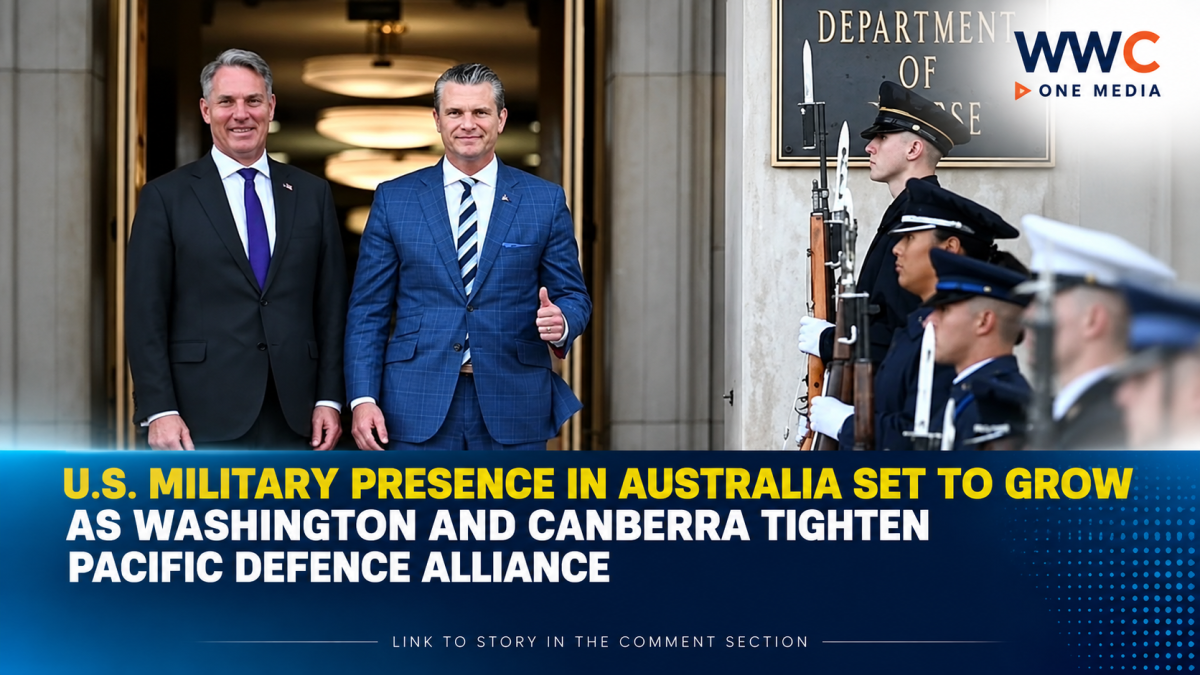
The United States and Australia are moving to deepen their military partnership, with Washington and Canberra agreeing to accelerate plans that could expand the U.S. military presence on Australian bases amid growing strategic concerns about China’s military expansion in the Indo-Pacific.
The announcement followed a September 2 meeting in Washington between Australian Deputy Prime Minister and Defence Minister Richard Marles and U.S. Defence Secretary Pete Hegseth.
Marles said the American military presence in Australia is already growing across multiple domains, including land, sea, air, logistics, cyber and space. However, he did not announce a specific new number of U.S. troops or a permanent troop deployment.
⚠ What Washington and Canberra agreed to
According to the Pentagon, the two countries agreed to:
- Accelerate force-posture initiatives at Australian bases
- Expand cooperation in combined logistics
- Improve interoperability through joint military exercises
- Strengthen defence-industrial cooperation involving guided weapons and next-generation capabilities
- Continue advancing the AUKUS security partnership
- Prepare for the planned Submarine Rotational Force–West in Western Australia.
The developments are significant because Australia’s existing arrangements already give U.S. forces access to facilities and support infrastructure for training, exercises, aircraft rotations and naval operations.
Reuters reported that the U.S.-Australia Force Posture Initiatives allow American forces to train and store equipment in Australia, including arrangements involving aircraft and logistical support for U.S. vessels.
This does NOT yet mean a major new permanent troop deployment
One important distinction is being overlooked in some headlines.
Australia has not announced a specific large-scale permanent U.S. troop increase.
Marles said further details on additional force-posture initiatives are expected during the next Australia-U.S. Ministerial Consultations (AUSMIN) later this year.
So, the current development is better described as an acceleration and expansion of existing military cooperation, rather than confirmation of a new U.S. military base or a massive influx of American troops.
AUKUS is already changing Australia’s military landscape
The announcement comes as Australia prepares for another major step under the AUKUS security partnership with the United States and United Kingdom.
U.S. Navy personnel are already at HMAS Stirling in Western Australia preparing for the Submarine Rotational Force–West, which is scheduled to begin operating from the end of 2027.
ABC reported that about 1,000 U.S. Navy personnel are expected to be based at HMAS Stirling from next year to support American Virginia-class submarines operating from the facility.
Australia also continues to host rotating U.S. Marines in Darwin, while military cooperation extends beyond traditional combat forces into logistics, air operations, cyber and space.
China is the bigger strategic backdrop
The strengthening of the alliance comes as Australia and the United States confront what they describe as a rapidly changing Indo-Pacific security environment.
Marles pointed to China’s military expansion as a major reason Australia needs stronger deterrence and regional partnerships. Reuters likewise reported that the two governments see their deeper cooperation as a way of strengthening deterrence across the Pacific as China’s influence expands.
The Pentagon said Hegseth emphasized the importance of maintaining a favorable balance of power in the region and called on capable allies to contribute to collective defence and invest in their own security.
China has previously criticized AUKUS, warning that the pact could contribute to an arms race in the region.
Australia says its own defence spending is rising
Marles also highlighted Australia’s increased defence spending during his Washington discussions.
He said Australia’s defence spending has reached 2.8% of GDP under the NATO measurement, with spending scheduled to reach 3% of GDP by 2033 under Australia’s investment program.
That matters because Washington has increasingly pressed allies to carry more of the burden for their own defence while contributing to collective deterrence.
Why this matters for the Indo-Pacific
The latest agreement could have consequences well beyond Australia.
A larger U.S.-Australian military footprint potentially gives the alliance greater ability to:
• Move forces and equipment through the region
• Conduct larger and more integrated exercises
• Improve logistics and sustainment
• Coordinate air and naval operations
• Expand defence-industrial production
• Strengthen cyber and space cooperation
• Support submarine operations from Western Australia
The Australian government says the growing U.S. force posture is intended to strengthen deterrence, stability and peace in the Indo-Pacific.
At the same time, the development illustrates how Australia’s security strategy is becoming increasingly tied to the broader U.S.-led regional network as strategic competition with China intensifies.
The bigger question now
The most important detail may be what comes next.
Washington and Canberra have agreed to accelerate force-posture initiatives, but the precise scale and location of additional deployments have not yet been publicly detailed.
More concrete announcements are expected at AUSMIN later this year—meaning today’s agreement could be only the beginning of a significantly deeper U.S.-Australia military presence in the Indo-Pacific.
WWC ONE MEDIA J.M.D




Leave a Reply