MANILA, Philippines — October 25, 2026
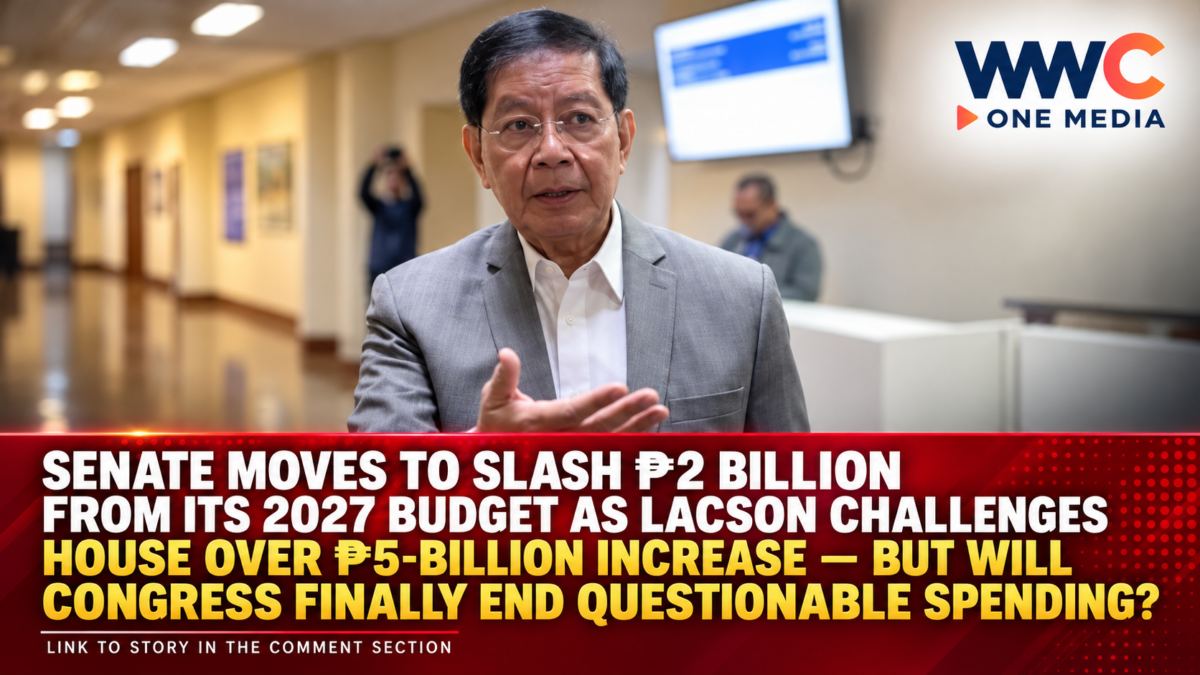
A major budget showdown is taking shape in Congress as the Philippine Senate moves to cut approximately ₱2 billion from its own proposed 2027 funding, challenging the House of Representatives to demonstrate the same financial discipline amid growing scrutiny of government spending.
Senator Panfilo “Ping” Lacson, chairman of the Senate Committee on Accounts, disclosed that he and Senate President Sherwin Gatchalian had agreed to pursue the reduction as part of a broader push for transparency, accountability, and responsible management of public funds.
The proposed cut would lower the Senate’s allocation under the 2027 National Expenditure Program (NEP) from approximately ₱7.7 billion to ₱5.7 billion — a reduction of nearly 26%.
But the move is more than a proposed spending adjustment. It comes as Congress faces renewed questions over budget insertions, questionable infrastructure allocations, and a landmark Supreme Court ruling that has put the country’s appropriations process under intense examination.
Senate Cuts Its Own Budget — But Challenges House Over ₱5 Billion
Lacson said the Senate wants to demonstrate that lawmakers can exercise spending restraint before demanding similar sacrifices from government agencies.
He also challenged the House of Representatives over a reported ₱5-billion increase in its own proposed allocation.
For Lacson, the contrast raises an important question: If one chamber of Congress can voluntarily reduce its spending, should the other reconsider its own proposed increase?
Despite the substantial reduction, the senator expressed confidence that Senate operations would continue without major disruption.
He pointed to available unused funds that could help cover operational needs, although the actual financial impact would depend on the chamber’s final appropriations and available balances.
The proposed reduction has not yet become a final approved budget cut.
Supreme Court Ruling Adds Pressure for Budget Reform
The political controversy comes after the Supreme Court issued a significant ruling affecting national budget laws for 2024, 2025, and 2026.
According to the high court’s October 20 announcement, the 2024 General Appropriations Act was declared unconstitutional following a ₱449.5-billion congressional increase in unprogrammed appropriations.
The Supreme Court likewise declared the 2025 budget unconstitutional over a ₱17.99-billion increase to the Department of Public Works and Highways’ Special Road Fund.
It also invalidated specific provisions governing unprogrammed appropriations in the 2026 budget.
The decisions reinforce constitutional limits on Congress’s power to increase the total appropriations recommended by the President.
However, the ruling does not automatically mean every government project funded under the affected budgets must be reversed. The Supreme Court has also explained how the doctrine of operative fact may protect certain projects already implemented in good faith.
For the ongoing 2027 budget deliberations, the ruling increases pressure on lawmakers to ensure that spending adjustments comply with constitutional requirements.
Questionable Farm-to-Market Roads Raise More Questions
Budget scrutiny has also intensified following the discovery of suspicious geographic coordinates attached to proposed farm-to-market road projects.
During Senate discussions, lawmakers flagged project entries containing coordinates that appeared to identify locations far from the intended project sites, including areas at sea.
Bombo Radyo reported concerns surrounding a purported ₱55-million farm-to-market road allocation whose coordinates appeared inconsistent with its stated location in Quezon province.
Gatchalian separately acknowledged problematic coordinates and duplicate entries in proposed infrastructure projects, while suggesting that some location errors might be clerical mistakes.
The discrepancies are warning signs requiring verification, not proof on their own that funds were stolen or projects were fraudulent.
Nevertheless, the controversy has strengthened calls for independent validation of proposed infrastructure locations, costs, and beneficiaries before funding is approved.
Could ₱7 Billion Be Redirected to More Urgent National Needs?
In an additional development reported on October 25, Lacson suggested that potential savings from the Senate’s ₱2-billion reduction and the House’s reported ₱5-billion increase could instead support urgent national priorities.
That combined ₱7 billion represents a possible fiscal reallocation scenario, not money already saved or officially transferred.
Among the possible beneficiaries are preparations for a severe El Niño, healthcare, education, and other essential public services.
The proposal comes amid concerns that extreme weather could place additional pressure on farmers, food production, and communities vulnerable to drought.
Rather than allowing institutional operating budgets to expand without sufficient justification, Lacson wants lawmakers to examine whether available resources could deliver greater public benefit elsewhere.
Civil Society Groups to Join October 26 Budget Reform Discussions
Attention now turns to Monday, October 26, when the Senate is scheduled to hear recommendations from civil society organizations on improving the national budget process.
The consultations are expected to address transparency, scrutiny of proposed projects, and safeguards against questionable appropriations.
Public access to budget documents, independently verifiable project details, and clear explanations for funding changes could become important elements of any meaningful reform.
Meanwhile, the House has defended its own budget review process as part of its effort to make the national spending program more transparent and responsive to public needs.
The Senate must now determine how to reconcile competing priorities and address questionable provisions without creating unnecessary delays in approving the 2027 national budget.
Budget Battle Could Shape Public Trust in Congress
The proposed ₱2-billion cut has become a test of whether Congress can move beyond promises of financial discipline and demonstrate meaningful changes in how taxpayer money is allocated.
A smaller legislative budget does not automatically guarantee better governance. The true measure of reform will be whether funding decisions become more transparent, legally sound, and responsive to the needs of ordinary Filipinos.
For millions of taxpayers, the central issue is not simply whether the Senate or House spends less.
It is whether public resources reach hospitals, classrooms, farms, disaster preparedness programs, and other services where they are most needed.
As lawmakers prepare for another round of budget scrutiny, one question remains unanswered:
Will the proposed Senate cut trigger genuine reform across Congress — or become another political confrontation while billions in public funds remain under scrutiny?