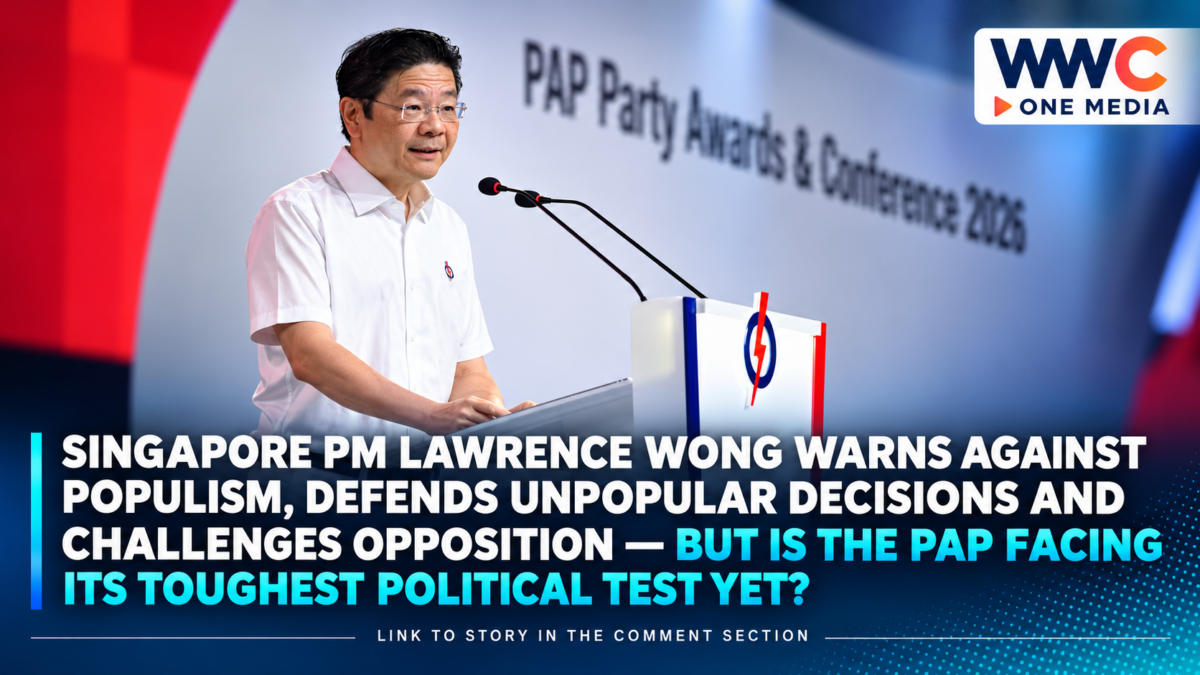
SINGAPORE, October 25, 2026 — Singapore Prime Minister Lawrence Wong has delivered a pointed warning about the dangers of populism and short-term political promises, declaring that responsible leadership requires confronting unpopular decisions rather than avoiding controversy to win public approval.
Speaking at the People’s Action Party (PAP) Awards and Conference on Sunday, Wong defended his government’s approach to politically sensitive issues, including ministerial salaries, public housing, foreign manpower and the country’s long-term energy security.
His remarks came as PAP members gathered to elect the party’s 39th Central Executive Committee, a key leadership body that will help shape the ruling party’s direction.
The address also included criticism of opposition Workers’ Party (WP) policy positions, underscoring the political differences surrounding Singapore’s approach to governance.
A Warning Against Popular Promises and Short-Term Politics
Wong argued that governing a country involves more than responding to competing public demands. Leaders must sometimes make decisions that create immediate dissatisfaction but are intended to protect future generations.
He warned that postponing difficult reforms can leave future governments and citizens facing even greater challenges.
The prime minister said the PAP’s approach must involve listening to Singaporeans, explaining difficult trade-offs, making decisions and accepting responsibility for their consequences.
His warning comes against a broader international backdrop in which economic insecurity, affordability pressures and frustration with established political institutions have increasingly shaped public debate.
Wong cautioned that simplistic promises can undermine public trust if they fail to address the underlying problems affecting ordinary citizens.
Ministerial Salary Increases Put Leadership Under Scrutiny
One of the most politically sensitive subjects raised by Wong was Singapore’s revised political salary framework.
In September 2026, the government announced changes following an independent review, with existing political officeholders receiving one-off salary adjustments of up to 9% from October 15, depending on individual circumstances.
The updated framework also raised the benchmark for an entry-level minister, known as MR4, from S$1.1 million to S$1.8 million annually. However, that revised benchmark should not be confused with an immediate 63.6% pay increase for every existing minister.
The government argued that competitive compensation remains important for recruiting capable political leaders, especially when experienced professionals may face substantial financial sacrifices when entering public service.
Wong acknowledged that political salaries attract public scrutiny but maintained that avoiding the issue would risk weakening Singapore’s ability to build strong leadership teams in the future.
The salary debate has also raised questions about the relationship between political compensation, public service and the financial pressures experienced by ordinary Singaporeans.
In Parliament, lawmakers proposed closer links between ministerial compensation and indicators such as household income, unemployment and housing affordability.
The broader question is whether Singapore’s leadership can maintain public confidence while defending a political remuneration system that remains unusually generous by international standards.
Wong Challenges Workers’ Party Over Housing and Foreign Manpower
The prime minister also criticised what he described as inconsistencies in the Workers’ Party’s positions on public housing and foreign employment policies.
According to Wong, the opposition had argued for fewer new public flats in 2019 when resale prices were falling, but later criticised insufficient housing construction after pandemic-related disruptions contributed to supply shortages.
He similarly pointed to changes in the WP’s approach to foreign manpower, citing earlier arguments for different levels of flexibility and restrictions, followed by more recent calls to ease quotas for businesses facing labour shortages.
Wong presented these examples as evidence of the difficulties involved in balancing changing public demands against longer-term policy consequences.
However, the arguments cited were Wong’s political characterisation of the opposition’s positions, not an independently established finding that the WP had acted inconsistently.
The opposition’s responses to these specific accusations were not included in the CNA report.
The exchange highlights a central question in Singaporean politics: How should policymakers respond when economic conditions change without sacrificing consistency, accountability or long-term planning?
Singapore’s Energy Security Becomes Another Major Test
Beyond domestic political disagreements, Wong pointed to Singapore’s energy vulnerability as an example of why governments must prepare for uncertain futures.
He cited Indonesia’s recently announced plans to reduce gas exports to Singapore, highlighting the risks associated with dependence on external energy supplies.
Singapore has invested in liquefied natural gas infrastructure to diversify its supply sources and reduce reliance on pipeline gas.
The government is also examining the potential role of nuclear energy in its longer-term power strategy.
Wong acknowledged public concerns about nuclear safety but argued that controversial options should be assessed carefully rather than rejected without examination.
Any potential move toward nuclear power would require extensive technical evaluation, regulatory preparation, safety considerations and public engagement.
There was no announcement in the speech that Singapore had approved construction of a nuclear power plant.
For a small, highly urbanised economy dependent on international energy markets, decisions about power infrastructure could have consequences extending decades into the future.
Global Political Frustration Adds Urgency to Wong’s Message
Wong linked Singapore’s political challenges to developments abroad, where frustration over living costs and uncertainty about economic opportunities have contributed to declining confidence in traditional political parties.
He pointed to protests in France and parts of Asia as examples of broader pressures confronting governments.
His argument was that solutions promising immediate relief without addressing structural problems could leave societies more divided and make effective governance harder.
Still, whether a policy represents responsible long-term planning or an unnecessary burden is ultimately a matter of public debate.
Governments must weigh expert recommendations against citizens’ lived experiences, while opposition parties have a responsibility to scrutinise decisions and offer credible alternatives.
PAP Leadership Renewal Comes Into Focus
The speech took place during an important leadership gathering for the PAP.
Party cadres were voting for members of the 39th Central Executive Committee, amid expectations that younger ministers could assume greater responsibilities as the ruling party prepares its next generation of leaders.
The leadership vote follows Wong’s first general election as prime minister and is part of the PAP’s continuing political renewal.
Wong also emphasised the importance of remaining connected to Singaporeans and responding when policies fail to deliver their intended results.
He cited improvements to parental leave and caregiving assistance as examples of how feedback from party activists and community representatives had influenced government decisions.
Analysis: The Bigger Challenge Is Public Trust
Wong’s message reflects a longstanding argument associated with Singapore’s governance model: political leaders must look beyond immediate popularity and prepare for challenges that may not become visible for years.
But there is another dimension to that argument.
For Singaporeans dealing with housing costs, job insecurity, changing workforce demands and family expenses, the benefits of long-term planning must also be measurable in everyday life.
The political difficulty is not merely deciding which reforms are necessary. It is demonstrating that those reforms are fair, effective and worth their costs.
The ministerial salary debate illustrates this tension particularly clearly.
While the government regards competitive pay as important to leadership recruitment, citizens can reasonably demand evidence of performance, transparency and accountability.
Likewise, investments in energy resilience may protect Singapore against future supply disruptions, but their cost, safety and environmental implications deserve careful scrutiny.
Strong leadership and public accountability are not competing ideals. Both are necessary for maintaining confidence in government.
What Happens Next?
As the PAP moves through another leadership renewal cycle, Wong’s warning sets out the political standard he wants the ruling party to uphold: resist populism, explain difficult choices and accept responsibility for long-term outcomes.
Whether this approach strengthens public confidence will depend less on the force of the prime minister’s words than on the results Singaporeans experience.
For Wong and the PAP, the defining political question is becoming increasingly clear:
Can Singapore’s leaders convince the public that today’s unpopular decisions will deliver a better future — or will growing demands for affordability, fairness and accountability reshape the country’s political landscape?