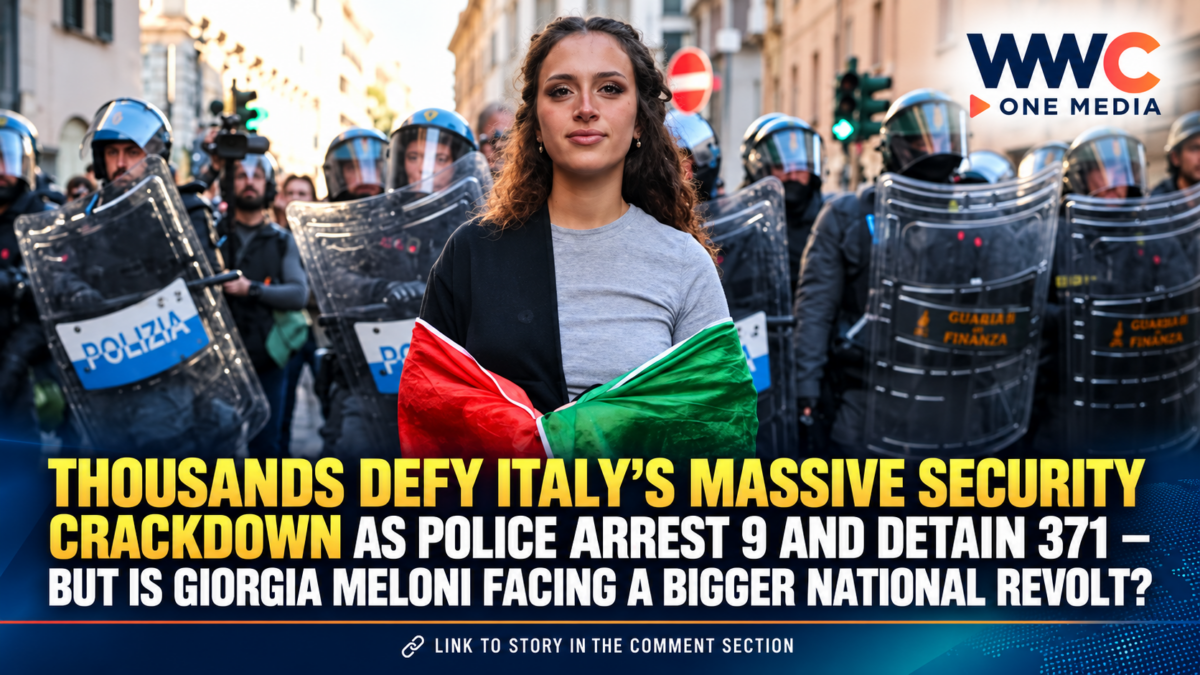
ROME, Italy — October 25, 2026 — Thousands of protesters flooded streets across Italy on Saturday, October 24, challenging a massive security operation launched by Prime Minister Giorgia Meloni’s government as anger over soaring living costs, military spending and deteriorating public services intensified.
What began as a wave of demonstrations over economic hardship has become a major confrontation over public order, the right to protest and the government’s response to growing public frustration.
Italian police reported nine arrests and 371 temporary detentions, including 110 minors, across eight cities following demonstrations that brought large crowds into the streets.
The rallies unfolded just one week after violent unrest shook parts of the country, prompting authorities to deploy additional security forces and introduce tougher measures aimed at preventing further clashes.
Thousands march as police tighten security across Italy
Demonstrators gathered in Rome, Milan, Turin, Bologna and other cities, demanding relief from economic pressures and protesting against military spending and government policies.
In Milan, several thousand people marched through the city centre, disrupting traffic as police and military personnel maintained a heavy presence.
A similarly large demonstration took place in Rome, where protesters confronted police and some briefly entered the Colosseum.
Additional confrontations erupted in Turin and Bologna, while demonstrations in Milan remained largely peaceful.
According to Reuters, witnesses did not observe a repeat of the widespread shop looting and property vandalism that had accompanied the previous weekend’s unrest.
Nevertheless, the police mobilisation underscored mounting concerns that Italy’s growing protest movement could develop into a prolonged nationwide challenge.
Meloni deploys soldiers and introduces tougher security measures
The latest demonstrations followed violent clashes on October 17 and 18, when confrontations involving protesters and police resulted in arrests, vandalism and damage to businesses.
In response, Meloni’s government intensified security preparations and introduced measures targeting violent conduct during demonstrations.
Authorities deployed 500 soldiers to Milan, while security planning reported by Euronews included approximately 1,800 police and military personnel in Milan and 1,500 officers in Rome ahead of the October 24 protests.
The government also approved stricter provisions involving minors, including changes to detention rules and financial penalties for parents whose children cause damage during demonstrations.
Officials argue that such measures are necessary to protect public safety, commercial establishments and law enforcement personnel.
Critics, however, fear that increasingly aggressive policing could discourage peaceful demonstrations and deepen tensions between citizens and the government.
Interior Minister Matteo Piantedosi defended the security response, saying police had successfully contained violent elements.
Police detain suspected protest organiser
Authorities also reported the detention of a 30-year-old man suspected of involvement in organising the so-called October 17 Movement, which had called for demonstrations following the previous weekend’s unrest.
The investigation highlights efforts by Italian authorities to identify individuals believed to be coordinating protests associated with violence.
However, participation in peaceful demonstrations remains distinct from criminal acts, and authorities have not established that the broader protest movement was responsible for the actions of violent individuals.
For many demonstrators, the decision to take to the streets despite the heightened security presence represented an assertion of their right to protest.
Why are Italians protesting?
The demonstrations reflect several overlapping concerns affecting Italian households and businesses.
1. Rising cost of living
Higher fuel prices, housing expenses and pressure on household finances have become central grievances. Recent disruptions to fuel supplies have further increased economic anxiety.
2. Military spending and war
Student groups and anti-war protesters have questioned government spending priorities, calling for greater investment in education, healthcare and social services rather than military expansion.
3. Deteriorating public services
Campaigners have raised concerns about access to affordable housing, educational opportunities and healthcare services, arguing that essential public needs should receive greater attention.
4. Government security policies
Tougher policing measures introduced after recent disturbances have become another source of controversy, with some groups warning that public-order restrictions could undermine the right to peaceful assembly.
These concerns have drawn together different sections of society, including students, workers, farmers and transport operators, although their specific demands are not identical.
Fuel crisis and truck blockades deepen economic pressure
Beyond the demonstrations, Italy has also faced disruptions linked to rising fuel prices and transport protests.
Truck blockades in southern Italy contributed to significant shortages of fuel and food supplies before being lifted.
The disruption illustrated how quickly economic grievances can affect essential supply chains and daily life.
Meloni’s government has approved financial measures intended to assist businesses struggling with higher fuel expenses following the Middle East war.
However, the latest protests suggest that immediate financial assistance may not be enough to address broader public concerns about affordability and government spending priorities.
Businesses fear another wave of violence
The demonstrations have created uncertainty for retailers in major Italian commercial centres.
In Milan, some businesses closed early or boarded up windows ahead of Saturday’s rallies, fearing another outbreak of looting and vandalism.
Others remained open, following Mayor Giuseppe Sala’s appeal for residents and businesses not to panic.
The contrast reflects the difficult position of local businesses caught between supporting citizens’ right to protest and protecting employees, customers and property.
Despite isolated clashes in other cities, the absence of widespread looting during Saturday’s demonstrations offered some reassurance.
Protests spread across Europe as economic frustration grows
Italy’s demonstrations coincided with protests in several other European countries, including France, Spain, Portugal and Albania.
According to Associated Press and Euronews reporting, the demonstrations involved different local grievances, ranging from living costs and public services to government policies.
Although these movements are not necessarily coordinated, their timing reflects the broader political pressures facing European governments as households confront economic uncertainty.
For Italy, the challenge is particularly sensitive because the protests have combined economic grievances with opposition to government security measures.
Could the protests threaten Meloni’s government?
The immediate political consequences remain uncertain.
There is no verified evidence that Saturday’s demonstrations have directly threatened Meloni’s parliamentary majority or triggered an imminent government collapse.
Nevertheless, the protests create a significant political challenge.
If rising prices persist, transport disruption returns or confrontations between protesters and police intensify, the government could face sustained pressure to reconsider its economic and security policies.
The administration must also balance its stated commitment to maintaining public order with Italy’s democratic protections for peaceful assembly.
For protesters, the central question is whether continued mobilisation can translate into meaningful policy changes.
For Meloni, the challenge is preventing further violence while convincing an increasingly vocal segment of the population that the government is addressing its economic concerns.
The protests may have ended for the day, but the underlying economic frustration remains. With thousands willing to march despite heavy police deployments, the bigger question is whether Italy’s government can restore public confidence before another round of demonstrations erupts.