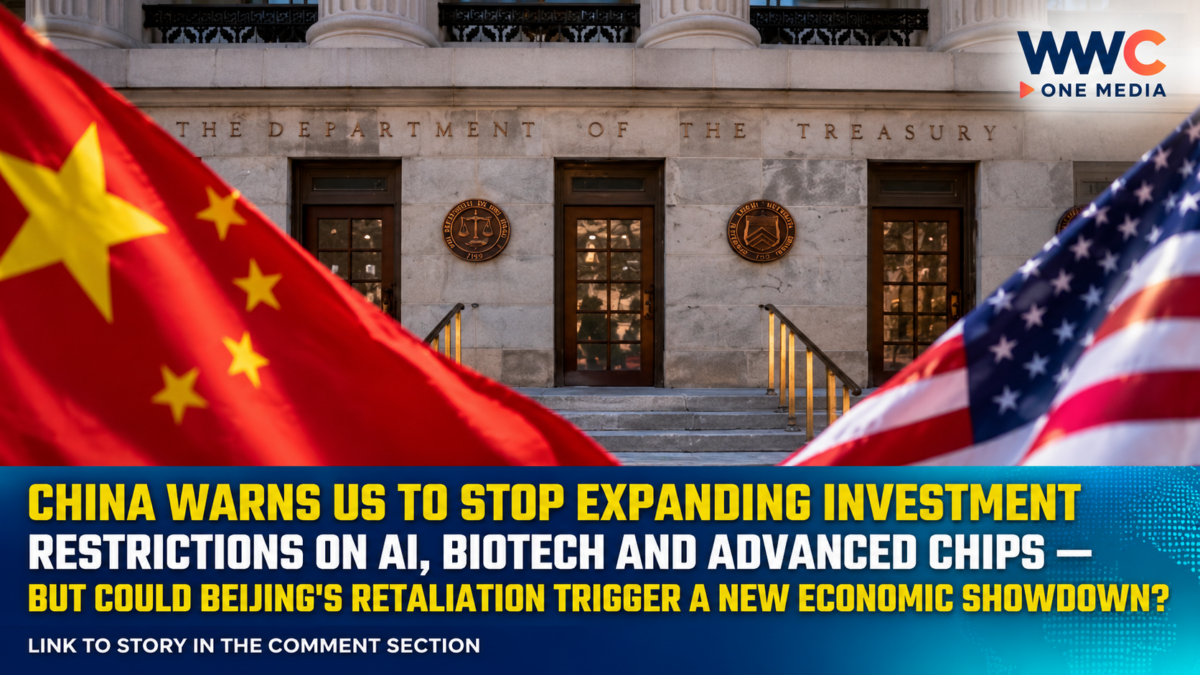
BEIJING, China — October 25, 2026. China has issued a strong warning to the United States over plans to tighten restrictions on American investment in critical technologies, signaling a potential new confrontation between the world’s two largest economies.
China’s Ministry of Commerce urged Washington on Saturday, October 24, to abandon its proposed expansion of outbound investment controls, arguing that the measures unfairly target Chinese businesses and risk undermining bilateral economic cooperation.
The warning follows an October 22 announcement by the US Treasury Department proposing broader restrictions on American investments involving advanced technologies with potential military and national security applications.
The proposed changes would extend regulatory scrutiny into additional industries, including biotechnology, hypersonic systems and high-performance computing, while expanding existing controls involving semiconductors, artificial intelligence and quantum technology.
Beijing strongly opposed the proposed measures and warned that it reserved the right to take countermeasures if its interests were harmed.
The escalating dispute highlights a growing reality in US-China relations: competition is increasingly focused not only on trade and tariffs, but also on who can finance, develop and control the technologies expected to shape future economic and military power.
China Accuses Washington of Discriminatory Investment Restrictions
China’s commerce ministry criticized the US proposal for disproportionately targeting Chinese businesses and placing additional barriers in the way of international investment.
According to Reuters, Chinese officials warned that the expansion could disrupt economic cooperation between the two countries.
Beijing also argued that Washington’s latest proposal was inconsistent with understandings reached during recent meetings between the American and Chinese presidents.
Although the ministry did not identify specific retaliatory actions, its warning raises the possibility of renewed economic friction if Washington proceeds with its expanded investment restrictions.
Potential responses could involve regulatory or trade measures, although no particular action was announced in the reported statement.
What Exactly Is the United States Trying to Restrict?
The latest proposal forms part of Washington’s Outbound Investment Security Program, a framework intended to prevent American capital and related investment benefits from supporting the development of sensitive technologies in designated countries of concern.
Under the existing framework, certain US investments involving China were already prohibited or subject to notification requirements in three major sectors:
- Semiconductors and microelectronics
- Quantum information technologies
- Artificial intelligence
The proposed October 2026 changes would expand the framework to address additional sensitive technologies, including biotechnology, advanced computing and hypersonic systems.
The Treasury Department says these measures are necessary to protect national security and prevent investments from helping foreign adversaries develop technologies with military, intelligence or surveillance applications.
Importantly, the restrictions are not a blanket prohibition on all American investment in China. They focus on defined transactions, technologies and covered entities.
The latest regulations also remain proposals rather than fully implemented new restrictions.
Biotechnology and Advanced Computing Enter the Spotlight
One of the most consequential aspects of the proposed expansion is the inclusion of biotechnology.
The sector has become increasingly important for medicine, pharmaceutical research and advanced biological technologies, but some capabilities also have potential national security implications.
Additional scrutiny of biotechnology investments could create complications for American investors and companies seeking partnerships with Chinese firms working in sensitive research areas.
High-performance computing and hypersonic systems are also attracting regulatory attention because of their potential applications in defense, advanced weapons development and other strategic capabilities.
For investors, the expansion could mean greater due diligence requirements, higher compliance costs and additional uncertainty surrounding future technology deals.
However, the actual economic impact will depend on the final regulations, exemptions and enforcement rules.
US Restrictions Build on Rules Introduced in 2025
The dispute did not begin with the latest Treasury announcement.
The United States introduced its outbound investment restrictions under a framework established during the Biden administration, with the original Treasury regulations taking effect on January 2, 2025.
The program was designed to address national security risks arising when American investors support certain sensitive technology activities in designated foreign markets.
In December 2025, Congress passed the Comprehensive Outbound Investment National Security Act as part of the fiscal year 2026 National Defense Authorization Act, establishing a statutory framework for the investment controls.
The October 22, 2026 proposal represents another significant stage in implementing and expanding that framework.
According to Associated Press reporting, the proposed regulations also demonstrate how Washington’s investment-security strategy has continued across presidential administrations despite broader diplomatic efforts to stabilize relations with Beijing.
Could the New Rules Hurt Global Technology Investment?
The proposed restrictions may have consequences beyond China and the United States.
American venture capital firms, multinational corporations and technology investors could face additional restrictions when pursuing sensitive investments involving countries covered by the regulations.
The increased compliance burden may discourage some cross-border transactions, particularly in emerging industries where commercial applications overlap with potential military uses.
For China, tighter restrictions could make access to certain categories of American investment and associated expertise more difficult.
For the United States, the measures could create trade-offs between national security objectives and opportunities for international technology investment.
Other Asian economies could experience indirect effects as businesses reassess regional investment strategies, technology partnerships and supply-chain risks.
These consequences remain possibilities rather than confirmed outcomes of the proposed rules.
Why the Latest Dispute Matters for Asia
The confrontation comes at a time when artificial intelligence, semiconductors, biotechnology and advanced computing are increasingly viewed as strategic assets.
Countries across Asia are investing in semiconductor manufacturing, data centers, AI infrastructure and advanced research, making the region particularly sensitive to shifts in global technology policy.
For economies such as Singapore, South Korea, Japan and the Philippines, greater US-China investment friction could introduce additional uncertainty for businesses linked to international technology supply chains.
Some companies may review where they establish operations or seek financing, but it remains too early to determine whether the latest US proposal will generate significant investment shifts.
The broader concern is that expanding national security restrictions could gradually divide international technology investment into increasingly separate ecosystems.
What Happens Next?
The US Treasury Department has opened the proposed regulations for public comment, with submissions due by December 7, 2026.
The government will review feedback before publishing final implementing regulations and establishing an effective date.
That means the latest expanded restrictions have not yet taken effect under the October proposal.
The coming weeks will reveal whether Washington modifies its approach in response to industry concerns and diplomatic objections, or moves ahead with tighter controls.
Beijing, meanwhile, has signaled that it will defend its economic interests but has not publicly specified which countermeasures it might adopt in response to this proposal.
For global businesses and investors, the uncertainty may be nearly as important as the regulations themselves.
A New Flashpoint in the US-China Technology Rivalry
The latest confrontation underscores the growing divide between the economic priorities of Washington and Beijing.
The United States argues that sensitive investments must be controlled to protect national security.
China maintains that broadening these restrictions unfairly limits legitimate business cooperation and threatens already fragile economic relations.
With AI, semiconductors, biotechnology and advanced computing increasingly central to global competitiveness, the dispute could influence technology investment decisions well beyond the two countries.
The critical question now is whether Washington and Beijing can prevent their competition over advanced technology from developing into a wider investment confrontation — or whether the proposed restrictions will become another turning point in their economic rivalry.