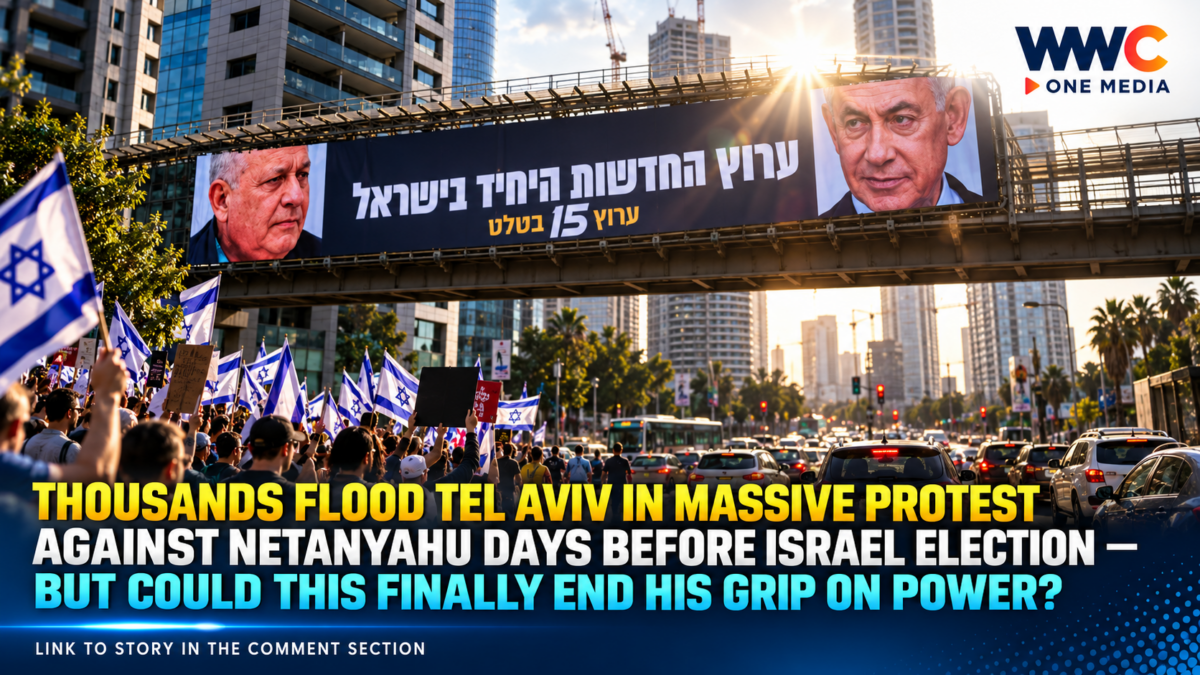
Tel Aviv, Israel — October 25, 2026
Thousands of Israelis poured into the streets of Tel Aviv on Saturday, October 24, in a powerful display of public anger against Prime Minister Benjamin Netanyahu, just three days before a fiercely contested general election that could reshape the country’s political leadership.
With Israel preparing to vote on October 27, demonstrators marched through the city demanding government accountability for the catastrophic security failures surrounding the October 7, 2023, Hamas-led attacks, which triggered years of devastating warfare and intensified political divisions.
The massive anti-government demonstration underscored growing dissatisfaction among Netanyahu’s critics, who accuse his administration of failing to adequately address the country’s security breakdown, international isolation and political uncertainty.
But with opinion polls suggesting neither major political bloc is on course to secure a parliamentary majority, the election could deliver an unpredictable result.
Families of October 7 victims demand answers
The demonstration was organized by the October Council, an advocacy group established by families of victims, former hostages and survivors of the October 7 attacks.
Protesters gathered near Rabin Square and marched toward Hostages Square, a location that has become a symbol of Israel’s prolonged struggle over the fate of hostages held in Gaza and accountability for government decisions.
At the center of the protest was one major demand: the creation of an independent state commission of inquiry to investigate how Israel’s military, intelligence and political institutions failed to prevent the Hamas-led assault.
For affected families, the issue extends beyond political rivalry. They want an independent examination of the decisions and institutional failures that left communities vulnerable to the attack.
Netanyahu’s government has declined to establish the type of independent state inquiry demanded by campaigners.
Instead, it has proposed a commission with members selected by the governing coalition and opposition lawmakers.
Opposition leaders have rejected that arrangement, arguing that a politically appointed investigation would lack the independence needed to restore public confidence.
Netanyahu faces serious challenge from opposition leaders
The demonstrations took place during the final weekend before Israel’s October 27 parliamentary election, with several prominent opposition leaders joining the public protest.
Among them was former Israeli military chief Gadi Eisenkot, who has emerged as a major challenger to Netanyahu and whose political bloc has been competing closely with the prime minister’s allies.
Former Prime Minister Naftali Bennett and opposition leader Yair Lapid have also emerged as prominent voices challenging Netanyahu’s government.
The latest pre-election polling suggests a deeply divided electorate.
A survey released by Israeli public broadcaster KAN projected:
- 52 parliamentary seats for the bloc associated with Eisenkot.
- 50 parliamentary seats for Netanyahu’s bloc.
- 18 remaining seats for parties outside those two blocs, including Arab parties.
Israel’s 120-seat parliament, the Knesset, requires a majority of at least 61 seats to support a governing coalition.
Those projections indicate neither side would automatically control parliament, potentially setting the stage for difficult coalition negotiations after election day.
The polling figures are projections rather than election results, and the final outcome will depend on voter turnout, party performance and coalition agreements.
Tensions rise after reported confrontation involving Bennett’s security
Political tensions surrounding the protest also prompted security concerns.
Before the demonstration, organizers warned police about possible attempts by pro-government activists to disrupt the event.
Israeli police subsequently reported arresting a suspect accused of assaulting the security team of a public figure in Tel Aviv.
Israeli media identified the individual whose security team was targeted as former Prime Minister Naftali Bennett.
The reported confrontation added to the atmosphere of tension surrounding the election, although authorities had not established that it formed part of an organized effort to interfere with the rally.
International isolation becomes another election battleground
Beyond domestic security concerns, Netanyahu is facing growing criticism over Israel’s international relationships and economic future.
Years of warfare involving Gaza, Lebanon and Iran, together with intensified violence in the occupied West Bank, have placed Israeli foreign policy under increasing scrutiny.
Several foreign governments have taken measures targeting Israeli settlement-related activities, while political debates continue over international trade, diplomatic relations and security assistance.
Netanyahu has suggested that Israel may need to strengthen its economic independence and consider alternative digital economic arrangements in response to growing international pressure.
He has also cautioned that major American weapons assistance should not be regarded as permanently guaranteed.
Opposition politicians swiftly criticized those comments.
Eisenkot mockingly referred to the proposed digital economic approach as “bbCoin,” invoking Netanyahu’s nickname, Bibi, while warning about the potential consequences of economic isolation.
Lapid similarly portrayed Netanyahu’s remarks as evidence that another term could expose Israel to greater economic and diplomatic risks.
These arguments remain campaign claims and predictions, rather than confirmed outcomes of Netanyahu’s proposals.
Young voters see an opportunity for change
The October 27 election will also test whether younger Israelis and first-time voters can influence the country’s political direction.
Among those participating in the Tel Aviv rally was 18-year-old first-time voter Naama Bitterman, who expressed optimism about the possibility of replacing Netanyahu’s government.
Her concerns reflected a broader debate over whether a change in leadership could improve Israel’s international standing and restore trust in public institutions.
However, Netanyahu retains an established political base, and his governing allies continue to compete for enough parliamentary support to remain in power.
The election will therefore be determined not simply by the size of anti-government demonstrations, but also by how the votes translate into parliamentary seats and governing alliances.
Why Israel’s October 27 election matters beyond its borders
The consequences of the vote could extend well beyond Israel.
A new government could potentially change the country’s approach to investigations into October 7, relations with the United States, Palestinian policy, regional security and economic diplomacy.
A Netanyahu victory, meanwhile, could allow his political coalition to maintain significant influence over these same decisions.
Yet either outcome could be complicated by the need to assemble a parliamentary majority.
The election comes amid continued regional instability and scrutiny of Israel’s military actions, humanitarian obligations and international relationships.
For voters, the central question is increasingly about more than which politician will lead the government.
It is also about whether Israel’s institutions can rebuild public trust after years of conflict and political division.
Will Netanyahu survive his biggest political test?
Saturday’s demonstration delivered a clear message from protesters: accountability for the October 7 attacks remains unresolved, and the demand for answers has become a central issue in the election campaign.
But large protests do not necessarily translate into an election victory.
With the country’s major political blocs closely matched and neither projected to secure an outright majority, Israel could face prolonged coalition negotiations even after the ballots are counted.
As Israelis prepare to vote on October 27, one question looms over Netanyahu’s political future: Will the anger filling Tel Aviv’s streets produce a change in government, or will Israel’s longest-serving prime minister find another path to power?