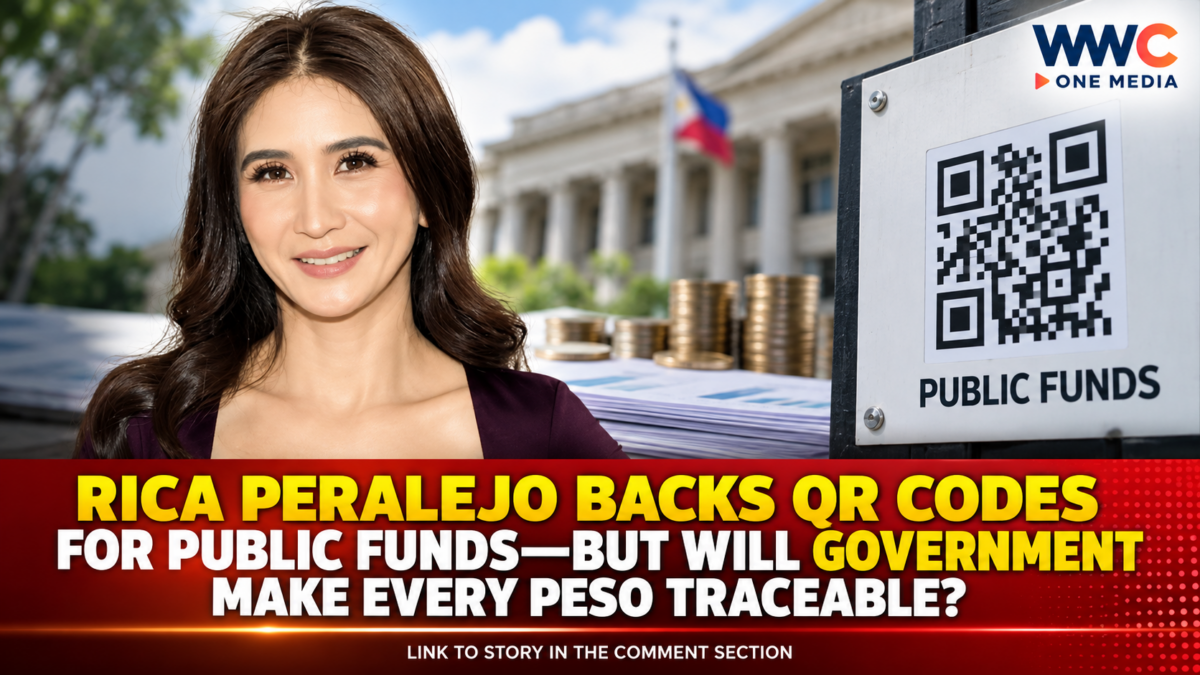
Actress and social media personality Rica Peralejo has drawn attention to calls for greater transparency in government spending, with netizens advocating for QR codes that would allow Filipinos to examine how public funds are used.
The idea is straightforward: make government spending information easier to access, so taxpayers can see where their money goes without having to navigate complicated records or multiple government websites.
Peralejo’s reported support for the initiative comes amid broader public discussions about accountability, the use of taxpayers’ money, and whether government officials should face the same expectations of transparency imposed on ordinary Filipinos and businesses.
The bigger question is whether a simple scan could make public spending easier to scrutinize—and government accountability harder to avoid.
How would QR codes for public funds work?
Under the proposal circulating among netizens, QR codes could link directly to public records showing how government money is allocated and spent.
Depending on how the system is designed, scanning a code could give citizens access to information such as:
- Project budgets: How much public money was approved for a particular project.
- Procurement records: Which contractor or supplier won the project and under what terms.
- Fund releases and disbursements: How much money was released or paid.
- Project implementation: Whether a project is ongoing, delayed, or reported as completed.
- Supporting documents: Records that would help citizens verify whether reported expenses match actual project delivery.
Such a system could make it easier for journalists, watchdog groups, community organizations, and ordinary taxpayers to examine government projects.
However, QR codes would only provide a convenient entry point. The information behind them would still need to be accurate, regularly updated, and supported by verifiable documents.
A growing demand for accountability
The call for more accessible spending records reflects a wider public concern: Filipinos want to know whether the taxes they pay are being used for their intended purposes.
The proposal also highlights an apparent contrast between the documentation required of private citizens and businesses and the transparency expected of public officials who manage taxpayer money.
For advocates of the idea, the objective is not simply to publish more information. It is to make that information understandable and accessible enough for citizens to question questionable expenses, identify discrepancies, and demand explanations.
A QR code would not, by itself, prove that corruption had occurred or prevent public funds from being misused. Its value would depend on whether the linked records are complete, independently verifiable, and open to meaningful public scrutiny.
The Philippines already has a government spending tracker
The proposal comes as the Philippine government develops digital tools intended to make public spending more transparent.
In June 2026, the Department of Budget and Management launched the Centralized Open Monitoring Platform for Appropriations and Spending Statistics, or DBM COMPASS. The platform consolidates national budget and spending information, allowing users to examine government expenditures by agency, department, funding purpose, and fiscal year.
President Ferdinand Marcos Jr. subsequently signed Executive Order No. 126 on September 28, 2026, institutionalizing COMPASS as a government-wide platform for covered budget, expenditure, procurement, and project information. National government agencies and other covered institutions are directed to disclose and update the information required by the Department of Budget and Management, while local government units are encouraged to participate.
The Philippine Information Agency and Philstar.com have reported on the platform and its institutionalization.
Sources: Philippine Information Agency | Philstar.com
COMPASS provides an existing foundation for digital transparency. A QR-based approach could potentially make selected records easier to reach by connecting a physical project signboard or an official’s public information page directly to the relevant documents.
However, a QR code system covering every public official and every category of government spending would require clear standards, reliable records, and appropriate implementation across government offices.
QR codes are already part of some public infrastructure transparency requirements
There is also a relevant provision in the Philippines’ 2026 General Appropriations Act.
Section 111 of the 2026 GAA’s General Provisions requires government agencies to publish specified documents about covered infrastructure projects. These include project descriptions, approved budgets, contractor information, procurement details, actual costs, and project status updates.
The provision also requires covered infrastructure project signboards to display a publicly accessible QR code linked to the required documents, subject to applicable exceptions, including national security protections.
This means the idea of using QR codes to improve access to public project records is not merely theoretical: a QR-code requirement already exists for covered infrastructure projects under the 2026 GAA.
Source: Department of Budget and Management — 2026 General Provisions, Section 111
The distinction is important. Existing requirements for covered infrastructure projects do not automatically mean that every public official must display a QR code covering all their expenditures, nor do they establish that the broader proposal circulating online has been adopted as a nationwide policy.
What happens next?
For a QR-based transparency initiative to make a meaningful difference, the government would need to ensure that the information linked to each code is current, complete, and easy to understand.
Citizens should be able to distinguish between approved budgets, obligated amounts, actual disbursements, and the physical completion of a project. Where records are incomplete or discrepancies emerge, there should also be clear channels for requesting explanations and reporting concerns.
Public access must also be balanced with legitimate legal restrictions, including the protection of sensitive information.
Ultimately, a QR code is only a tool. Its effectiveness depends on the quality of the information it provides and whether public institutions respond when citizens identify possible problems.
Peralejo’s reported support for the idea has helped bring the discussion into the spotlight. But the larger issue extends beyond one celebrity or one proposed technology: How easily should Filipinos be able to follow the money they entrust to their government?
That is the question the growing demand for transparency puts before public officials—and one that any credible accountability system must be prepared to answer.