
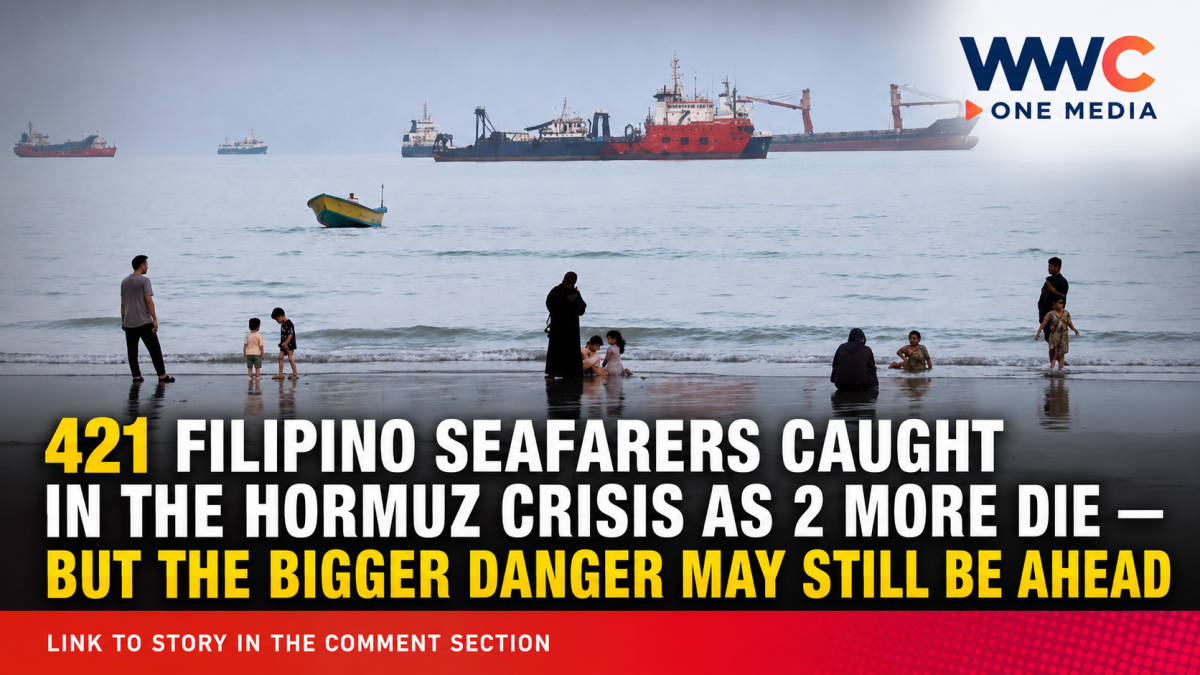
MANILA, Philippines — The deadly attack on a Saudi-flagged oil tanker in the Strait of Hormuz has pushed the human cost of the worsening maritime crisis closer to home, with Philippine authorities saying 421 Filipino seafarers aboard 31 vessels have now been affected by attacks connected to the strategic waterway since February 28.
Two Filipino crew members were killed in the latest incident involving the crude oil tanker SIDR, operated by Saudi Arabia’s national shipping company Bahri.
The vessel was transiting the Strait of Hormuz late on August 31 when it was struck during what Bahri described as a “security incident.” Philippine officials said unidentified projectiles hit the tanker and caused a fire onboard.
There were 16 Filipino seafarers aboard the SIDR at the time.
The crew managed to contain the fire, but two Filipinos died.
The remaining 14 Filipino crew members survived and were brought safely to Oman, where arrangements are underway for their return to the Philippines. The remains of the two fatalities were also taken ashore in Oman as Philippine officials coordinate their repatriation.
Bahri said the incident occurred at approximately 11:40 p.m. local time on August 31 while SIDR was passing through the Strait of Hormuz. Maritime security authorities separately reported that a tanker in the area had been struck by three unidentified projectiles.
Saudi Arabia later blamed Iran for the attack. Iran, however, had not publicly claimed responsibility for the strike at the time Philippine reports were published.
421 Filipinos affected by attacks since February
The deaths have brought renewed attention to the number of Filipino seafarers exposed to the escalating security crisis surrounding one of the world’s most dangerous maritime chokepoints.
Department of Migrant Workers Secretary Hans Leo Cacdac said 31 vessels carrying a total of 421 Filipino seafarers have been involved in attacks linked to the Strait of Hormuz since February 28.
Of that total:
406 escaped unharmed, 10 were injured but have recovered, three have died, and one Filipino seafarer remains officially missing.
The DMW also reported that approximately 268 Filipino seafarers have already been repatriated to the Philippines.
But the scale of the exposure goes far beyond those already caught in attacks.
Government estimates cited by Philippine media indicate that about 3,000 Filipino seafarers may still be serving aboard ships in the wider Persian Gulf, meaning thousands could potentially face difficult decisions if regional hostilities continue.
Why were ships still sailing through Hormuz?
That question is becoming increasingly significant.
Months before the SIDR attack, the DMW issued an advisory telling licensed manning agencies, principals and shipowners to exercise the highest level of caution in Middle Eastern high-risk areas.
The March 2026 advisory specifically urged operators to avoid routing vessels carrying Filipino seafarers through the Strait of Hormuz and other high-risk maritime chokepoints unless absolutely necessary and backed by a comprehensive security risk assessment.
It also ordered strict recognition of Filipino seafarers’ right to refuse sailing, request rerouting or decline assignments to high-risk areas without prejudice.
After the SIDR tragedy, Cacdac again stressed that Filipino crew members must be allowed to refuse deployment aboard ships that would enter dangerous or warlike areas.
The Philippine manning agency handling the two Filipino fatalities, Jebsen PTC, said it is working with Bahri, the DMW, Overseas Workers Welfare Administration, Department of Foreign Affairs and other authorities to facilitate repatriation.
As of September 4, however, GMA News reported that the agency had not yet publicly addressed questions over why the seafarers were deployed through the Strait of Hormuz.
No finding of wrongdoing has been announced, and any determination of whether existing Philippine deployment and safety rules were followed would require an official investigation.
Marcos orders compensation and benefits for families
President Ferdinand Marcos Jr. has ordered government agencies to provide immediate assistance to the families of the two slain Filipino seafarers.
The assistance includes whatever benefits, compensation and insurance proceeds are applicable to the victims.
The government said the two fatalities were from Cabuyao, Laguna, and Daanbantayan, Cebu.
Authorities have not broadly released their identities while coordination with their families continues.
The DMW, Philippine Embassy and Migrant Workers Office in Oman are also coordinating with Omani authorities over the return of the survivors and the remains of those who died.
The attack was part of a much larger escalation
SIDR was not the only tanker attacked that night.
Reuters reported that the Saudi-flagged SIDR and the Liberian-flagged Senegal Prosperity — both carrying Saudi crude — were attacked within minutes of each other near Oman.
Each tanker had reportedly loaded about two million barrels of crude oil at Saudi Arabia’s Juaymah terminal.
The attacks came amid an increasingly dangerous confrontation involving Iran, the United States and regional powers, turning commercial shipping through Hormuz into one of the most closely watched risks in global trade.
Another Bahri tanker, Wedyan, had also been hit near the Strait roughly a month earlier.
Why Hormuz matters to the entire world
The Strait of Hormuz is far more than a dangerous shipping lane.
It is one of the world’s most important energy arteries, connecting the Persian Gulf with the Gulf of Oman and the Arabian Sea.
Before the current disruption, roughly one-fifth of global petroleum consumption and a major share of global liquefied natural gas trade moved through Hormuz.
U.S. Energy Information Administration data show just how dramatically the crisis has affected traffic.
Oil flows through the Strait averaged around 21.6 million barrels per day in the fourth quarter of 2025. That figure fell to 14.9 million barrels per day in the first quarter of 2026 and just 4.9 million barrels per day in the second quarter.
That collapse highlights why every new attack can affect far more than the vessels directly involved.
A prolonged disruption can threaten energy supplies, shipping costs, insurance premiums and fuel prices across Asia and beyond.
For the Philippines, however, the crisis carries another price that cannot be measured in barrels.
Filipino seafarers remain one of the most important workforces in global shipping — and hundreds have already found themselves sailing through a conflict in which commercial vessels are increasingly becoming targets.
The two deaths aboard SIDR have therefore intensified an uncomfortable question for shipowners, regulators and manning agencies:
If the Strait of Hormuz is dangerous enough for Filipino seafarers to be given the right to refuse sailing through it, how many more should still be asked to make the journey?
WWC ONE MEDIA J.M.D



Leave a Reply