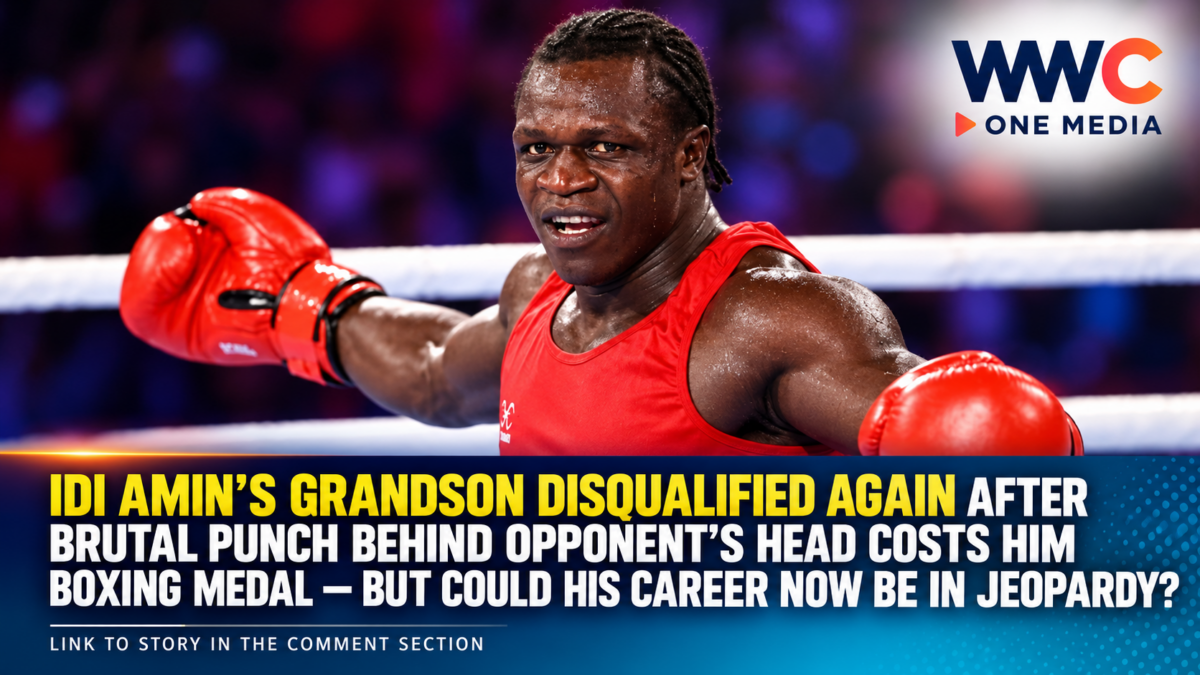
Nairobi, Kenya | October 24, 2026 — A championship fight turned into a stunning controversy after Ugandan boxer Aziz Abdul, the 25-year-old grandson of former dictator Idi Amin, was disqualified for striking his opponent after the bell at the African Boxing Championships in Nairobi.
Abdul, widely known by his ring nickname “Ringo,” was competing against Egypt’s Mohamed Hossen in the men’s 90-kilogram final when an illegal punch abruptly ended his hopes of securing a medal.
The incident marked his second major disqualification in just three months, raising fresh questions about his discipline, competitive future and ability to handle the pressure of international boxing.
A shocking punch after the bell
The controversy erupted when Abdul and Hossen separated from a clinch as the bell sounded.
As the Egyptian boxer turned away, Abdul delivered a punch to the back of Hossen’s head, sending him to the canvas.
The blow sparked an angry reaction from Hossen’s corner, with members of the Egyptian team entering the ring as tensions escalated.
Officials disqualified Abdul and declared Hossen the winner. The Ugandan fighter was also stripped of the silver medal he would otherwise have earned as the losing finalist.
Despite the alarming nature of the incident, reports indicated that Hossen escaped injury.
The incident quickly attracted attention beyond the championship itself, particularly because Abdul had already faced disciplinary controversy at another major international competition earlier this year.
Second disqualification in just three months
The Nairobi controversy followed an earlier incident at the 2026 Commonwealth Games in Glasgow, Scotland.
In July, Abdul was disqualified during his super-heavyweight quarter-final against England’s Damar Thomas after officials ruled that he had headbutted his opponent.
The ruling ended his Commonwealth Games campaign and triggered a furious response from the Ugandan boxer.
Abdul subsequently accused officials of unfair treatment and alleged anti-African bias in the handling of the contest.
Before that competition, he had confidently declared his ambition to become the “new King of Scotland,” drawing attention to his grandfather’s controversial history and the title of the film The Last King of Scotland.
Now, a second disqualification has placed his conduct inside the ring under renewed scrutiny.
Although the two incidents involved different prohibited actions, both resulted in the same outcome: Abdul lost the opportunity to advance his sporting ambitions.
The complicated legacy of Idi Amin
Abdul’s family history adds another dimension to his growing public profile.
His grandfather, Idi Amin, seized power in Uganda through a military coup in 1971 and ruled until 1979.
Amin’s presidency became notorious for widespread human rights abuses, political repression and mass killings. Historical estimates suggest that hundreds of thousands of people died during his rule.
Amin was also a boxer before entering politics, having held Uganda’s light-heavyweight championship during the 1950s.
That sporting connection has become part of Abdul’s own boxing story, although the younger fighter has generally avoided extended discussions about his grandfather’s political record.
Abdul was still a young child when Amin died in exile in 2003, and the two never met.
In an interview with the BBC in July, Abdul acknowledged that people held sharply different views about his grandfather and expressed reluctance to speak negatively about someone who had died.
His association with one of Africa’s most controversial former leaders has attracted significant media attention, but his latest disciplinary problems concern his own actions as a competitive athlete.
Why the illegal punch matters
Boxing regulations prohibit fighters from deliberately striking opponents after the referee has stopped the action or the bell has ended a round.
Punches delivered to the back of an opponent’s head are also prohibited because of the potential risk of serious injury.
Such violations can lead to warnings, point deductions or disqualification, depending on the circumstances and applicable competition rules.
In Abdul’s case, officials determined that his conduct warranted immediate disqualification.
The decision also meant the loss of a silver medal, a significant sporting consequence for a fighter competing at continental championship level.
The incident illustrates why discipline and awareness remain essential in amateur and elite international boxing, even when emotions run high during championship contests.
Could the controversy threaten Abdul’s boxing future?
For Abdul, the immediate consequences are clear: another disqualification and another major competition ending in disappointment.
The longer-term implications are less certain.
Two high-profile incidents within three months could increase scrutiny of his conduct in future tournaments. However, there has been no confirmed announcement of an additional suspension or career-ending sanction arising from the Nairobi incident.
Any further disciplinary penalties would depend on the relevant boxing authorities and their review processes.
At 25, Abdul still has time to rebuild his reputation and demonstrate that he can compete successfully without further violations.
But his latest defeat suggests that technical ability alone will not determine how far he can progress.
A boxing career at a crossroads
Abdul entered the African Boxing Championships seeking a significant competitive achievement. Instead, his campaign ended with another controversial ruling that overshadowed his performance.
His family’s history may continue to draw public attention, but his future in boxing will ultimately depend on his conduct, development and results inside the ring.
After two disqualifications at major events in 2026, the question is no longer simply whether Aziz “Ringo” Abdul has the talent to become an international champion.
It is whether he can demonstrate the discipline required to get there.