
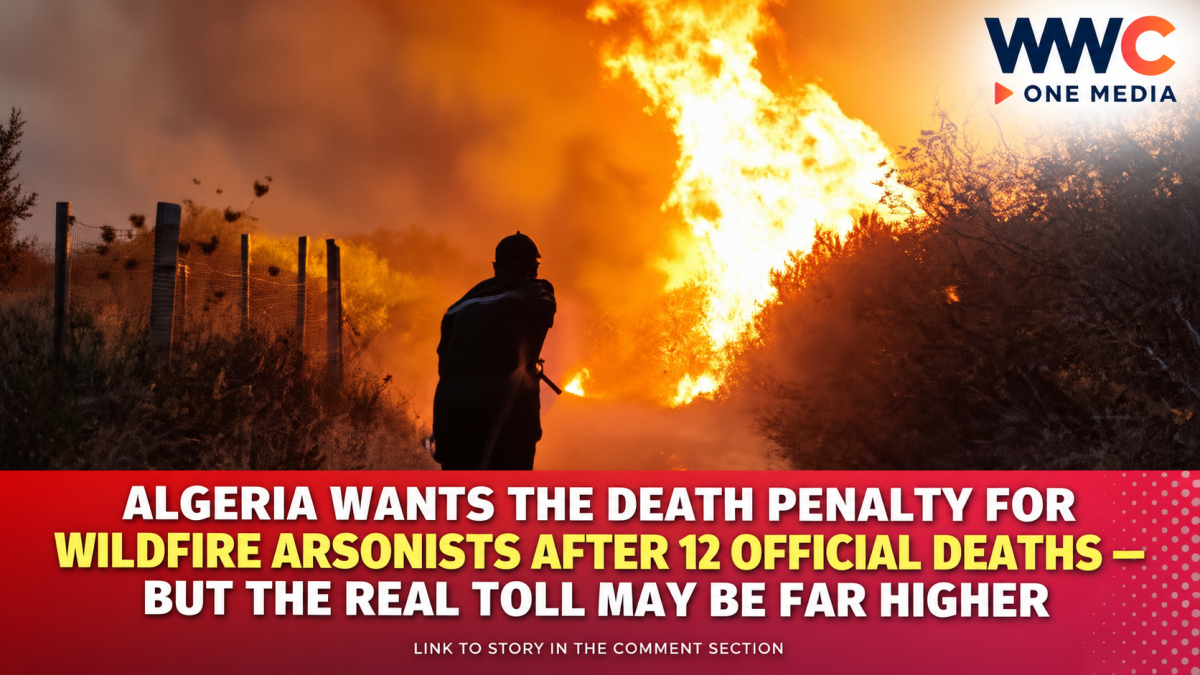
ALGIERS, Algeria — Algeria is confronting one of its most devastating wildfire disasters in years, and the crisis has now moved beyond burned forests and destroyed villages into a fierce national debate over punishment, accountability and the true number of people who died.
President Abdelmadjid Tebboune has ordered Algeria’s justice minister to prepare changes to the country’s Penal Code by September 15 that would allow the death penalty to be imposed — and carried out — against people convicted of deliberately starting forest fires.
The announcement came after catastrophic fires tore through northeastern and eastern Algeria in late August, hitting Jijel, Béjaïa, Tizi Ouzou and other provinces.
But behind the president’s dramatic proposal is an even more disturbing question:
How many people actually died?
Official Toll Says 12 — Independent Count Reaches 200
Algerian authorities initially reported 12 deaths, while at least 54 people were hospitalized with burn injuries, including several in critical condition.
That official figure, however, has increasingly been challenged by accounts emerging from devastated communities.
Independent Algerian journalist Nozha Khelalef began compiling victims’ names using family death announcements, municipal pages, community organizations and other local information.
Her tally, published by independent outlet Twala, reached 200 identified deaths from Jijel province alone by August 31.
The figure remains an independent count rather than an official government death toll, but it illustrates the potentially enormous gap between publicly confirmed figures and what communities on the ground say they have experienced.
Le Monde reported that one municipality, El Djemaa Beni Habibi, had posted a list containing the names of more than 70 people who died.
Some victims were so badly burned that they could not immediately be identified, according to the newspaper, with DNA samples reportedly sent for analysis.
The Associated Press also reported scenes of mass burials and quoted a veteran Civil Protection officer who said the disaster had produced casualties far beyond anything he had seen during four decades of service.
The AP nevertheless continued to describe 12 as the official toll, underscoring the uncertainty surrounding the final number of victims.
Entire Communities Caught in the Flames
The devastation was particularly severe in Jijel, a coastal province east of Algiers known for its forests, mountains, beaches and agricultural communities.
AP reported extensive destruction across the province, including burned homes, forests and livestock.
Villages were caught in rapidly advancing fires as extreme heat and powerful winds created exceptionally dangerous conditions.
Le Monde reported temperatures exceeding 45°C during the worst of the crisis and said nearly 200 separate fires were recorded on August 27 alone.
Some fires moved so violently that residents reportedly found roads blocked while attempting to escape.
Civil Protection units were reinforced by the Algerian military and firefighting aircraft, while thousands of ordinary Algerians organized convoys carrying food, medicine, clothing and drinking water into devastated communities.
AP reported that firefighting teams were still dealing with flare-ups in Sétif and Guelma this week.
Tebboune Turns to the Death Penalty
As anger over the destruction grew, President Tebboune ordered tougher punishment for anyone proved to have intentionally caused forest fires.
Algeria’s state-run news agency, Algérie Presse Service, reported that the president directed the justice minister to amend the Penal Code before September 15 to establish the death penalty with execution for deliberate arsonists.
The proposal is not yet a completed law.
Reports indicate that the amendment must still move through Algeria’s government and parliamentary process before becoming legally effective.
Under existing law, deliberately setting forest fires can already carry sentences of up to 30 years in prison, with life imprisonment in certain circumstances.
Why Algeria’s Death-Penalty Proposal Is So Significant
Algeria still retains capital punishment in its laws, but the country has maintained a de facto moratorium on executions since 1993.
That means courts can impose death sentences even though executions have not been carried out for more than three decades.
The United Nations has previously documented Algeria’s moratorium, while Amnesty International also reported in 2026 that no executions had taken place since 1993.
If Tebboune’s proposal ultimately results in executions, it would therefore represent a major reversal of a practice that has lasted roughly 33 years.
Supporters argue that extraordinarily harsh punishment is needed to deter deliberate fires capable of destroying entire communities.
Critics, including human-rights groups and parts of Algeria’s political opposition, have objected to reinstating executions and have questioned whether the focus on arson could distract from wider questions about disaster preparedness and wildfire management.
AP reported that parties supporting Tebboune and some Islamist political groups backed the tougher punishment, while democratic opposition groups and human-rights organizations opposed it.
Were the Fires Deliberately Started?
That remains one of the most important unanswered questions.
Tebboune has said the unusual timing and intensity of some fires raised suspicions that human involvement could have played a role, and authorities have opened investigations.
The president reportedly pointed to fires appearing almost simultaneously during the night as one reason investigators should examine possible deliberate ignition.
Several suspects have reportedly been arrested.
But there is no evidence establishing that all — or even most — of the catastrophic fires were deliberately started, and any individual accused of arson would still have to be investigated and convicted through the judicial process.
Tebboune himself has also acknowledged the broader environmental conditions behind wildfire risk rather than attributing the entire catastrophe to a coordinated plot.
Extreme Heat Added Fuel to the Disaster
The fires erupted during exceptionally hot conditions across parts of North Africa.
Scientists have repeatedly warned that hotter and drier conditions can create environments in which vegetation ignites more easily and fires spread more aggressively.
Copernicus notes more generally that heatwaves increase conditions conducive to wildfires, while AP reported that Tebboune himself cited similar wildfire crises elsewhere around the Mediterranean when discussing the Algerian disaster.
That does not establish climate change as the cause of any particular ignition.
It does, however, highlight an important distinction: what starts a wildfire and what allows it to become catastrophic are not necessarily the same thing.
An intentionally or accidentally started fire can become dramatically more dangerous when extreme heat, dry vegetation and strong winds are already in place.
Algeria Has Seen This Tragedy Before
The disaster has revived painful memories of 2021, when deadly wildfires devastated Algeria’s Kabylie region.
About 90 people died in that catastrophe, according to Le Monde.
Afterward, Algeria invested in additional firefighting aircraft, including water bombers, in an effort to strengthen its ability to confront future fire seasons.
Yet the scale and speed of the August 2026 fires again overwhelmed communities in parts of the country.
Government Promises Compensation and Reconstruction
Tebboune has ordered compensation for affected families and assistance for people whose homes and livelihoods were destroyed.
Authorities were also instructed to restore electricity, gas, drinking water and telecommunications, repair damaged homes and assess agricultural and livestock losses.
Schools have also become a priority as Algeria prepares for the new academic year.
AP reported that the government wants damaged schools restored before students are scheduled to return on September 21.
But reconstruction may prove easier than answering the questions now hanging over the disaster.
Was Algeria sufficiently prepared for fires of this scale?
How many of the blazes were actually caused by arson?
And most urgently, why does the country’s official death toll remain at 12 when independent investigators have already documented the names of around 200 people believed to have died in Jijel alone?
Until authorities provide a comprehensive and independently verifiable casualty count, that discrepancy may become as politically explosive as the president’s proposed punishment for whoever started the fires.
WWC ONE MEDIA J.M.D



Leave a Reply