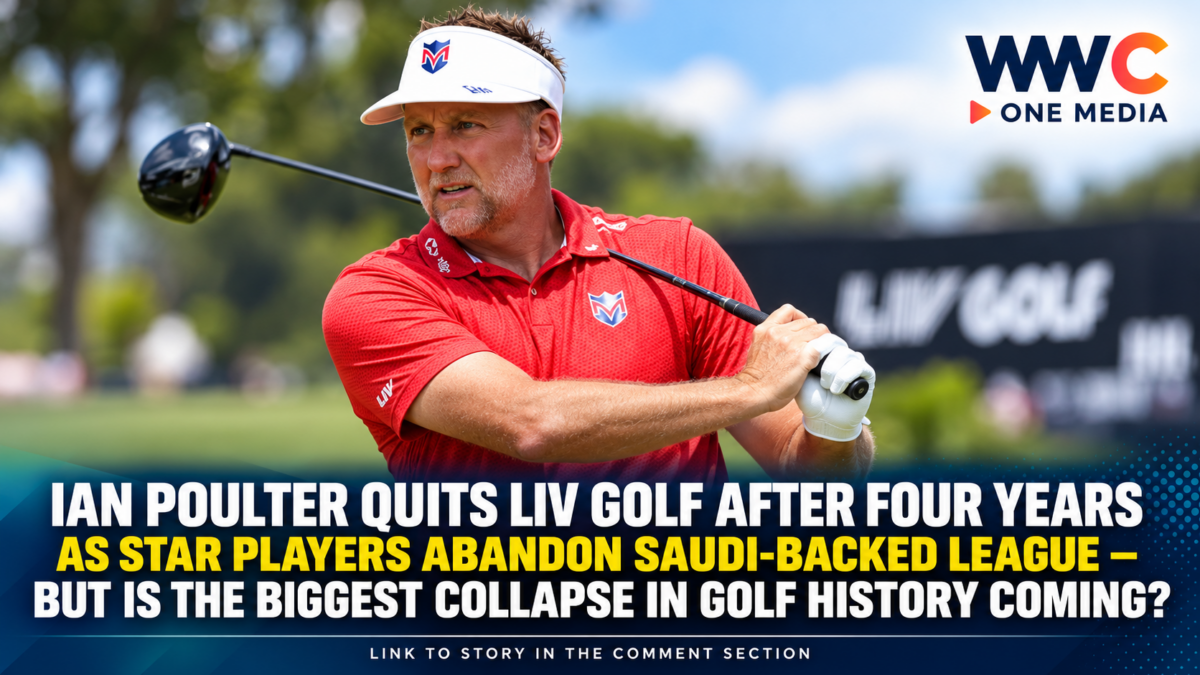
Ryder Cup icon Ian Poulter has confirmed his departure from LIV Golf after four years, choosing family, senior golf and a new chapter in his career as the Saudi-backed circuit faces one of its biggest challenges yet.
The future of LIV Golf has been thrown into further uncertainty after English golf legend Ian Poulter announced he will not participate in the proposed LIV Golf 2.0 relaunch, becoming the latest high-profile player to leave the controversial competition.
The 50-year-old, one of the breakaway league’s original recruits and most recognizable personalities, confirmed his decision on October 23, 2026, following extensive discussions with his family and management team.
Poulter’s departure comes at a particularly difficult moment for LIV Golf, which is attempting to restructure its operations, secure player commitments and establish a sustainable financial future after losing support from its original principal backer.
His announcement follows exits by several other prominent players, including former world No. 1 Jon Rahm and former Open champion Louis Oosthuizen.
For a league that once attracted some of golf’s biggest names with lucrative contracts, the growing departures raise a fundamental question: Can LIV Golf survive without the stars who helped build its identity?
Poulter chooses family and senior golf over LIV Golf 2.0
Poulter explained that the decision to leave was difficult but reflected a change in his personal and professional priorities.
The five-time Ryder Cup winner said he wanted to spend more time with his family, reduce international travel, compete in senior golf tournaments and explore opportunities outside traditional competition.
Rather than commit to another demanding global schedule, Poulter is looking ahead to a different phase of his career.
He also plans to support his two sons, Luke and Joshua, in their golfing ambitions.
Luke is pursuing a career in professional golf, while Joshua is developing his game as a teenager.
Poulter said being able to support his children after decades of international competition was particularly meaningful.
His plans also include expanding his YouTube channel, The Postman, through which he intends to share more of his experiences, golf content and personal life.
From LIV Golf pioneer to one of its biggest departures
Poulter was among the original group of established players who joined LIV Golf when the competition launched in June 2022.
The league, initially supported by Saudi Arabia’s Public Investment Fund, disrupted professional golf by offering substantial financial incentives, a team-based format and a shorter tournament structure.
Poulter became a co-captain of Majesticks GC alongside fellow European Ryder Cup veterans Lee Westwood and Henrik Stenson.
Despite failing to claim an individual or team championship during his LIV Golf career, Poulter remained one of the competition’s most recognizable figures.
Across his wider professional career, he has recorded 17 victories, including three on the PGA Tour.
His reputation was built particularly through the Ryder Cup, where his emotional performances and remarkable match-play record made him a favorite among European supporters.
Poulter helped Europe win five Ryder Cups and became widely known for his intensity, resilience and ability to deliver under pressure.
His departure therefore represents more than the loss of another competitor. It removes one of the league’s founding personalities and most passionate advocates.
LIV Golf faces financial uncertainty and growing player exits
Poulter’s announcement comes as LIV Golf faces a critical period in its attempt to continue operating beyond 2026.
Saudi Arabia’s Public Investment Fund announced earlier this year that it would withdraw financial support, triggering a major reassessment of the league’s future.
LIV subsequently sought Chapter 11 bankruptcy protection in the United States as part of its restructuring efforts.
The organization has pursued new financial backing from BC Partners Credit and is attempting to secure sufficient player commitments for a proposed 2027 relaunch.
However, the departure of leading golfers has complicated those ambitions.
Apart from Poulter, Rahm and Oosthuizen, Sergio Garcia, Tyrrell Hatton, Tom McKibbin and David Puig have also been reported among players moving away from the league’s next proposed iteration.
The growing list of departures has intensified questions about LIV Golf’s ability to retain a competitive roster, attract sponsors and maintain its global audience.
According to reports, a key player commitment deadline falls on October 25, although the prospective financial backers may have the ability to extend or waive it.
A decision on whether LIV Golf will move forward with its restructuring or cease operations could emerge before the end of October.
Importantly, the departures and financial difficulties do not mean LIV Golf has already shut down. The competition’s future remains unresolved.
Could Poulter return to traditional professional golf?
Poulter’s departure could create opportunities to compete more regularly on established golf circuits, although eligibility rules and previous sanctions remain relevant.
His involvement with LIV Golf had previously affected his relationship with the DP World Tour, which imposed penalties on players who competed in unauthorized events.
Poulter paid outstanding fines and returned to a DP World Tour event at the Alfred Dunhill Links Championship earlier this month.
Senior golf now appears central to his next chapter.
Potential opportunities include European senior competitions and, subject to eligibility and suspension rules, the PGA Tour Champions in the United States.
For Poulter, the priority is no longer simply competing for trophies or pursuing another lucrative contract.
It is about continuing his golfing career while having more time for his family and other interests.
What happens next to LIV Golf?
LIV Golf’s original mission was to challenge the traditional structure of professional golf through substantial prize money, international tournaments and a more entertainment-focused presentation.
Its arrival generated intense debate over player loyalty, Saudi investment, competitive opportunities and the future relationship between established tours and alternative competitions.
Four years later, the landscape is changing again.
For LIV Golf’s leadership, the immediate challenge is to secure the financial support and player participation necessary to make its proposed relaunch viable.
For the players, the calculation has become increasingly personal: whether to commit to an uncertain competition or pursue opportunities elsewhere.
Poulter has made his choice.
The Ryder Cup legend is moving toward senior golf, family commitments and media projects rather than another season with the breakaway circuit.
His decision does not necessarily signal the end of LIV Golf, but it adds to the mounting pressure on an organization facing a defining moment.
With more established stars choosing to leave and a crucial deadline approaching, the question is no longer just who will play for LIV Golf next year — it is whether the league can build a future strong enough to convince them to stay.