
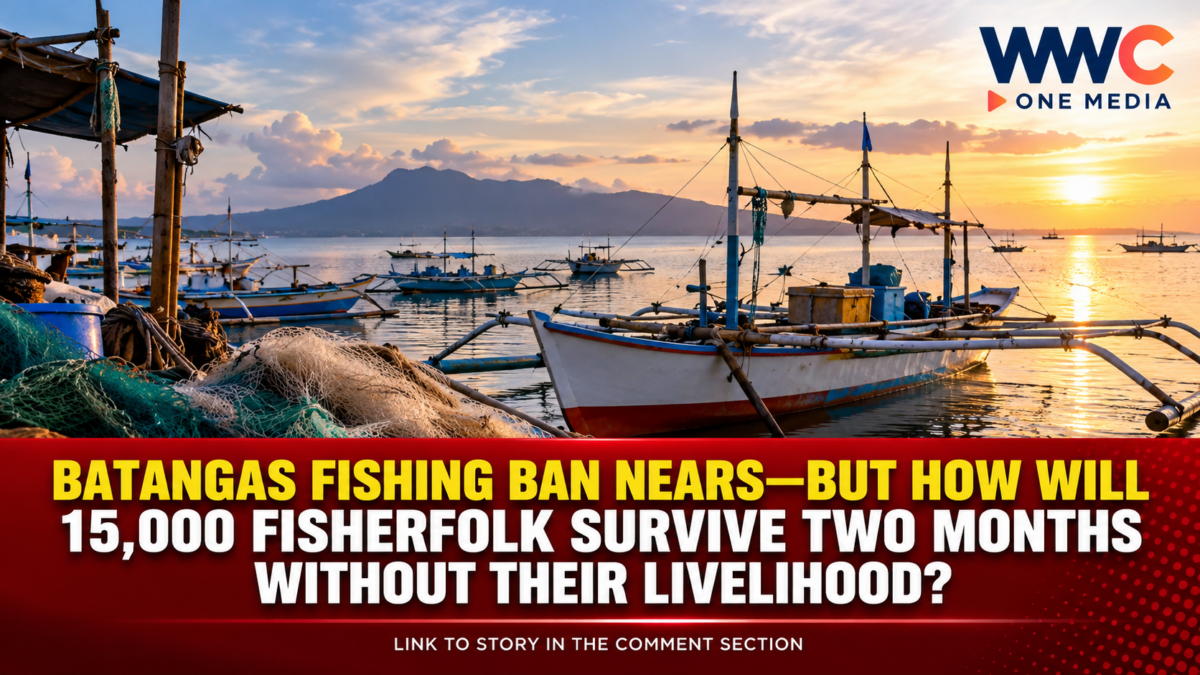
BATANGAS, Philippines — Thousands of small-scale fishers around Balayan Bay are bracing for another two-month fishing shutdown, raising urgent concerns about lost income and the need for government livelihood assistance as the Christmas season approaches.
More than 15,000 fisherfolk across nine coastal towns are expected to be affected by the seasonal closure, according to reports citing local fisherfolk organizations. The restriction is expected to run from December 2026 into February 2027, leaving families that depend on daily fishing catches facing a difficult period financially.
For many fishing households, the timing is especially challenging. The holiday season typically brings additional expenses for food, electricity, school needs and family gatherings—costs that become harder to manage when daily earnings disappear.
The central concern raised by fishing communities is whether adequate livelihood alternatives and financial assistance will be available while fishing activities are restricted.
Thousands of Fishing Families Face an Income Crisis
The Samahan ng mga Mangingisdang Kababaihan sa Palikpikan (SAMAKAPA), an organization affiliated with the fisherfolk group Pambansang Lakas ng Kilusang Mamamalakaya ng Pilipinas (PAMALAKAYA), has expressed concern over the impact of the annual closure.
The group says fishing families continue to struggle with the absence of sufficient alternative livelihoods and support during the restricted season.
The affected communities are spread across nine coastal towns surrounding Balayan Bay. For households whose primary income comes from fishing, even a temporary interruption can affect their ability to purchase basic necessities and meet financial obligations.
The latest concerns reflect a recurring issue: how can authorities protect marine resources while ensuring that small-scale fishers have enough support to sustain their families?
Why Is Fishing Being Restricted?
Seasonal fishing closures are intended to give fish populations time to reproduce and replenish marine resources. Such restrictions form part of fisheries management measures under the Philippine Fisheries Code of 1998, or Republic Act No. 8550, as amended by Republic Act No. 10654.
However, fisherfolk organizations have questioned whether the current approach adequately considers the economic consequences for small fishing communities.
In a report published by News5 in November 2025, the Makabayan bloc sought the cancellation of the planned closure in Balayan Bay, arguing that thousands of small-scale fishers could lose their primary source of income. The lawmakers also questioned the adequacy of community consultations and called for a review of the program.
These objections represent the position of the groups opposing the closure. The conservation objective, meanwhile, is to help protect fish stocks and support the long-term sustainability of fisheries.
Government Assistance Remains a Key Concern
The call for livelihood support comes as the provincial government has previously distributed fishing equipment to selected beneficiaries.
In a February 27, 2026, announcement, the Provincial Government of Batangas reported the distribution of fishing gear to beneficiaries in Nasugbu, Calatagan and Balayan. The assistance included hook-and-line equipment and gill nets.
While the initiative demonstrates that fisheries assistance programs have been implemented, the announcement does not establish that all households affected by the upcoming seasonal closure will receive financial aid or alternative employment.
The Department of Labor and Employment has also announced a Trabahong-Dagat and Blue Enterprise Development initiative, designed to connect eligible coastal communities and fisherfolk households with temporary work, skills training, employment opportunities and small-business support. Its initial target areas and eligibility requirements should be checked before assuming that Balayan Bay residents are covered.
For affected fishers, the immediate questions remain whether assistance will reach the right beneficiaries, whether it will arrive before the closure begins, and whether the support will be enough to cover essential household expenses.
Could the Closure Affect Local Fish Supply?
Balayan Bay supports local fishing communities that catch species including galunggong, tulingan, tanigue, hasa-hasa and tamban, according to reports on the concerns raised by fisherfolk groups.
A restriction on certain fishing activities may affect the availability of locally caught fish from the covered fishing grounds. However, the overall effect on market supply and prices will depend on the scope of the restrictions, catches from other areas, distribution networks and other supply conditions.
PAMALAKAYA has warned that restrictions could hurt local fishers and domestic production. That warning is an advocacy group’s assessment, not proof that a nationwide fish shortage or price increase will necessarily follow.
The issue highlights the need for transparent information about which fishing gears and species are covered, how the closure will be enforced, and how local communities will be supported.
The Challenge: Protecting the Sea Without Leaving Fishers Behind
The approaching closure places two important concerns at the center of the debate: the need to protect marine resources and the need to safeguard the livelihoods of families who depend on them.
A more sustainable approach could combine clear conservation rules with timely cash or food assistance, temporary employment, skills training and alternative livelihood programs. Consultation with affected fishing communities could also help authorities explain the scientific basis for restrictions and address concerns about implementation.
For thousands of Batangas fisherfolk, the coming months could determine whether their families can manage another fishing season without regular income.
As the seasonal closure approaches, the question is no longer only how to protect Balayan Bay’s marine resources—but how to ensure that the people who depend on those waters are not left struggling to survive.










