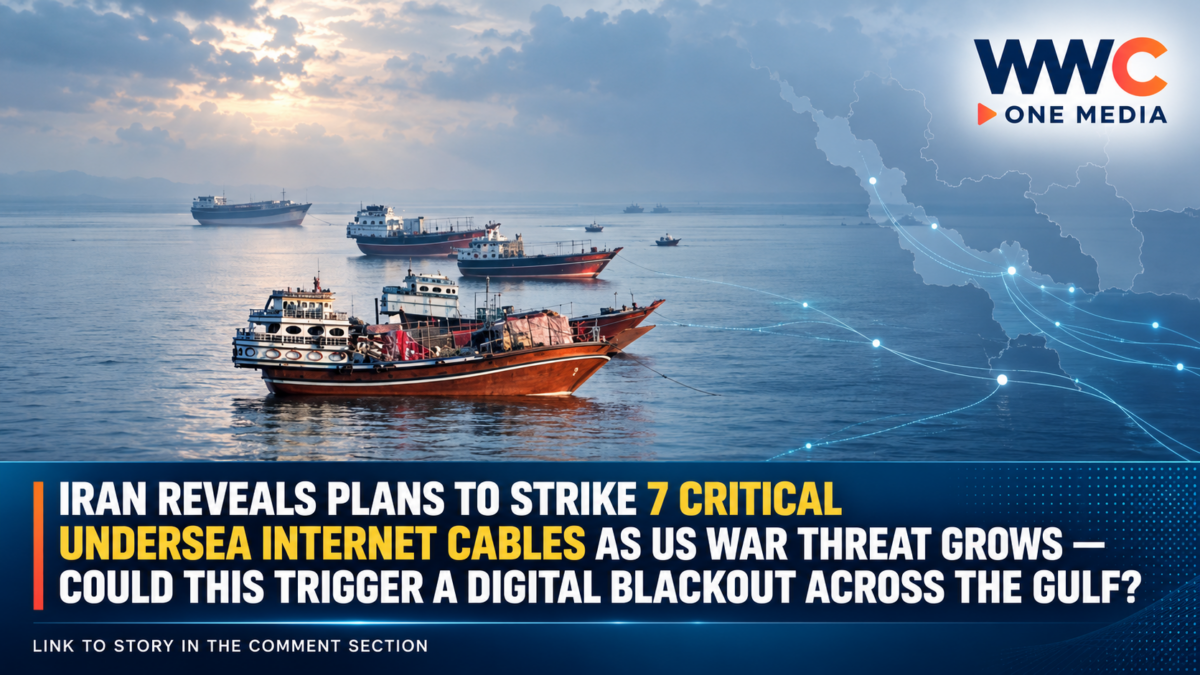
DUBAI — The escalating confrontation between Iran and the United States has taken a dangerous new turn, with senior Iranian security officials revealing plans to attack undersea telecommunications cables in the Persian Gulf if American and Israeli military strikes resume.
Two senior Iranian security officials told Reuters that Tehran has developed plans to target critical communications infrastructure. The officials did not disclose specific attack methods or locations, and one said Iran could seek to prevent damaged cables from being repaired to prolong disruptions.
Iran identifies seven critical cables beneath Strait of Hormuz
On October 21, Yadollah Javani, deputy head of political affairs for Iran’s Islamic Revolutionary Guard Corps (IRGC), warned that seven major internet cables beneath the Strait of Hormuz could become targets if Iranian infrastructure were attacked.
The implications extend beyond ordinary internet access. Submarine fiber-optic cables underpin international financial transactions, cloud services, digital commerce and communications. An attack affecting multiple connections could create serious disruptions for Gulf economies and technology companies operating in the region.
Could Iran’s threats trigger a global internet blackout?
The International Telecommunication Union estimates that undersea cables carry approximately 99% of global internet traffic.
However, telecommunications researcher Alan Mauldin of TeleGeography said less than 1% of international bandwidth passes through the Strait of Hormuz.
This means an attack there would not necessarily cause a worldwide internet blackout, although serious regional disruptions remain possible.
The consequences would depend on the number of cables damaged, available backup connections and how quickly network operators could redirect traffic.
US technology companies and AI infrastructure face growing risks
The threat comes as Gulf governments are spending heavily on artificial intelligence, cloud computing and digital infrastructure.
In March, Iranian strikes hit two Amazon Web Services facilities in the United Arab Emirates and damaged infrastructure near another facility in Bahrain.
Iranian security official Mohsen Rezaei has also warned that US-linked data centers and AI installations could face attack if fighting resumes.
The escalating threats raise concerns about the exposure of technology infrastructure to military conflict, particularly as Gulf states seek to attract investment from major American technology companies.
Is Tehran using internet infrastructure as a bargaining chip?
Analysts suggest the warnings form part of a broader deterrence strategy.
Alex Vatanka of the Middle East Institute said Tehran wants Gulf governments and corporate leaders to pressure Washington over the potential consequences for regional investments.
By threatening telecommunications networks, financial systems and cloud facilities, Iran could increase the perceived economic cost of renewed military action.
Red Sea cables present an additional vulnerability
The Red Sea presents another potential vulnerability, with major communications connections linking Europe, Africa and Asia passing through the region.
Al Jazeera reported on October 13 that fighting involving the Houthis in Yemen had increased concerns about infrastructure around the Bab al-Mandeb Strait.
However, there is no confirmed Iranian plan to attack Red Sea cables.
Damage to these connections could create wider disruptions because of their importance to data traffic between regions.
Why repairs could take longer during wartime
Repairing damaged seabed cables during military conflict could be particularly difficult because of security risks, insurance costs and restrictions on repair vessels entering territorial waters.
Alternative land-based networks could provide some resilience, but their effectiveness depends on available capacity and the location of any damage.
Microsoft is planning investments exceeding $400 million in subsea and terrestrial connectivity across the Middle East by 2030, reflecting growing efforts to strengthen regional infrastructure.
A new front in the Iran-US confrontation?
The United States and Iran have not publicly confirmed the anonymous officials’ operational claims. Reuters reported that the US State Department and Iranian Foreign Ministry did not respond to requests for comment.
There is no verified evidence in the cited reports that Iran has already carried out the threatened attacks on Gulf undersea cables.
As regional tensions rise, the confrontation highlights a strategic vulnerability: the physical infrastructure that keeps banks, businesses and societies connected.
The critical question now is whether Iran’s warnings will remain a means of deterrence — or become a damaging new front in a renewed Middle East war.