The Philippine peso has fallen to another historic low against the US dollar, intensifying concerns about inflation, import costs and the financial pressure facing Filipino households and businesses.
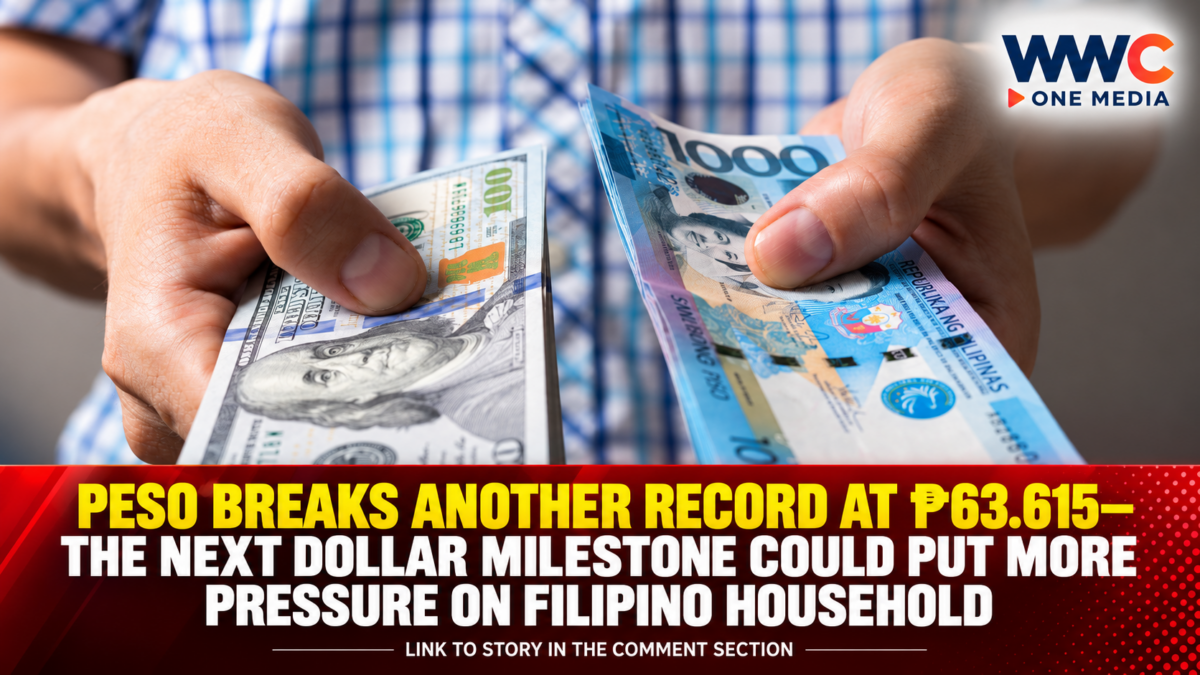
The peso closed at ₱63.615 against the US dollar on Friday, October 23, weakening by 9.5 centavos from Thursday’s record-low close of ₱63.52, according to reports by Philstar.com, GMA News Online and ABS-CBN News. It was the currency’s 31st record-low closing level of 2026.
The latest decline came despite the Bangko Sentral ng Pilipinas (BSP) raising its benchmark interest rate to 5.5% a day earlier in an effort to contain mounting inflationary pressures. The peso’s continued weakness highlights the challenge facing policymakers as domestic price risks collide with uncertainty in global financial markets.
Why does the peso keep falling?
Several domestic and international forces are putting pressure on the Philippine currency.
1. A stronger US dollar and uncertainty over US interest rates
When investors expect US interest rates to remain high or rise further, dollar-denominated assets can become more attractive. This can increase demand for dollars and put pressure on emerging-market currencies, including the peso.
Philippine Daily Inquirer reporting ahead of the BSP’s latest policy decision identified expectations surrounding the US Federal Reserve as one of the factors influencing the peso’s movement.
2. Higher oil prices and geopolitical tensions
The Philippines relies heavily on imported oil and other commodities. When global energy prices rise, the country needs more dollars to pay for imports, potentially increasing demand for the US currency.
Reuters reported that elevated oil prices associated with the conflict involving the United States, Israel and Iran have added to inflation risks and pressure on the peso.
3. Persistent demand for foreign currency
Importers, businesses and other market participants need dollars to settle international transactions. When dollar demand remains strong while external conditions are unfavorable, the peso can continue weakening.
Economists cited in Philstar.com coverage have also pointed to external uncertainty and the country’s balance-of-payments position as factors affecting the currency.
Why didn’t the BSP’s rate hike stop the peso’s slide?
On October 22, the BSP raised its key policy rate by 50 basis points, or half a percentage point, to 5.5%. Reuters described the move as larger than expected and the central bank’s fourth consecutive rate increase.
Higher interest rates can help support a currency by making peso-denominated investments more attractive. They can also help contain inflation by moderating demand.
However, rate increases cannot guarantee an immediate currency recovery. If the dollar remains strong, oil prices stay elevated and investors remain cautious, external pressures can outweigh the potential support from tighter monetary policy.
BSP Governor Eli Remolona Jr. has also emphasized that the central bank does not target a particular peso exchange-rate level. Its foreign-exchange interventions are intended to limit excessive volatility that could worsen inflation, rather than guarantee a specific rate.
What does a ₱63.615 dollar rate mean for ordinary Filipinos?
The impact depends on how much of a household’s spending or income is linked to foreign currencies.
- Fuel and transportation: A weaker peso can make imported oil more expensive in local-currency terms, potentially adding pressure to fuel prices and transport costs.
- Food and everyday goods: Businesses that import ingredients, raw materials, machinery or finished products may face higher costs, some of which could eventually be passed on to consumers.
- Overseas Filipino workers’ remittances: Families receiving dollars may get more pesos when converting the same amount, although the benefit depends on transfer fees and the exchange rate offered by the provider.
- Businesses and borrowers: Companies with dollar-denominated expenses or debt may face larger peso costs, while exporters and some tourism businesses may benefit from more competitive prices for foreign customers.
These effects are not automatic or uniform. Actual retail prices also depend on global commodity prices, existing inventories, contracts, taxes, business decisions and the timing of currency conversion.
Could the peso reach ₱64 per dollar?
The possibility deserves attention, but it is not a certainty.
Before the latest record, economists cited in Philstar.com coverage had warned that ₱64 per dollar could become a near-term risk if expensive oil, dollar strength and global uncertainty persisted. That assessment was made when the peso was already under significant pressure.
Whether the currency reaches that level will depend on changing market conditions, including US monetary policy expectations, geopolitical developments, oil prices, foreign-exchange flows and investor sentiment.
The BSP’s rate hike may help contain inflation, but it does not ensure that the peso will strengthen immediately. A sustained improvement in external conditions could ease pressure, while further shocks could deepen it.
The bigger economic concern
The key issue is not simply how many record lows the peso reaches, but whether continued depreciation feeds into domestic inflation and erodes household purchasing power.
A weaker currency can increase the peso cost of imports, while higher interest rates can make borrowing more expensive for consumers and businesses. Policymakers therefore face a difficult balancing act: keeping inflation under control without placing unnecessary strain on economic activity.
For Filipino households, the coming weeks will be important as changes in the exchange rate, oil prices and domestic inflation determine how much pressure reaches everyday expenses.
The bottom line: The peso’s close at ₱63.615 per dollar marks another record for 2026, even after the BSP’s latest rate increase. Whether ₱64 becomes the next milestone will depend on how global dollar strength, energy costs and domestic economic conditions evolve.