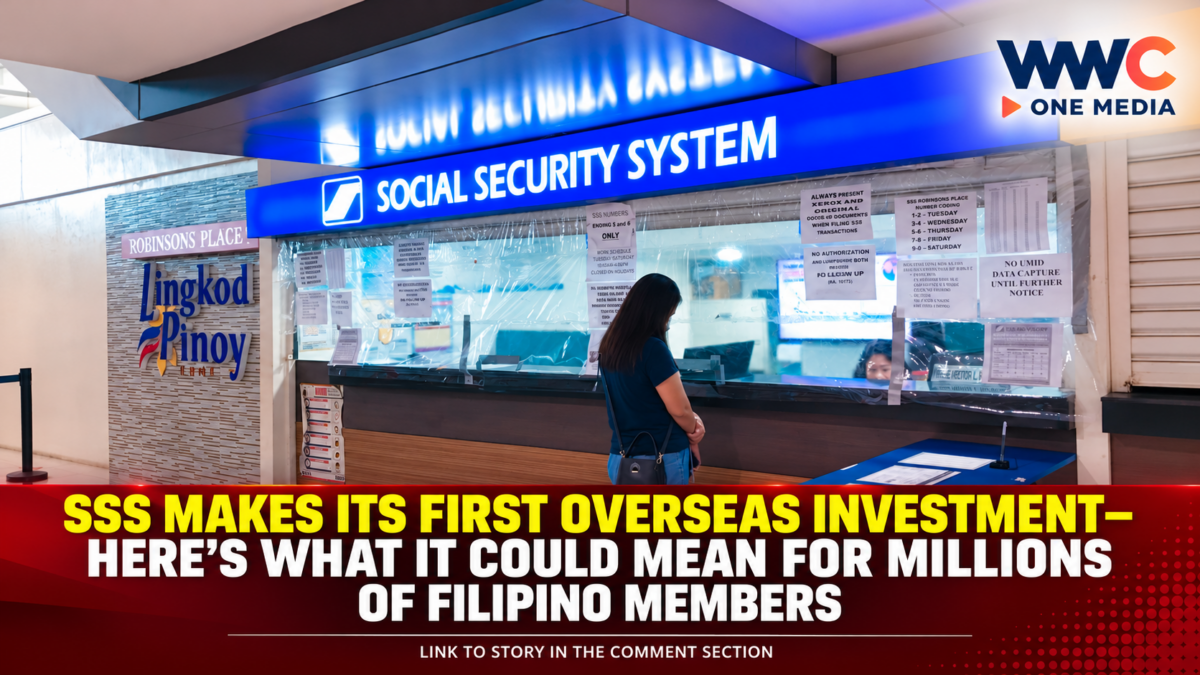
The Social Security System (SSS) has made its first reported overseas investment by purchasing US government Treasury securities, marking a new chapter in how the state-run pension fund manages the contributions and reserves intended to support Filipino workers and retirees.
Newly appointed SSS president and chief executive officer Victor Alfonso A. Limlingan said the initial investment is small and is intended partly to test the systems needed for international investing. The agency is exploring a broader allocation to overseas assets as it seeks to diversify its portfolio and improve long-term investment performance.
The move could eventually give the pension fund access to more investment opportunities outside the Philippines. However, the strategy also raises important questions about investment risks, returns and the safeguards needed to protect members’ money.
Why is SSS investing overseas for the first time?
The initial purchase of US Treasury securities represents a departure from the SSS’s previously domestic-focused investment portfolio.
US Treasury securities are debt instruments issued by the US government. They are widely regarded as relatively low-credit-risk investments, although their market value can fluctuate with interest rates, and dollar-denominated holdings carry foreign-exchange risks.
Limlingan explained that holding dollar assets could help protect the fund against a weakening Philippine peso. If the peso depreciates against the dollar, the peso value of an unchanged dollar-denominated investment generally rises, all else being equal. Currency movements can also work in the opposite direction.
According to reports published on October 23, the SSS intends to start cautiously while establishing the procedures and professional support needed to invest internationally.
How much of the SSS pension fund could go abroad?
The SSS is considering a gradual expansion of its international investments rather than immediately shifting a large portion of its reserves overseas.
Reports on the agency’s latest plans indicate that it wants to place approximately 1% of its Investment Reserve Fund in foreign investments by the end of 2026, with a longer-term goal of increasing the offshore allocation to as much as 5% by the end of 2027.
The legal ceiling is higher: the Social Security Act of 2018 allows foreign-currency-denominated investments of up to 7.5% of the Investment Reserve Fund, subject to applicable rules and investment policies. The maximum permitted allocation is not a requirement to invest that amount.
The agency is also seeking an international investment consultant to help assess overseas opportunities, manage risks and guide the development of its global investment strategy. Final investment decisions remain subject to the SSS’s governance and approval processes.
SSS manages more than ₱1.2 trillion in investments
The overseas expansion comes as the SSS manages a substantial investment portfolio.
In its August 2026 disclosure, the agency reported ₱1.27 trillion in consolidated investments as of June 30, 2026. These holdings included:
- ₱629.05 billion in government securities
- ₱179.44 billion in equities
- ₱154.56 billion in property
- ₱151.90 billion in member loans
- ₱96.34 billion in corporate notes and bonds, among other assets
The portfolio generated ₱27.16 billion in actual investment income during the first half of 2026, equivalent to an annualized return on investment of 4.53%, according to the SSS.
The figures provide context for why the agency is exploring additional markets. By spreading investments across different asset classes and geographic regions, the fund may reduce its dependence on the performance of a single market.
Diversification, however, does not guarantee higher returns or eliminate losses.
Will the overseas investment increase SSS pensions?
Not automatically.
The purpose of the investment strategy is to help improve portfolio diversification and support the fund’s long-term financial sustainability. Any additional earnings would have to be considered alongside benefit obligations, operating expenses, market conditions and the fund’s broader financial requirements.
In August, the SSS said its overseas investments would complement—not replace—its participation in the Philippine capital market. It also set a target of growing its reserve fund to ₱2 trillion by 2030.
The agency’s financial position matters because the SSS must continue paying benefits to eligible members and pensioners while preparing for future obligations.
The SSS also reported in October that benefit payouts rose 19% year-on-year to ₱173.45 billion in the first half of 2026, underscoring the importance of balancing investment income with growing benefit payments.
Consequently, members should not interpret the first overseas investment as an announcement of an immediate pension increase or a change in contribution rates.
What other news outlets have reported
The latest development follows months of reporting about the SSS’s plans to enter international markets.
- Philippine Daily Inquirer: Reported the pension fund’s first overseas investment and the new administration’s plans to expand its foreign exposure.
One Democrat
- Bilyonaryo: Reported that the initial investment was intended to test overseas investment procedures and that the agency was considering a larger allocation by 2027.
BILYONARYO Business
- Philstar: Previously reported the SSS’s ₱1.27-trillion investment portfolio and its strategy to diversify internationally while remaining active in the domestic market.
Philstar
- BusinessMirror: Reported earlier plans to enter foreign markets, including exchange-traded funds, as part of efforts to strengthen the pension fund’s long-term sustainability.
Reine Juvierre S. Alberto
Taken together, these reports show that the overseas investment is part of a broader strategy that had been under consideration before the initial purchase was announced.
The bigger question: Can global investments strengthen retirement security?
The SSS’s move abroad signals a more internationally diversified approach to managing pension reserves. If implemented carefully, investments in foreign markets could create additional sources of income and reduce the portfolio’s concentration in domestic assets.
But the results will depend on investment selection, currency movements, market conditions, transaction costs and effective oversight.
For millions of Filipino workers and pensioners, the most important measure of success will not simply be how much money the SSS invests abroad. It will be whether the strategy contributes to a financially sustainable fund capable of meeting its obligations over the long term.
The first investment may be small, but the strategy behind it could become increasingly significant as the SSS expands its global exposure.