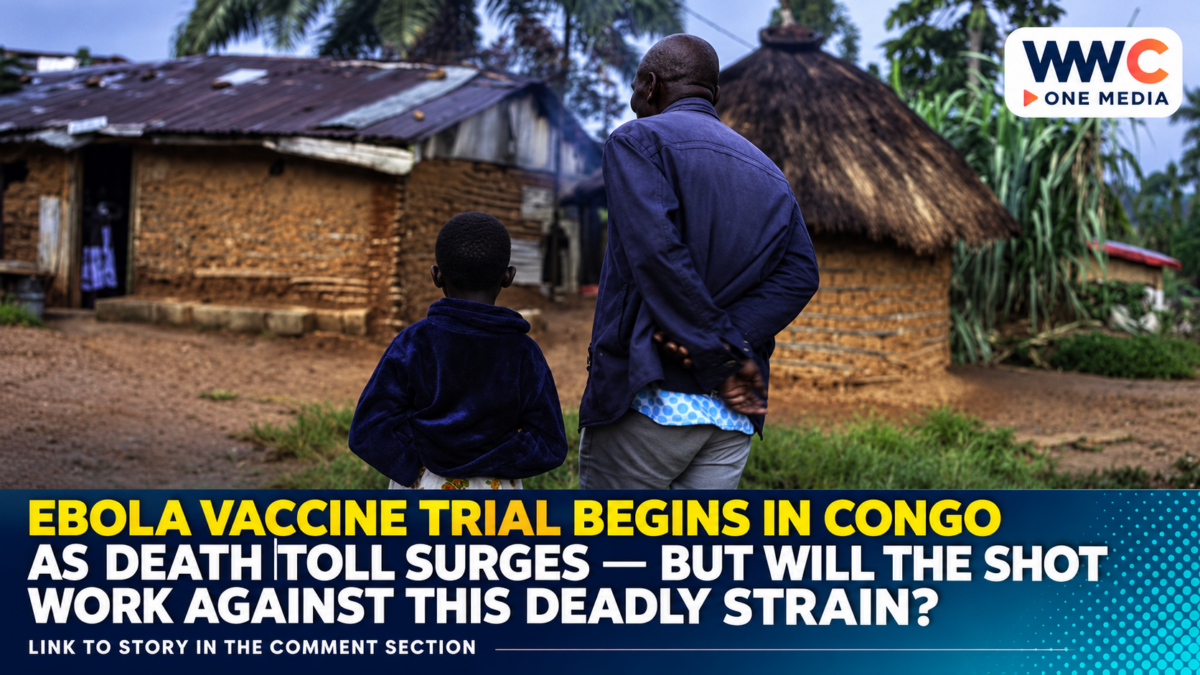
BUNIA, Democratic Republic of the Congo — Scientists have launched a major Ebola vaccine trial in the Democratic Republic of the Congo (DR Congo), opening a new front in the fight against an outbreak that has killed thousands and exposed a critical gap in protection against one of the virus’s rare strains.
The first participant received a vaccine dose on October 23, 2026, in Bunia, the capital of Ituri province, where the outbreak has hit particularly hard. The study, called Tumaini, meaning “hope” in Swahili, will assess vaccine candidates against the Bundibugyo virus.
The trial comes with an urgent question: Can a vaccine developed for a different Ebola strain provide meaningful protection against the virus now spreading through affected communities?
There is currently no approved vaccine specifically for Bundibugyo Ebola, making the research a potentially important step toward improving protection for people at risk. However, scientists must establish whether the vaccines being tested are safe and effective against this particular strain before their benefits can be confirmed. <Cite refs={[“turn365952search2″,”turn365952search1”]}/>
Ebola outbreak has killed thousands in DR Congo
The outbreak was officially declared on May 15, 2026. By October 21, authorities had recorded 9,552 cases and 4,602 deaths in DR Congo, according to the Institute of Tropical Medicine in Antwerp, one of the institutions involved in the trial.
The Associated Press subsequently reported that the outbreak had surpassed 9,700 infections, with nearly half of those infected dying. Figures may vary according to reporting dates and case definitions, but both reports underline the scale of the public health emergency. <Cite refs={[“turn365952search2″,”turn365952news9”]}/>
The outbreak is especially concerning because Bundibugyo Ebola is a rare strain for which no vaccine or specific treatment has been approved. The World Health Organization (WHO) has warned that insecurity, population movements, difficult access to affected areas and gaps in surveillance are complicating efforts to contain the disease. <Cite refs={[“turn365952search7″,”turn365952news9”]}/>
Why the vaccine trial matters
The Tumaini trial is designed to evaluate multiple vaccine candidates within a single clinical research framework, allowing researchers to assess their safety, immune responses and effectiveness.
The first vaccine to enter the trial is Ervebo, which is licensed to protect against the Zaire strain of Ebola. Its ability to protect people against Bundibugyo virus remains uncertain.
Earlier laboratory and animal findings suggested that Ervebo might offer some protection, but that possibility has not been established in humans. The trial is intended to help answer that question using evidence gathered during the ongoing outbreak. <Cite refs={[“turn365952search1″,”turn365952search2”]}/>
The WHO and the Africa Centres for Disease Control and Prevention previously welcomed the allocation of 70,000 Ervebo doses to DR Congo. Of that initial allocation, 20,000 doses were designated for a clinical trial, while 50,000 were intended for frontline and health workers under the applicable recommendations. <Cite refs={[“turn365952search1”]}/>
Two more vaccine candidates are expected to join the study
Researchers are also preparing to evaluate two vaccines specifically developed against Bundibugyo virus.
One is being developed by the University of Oxford in collaboration with the Serum Institute of India, using an adenoviral-vector approach. The other is an mRNA vaccine being developed by Moderna.
Both candidates have received support from the Coalition for Epidemic Preparedness Innovations (CEPI). Their entry into the trial is expected to expand the options researchers can evaluate against the outbreak strain. <Cite refs={[“turn365952search2″,”turn365952search6”]}/>
The platform design allows researchers to assess candidates within a coordinated framework rather than relying entirely on separate studies. This could help speed up the generation of evidence during an emergency, while maintaining the safeguards required for clinical research.
How the trial will work
Tumaini will use a strategy known as ring vaccination, which focuses on people who have been in contact with confirmed cases and others considered at high risk of infection.
By concentrating protection around affected individuals and their contacts, researchers aim to gather evidence about vaccine performance among people most likely to be exposed to the virus.
The trial also seeks to include groups that are often underrepresented in clinical research, including pregnant women and children, subject to the study’s specific eligibility and safety requirements. <Cite refs={[“turn365952search2”]}/>
The study is being led by DR Congo’s health authorities, with the country’s National Institute of Biomedical Research and the University of Antwerp’s Global Health Institute serving as co-leads and co-sponsors. International partners, including the WHO, CEPI and Médecins Sans Frontières, are supporting the effort. <Cite refs={[“turn365952search2”]}/>
A vaccine trial alone will not end the outbreak
While the launch offers a reason for cautious optimism, it does not mean an effective vaccine against Bundibugyo Ebola has already been established.
Researchers still need to determine whether the candidates can prevent infection or disease, assess their safety, and establish how well they perform in real-world outbreak conditions.
In the meantime, health authorities must continue strengthening surveillance, contact tracing, infection prevention, treatment and community engagement. The WHO has emphasized that working with affected communities is essential to bringing outbreaks under control. <Cite refs={[“turn365952search7″,”turn365952search3”]}/>
The stakes extend beyond DR Congo. The Associated Press reported on October 23 that Ebola cases linked to the outbreak had been reported in five countries: DR Congo, Uganda, Kenya, France and Nigeria, although active cases were reported in only some of those locations at the time of publication. <Cite refs={[“turn365952news9”]}/>
The spread underscores the importance of regional coordination, particularly where people cross borders for work, trade and family reasons.
For now, the Tumaini trial represents a significant scientific step—but not a confirmed breakthrough. The critical test will be whether the vaccines can demonstrate protection against a strain that has so far lacked an approved vaccine of its own.
The question that now matters most is whether the research can deliver reliable protection quickly enough to help the communities bearing the heaviest burden of the outbreak.