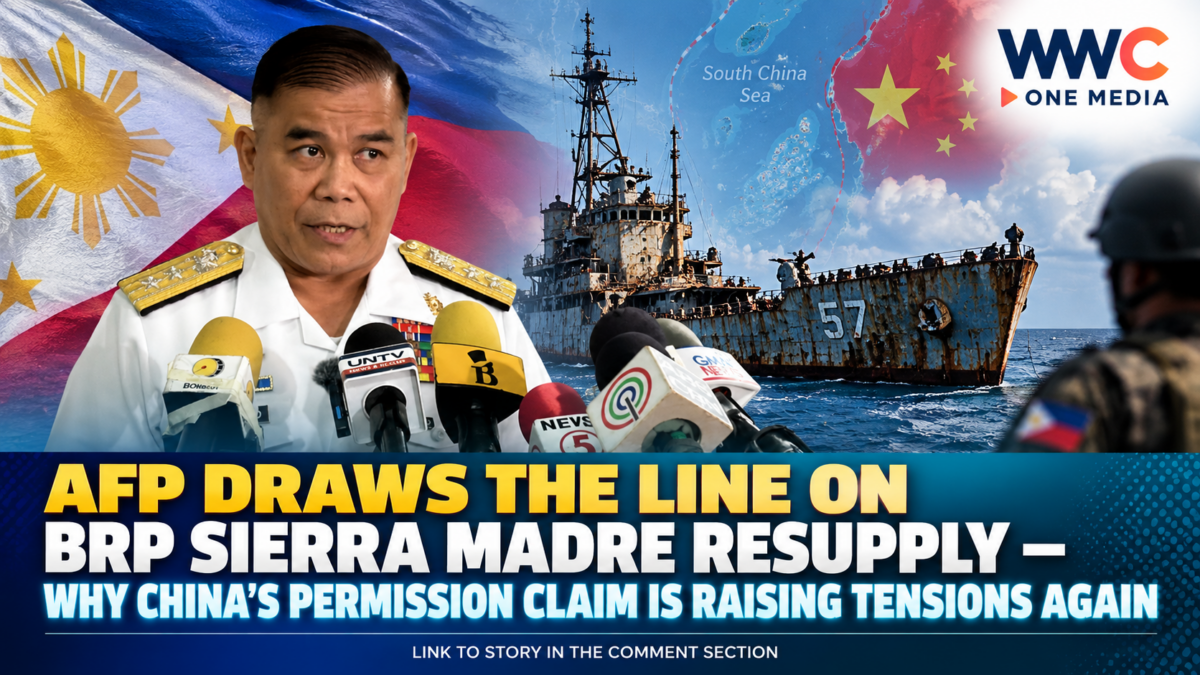
MANILA, Philippines — The Armed Forces of the Philippines (AFP) has reaffirmed that it does not need permission from China to resupply the BRP Sierra Madre, the Philippine Navy vessel stationed at Ayungin Shoal in the West Philippine Sea.
The military’s position underscores Manila’s continuing insistence that it has the right to sustain its personnel and carry out routine operations in waters where the Philippines exercises sovereign rights and jurisdiction.
The issue has gained renewed attention amid competing claims over the disputed maritime area and questions about the provisional understanding reached by Manila and Beijing in July 2024 to help manage resupply missions.
AFP: Philippine troops will not be abandoned
Rear Admiral Roy Vincent Trinidad, the AFP’s spokesperson for the West Philippine Sea, has stressed that resupplying the BRP Sierra Madre is part of the military’s responsibility.
The vessel is a commissioned Philippine Navy ship that has been grounded at Ayungin Shoal since 1999. It serves as a military outpost for Filipino personnel in a strategically important part of the South China Sea.
According to the AFP, supplying the troops, rotating personnel and ensuring their welfare are routine military duties that do not require approval from a foreign government.
In a report published by the Philippine News Agency on August 11, 2026, Trinidad reiterated that the Philippines would not abandon the vessel or Ayungin Shoal. He also said operational considerations determine when resupply and rotation missions take place.
The military’s position directly challenges China’s efforts to portray Philippine resupply operations as activities conducted with Beijing’s permission or under Chinese supervision.
Why China’s claims matter
China refers to Ayungin Shoal as Ren’ai Jiao and asserts sovereignty over the area as part of its broader claims in the South China Sea.
In May 2025, the China Coast Guard claimed it had allowed and supervised a Philippine resupply mission conducted on May 16. The AFP rejected that characterization, maintaining that the operation was lawful and did not depend on Chinese authorization.
GMA News and the Manila Bulletin reported the dispute, including the military’s position that the mission took place within the Philippines’ exclusive economic zone (EEZ).
The disagreement is significant because descriptions such as “permission,” “supervision” and “lawful resupply” carry different implications for how the two countries present their claims to domestic and international audiences.
Beijing’s statements do not, by themselves, establish that China has legal authority over the Philippine operation. Manila, for its part, continues to reject China’s assertion that its resupply missions require Chinese approval.
What does the 2024 provisional understanding actually say?
The Philippines and China reached a provisional understanding in July 2024 aimed at reducing misunderstandings and preventing escalation during rotation and resupply operations at Ayungin Shoal.
The arrangement followed a period of heightened tension, including a violent confrontation in June 2024 that injured Filipino personnel.
The Department of Foreign Affairs (DFA) has repeatedly clarified that the understanding is intended to help manage operational differences—not to surrender Philippine sovereign rights or give China authority over Philippine vessels.
In July 2026, the DFA again stressed that the arrangement does not require Manila to seek permission from Beijing, permit the boarding and inspection of Philippine vessels, or recognize Chinese jurisdiction over the area.
The DFA also said the understanding had facilitated multiple incident-free resupply missions since it was introduced. Philippine News Agency reporting in August 2026 cited the government’s account of 15 incident-free missions over the preceding two years.
The distinction is important: an arrangement intended to prevent confrontations at sea does not necessarily mean one side accepts the other’s territorial claims.
The 2016 arbitral ruling remains central
The dispute is also shaped by the 2016 South China Sea arbitral award, issued under the United Nations Convention on the Law of the Sea (UNCLOS).
The tribunal rejected the legal basis for China’s claims to historic rights over resources within the area encompassed by its expansive nine-dash line, where those claims exceeded the rights provided under UNCLOS.
The ruling also addressed the maritime status of features in the Spratly Islands, including Second Thomas Shoal, known in the Philippines as Ayungin Shoal.
The award did not decide sovereignty over land territory, nor did it draw a final boundary between the Philippines and China. Beijing has rejected the ruling, while Manila continues to invoke it in defending its maritime rights.
These legal distinctions matter because sovereignty over land features, sovereign rights in an EEZ and the legal status of a maritime feature are separate questions under international law.
Why BRP Sierra Madre remains a flashpoint
The BRP Sierra Madre has become one of the most prominent symbols of the Philippines’ presence in the West Philippine Sea.
Its location makes routine deliveries of food, fuel and other necessities a sensitive operation whenever Chinese vessels are present or attempt to interfere.
Although the 2024 understanding helped facilitate some resupply missions without incidents, it has not resolved the underlying territorial and maritime dispute. The two governments continue to disagree over the meaning of their arrangement and the legal basis of their respective claims.
For the Philippines, sustaining personnel aboard the vessel is both a practical military responsibility and an assertion of its maritime rights. For China, monitoring the area forms part of its enforcement of claims that Manila disputes.
What happens next?
The central question is whether both countries can maintain channels for managing resupply operations without further confrontation.
The AFP has maintained that its missions will continue, with their timing determined by operational requirements. The DFA’s position is that the provisional understanding must not be interpreted as a requirement for Chinese permission or as a concession of Philippine sovereignty and sovereign rights.
Ultimately, the dispute over the BRP Sierra Madre is not simply about who delivers supplies to a grounded ship. It reflects the wider struggle over maritime rights, international law and the risk of escalation in the West Philippine Sea.
As Manila and Beijing continue to assert conflicting positions, the conduct of future resupply missions—and how both sides respond at sea—will remain an important test of whether tensions can be managed peacefully.