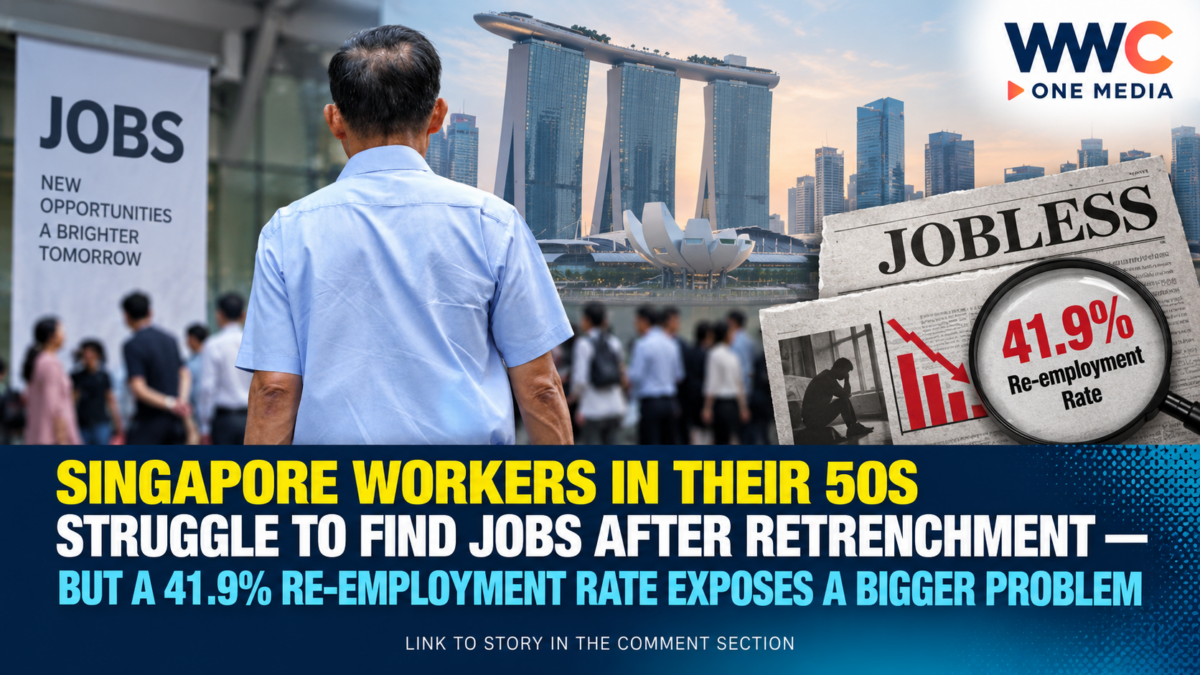
SINGAPORE — Losing a job in your 50s can mean more than losing a monthly salary. For some experienced professionals in Singapore, it has also meant months of unanswered job applications, difficult career changes and uncertainty over whether decades of expertise still carry the same value in today’s labour market.
A new Channel NewsAsia report published on October 22 highlights the growing difficulties facing retrenched workers in their 50s as Singapore experiences its highest quarterly retrenchment figures since late 2020.
The latest Ministry of Manpower (MOM) data reveal a worrying trend: only 41.9% of retrenched residents aged 50 to 59 found employment within six months in the second quarter of 2026, compared with 51.8% in the previous quarter.
That’s a decline of 9.9 percentage points.
The findings come as more companies restructure operations, change job requirements and adjust their workforce strategies.
While Singapore continues to have job vacancies, the experience of older workers suggests that available openings do not always translate into suitable opportunities for those who have lost long-established careers.
The bigger question is whether retraining and government employment programmes can help mature workers return to stable, meaningful jobs — or whether employers must change how they recruit and evaluate experienced applicants.
Key Figures: Singapore’s Growing Re-employment Challenge
SINGAPORE LABOUR MARKET — Q2 2026
Workers retrenched
4,620
Highest quarterly total since Q4 2020
Re-employed within 6 months, ages 50–59
41.9%
Down from 51.8%
Retrenchment incidence, ages 50–59
3.6
Per 1,000 resident employees
Overall 6-month re-entry rate
54.9%
Down from 60.7%
Source: Singapore Ministry of Manpower’s Q2 2026 Labour Market Report, as reported by CNA. Figures describe different labour-market measures and populations.
Fewer retrenched workers in their 50s find a job within six months
Six-month re-entry rates for Singapore residents aged 50–59, by reporting quarter.
0%15%30%45%60%Q1 2026Q2 2026
The six-month re-entry measure tracks the proportion of retrenched workers who returned to employment within six months. It does not mean that the remaining workers will never find another job.
A 59-Year-Old Director Loses His Job — and His Phone Stops Ringing
For 59-year-old Francis Lee, retrenchment arrived unexpectedly.
After more than three decades of working in a multinational packaging company, he lost his director-level position in February 2025 when the business underwent restructuring.
The transition was difficult.
Lee had spent much of his career managing professional responsibilities, maintaining client relationships and remaining available for colleagues.
Then the daily calls and messages stopped.
Despite his extensive experience, new applications brought almost no response. Over several months, he secured only one interview through a former colleague’s referral, but did not receive a job offer.
Lee took artificial intelligence courses to update his capabilities.
He also briefly tried working as a taxi driver, drawing on a licence he had acquired years earlier, but eventually concluded that the earnings and working conditions did not suit his longer-term plans.
In April 2026, he established a consultancy, APAC Edge, to offer business and workflow automation services. He subsequently gained training qualifications in September.
As of CNA’s report, he was developing a paid course and still seeking his first paying consultancy client.
His experience demonstrates a difficult reality: creating an alternative professional path after retrenchment may require additional time and financial resources, even for highly experienced workers.
CNA
More Than 400 Job Applications — Without a Single Interview
Another worker featured in CNA’s report, 53-year-old Rahmat Mohamad, experienced a similarly challenging return to employment.
He lost his creative production management job at the end of 2024 after his employer encountered business difficulties.
Determined to explore opportunities beyond his previous logistics career, Rahmat completed courses in desktop support engineering and data science.
He also participated in employment workshops and career consultations through Singapore’s support programmes.
But his efforts encountered an unexpected barrier.
After submitting more than 400 job applications, he did not receive a single interview.
He said that even when applicants completed relevant courses and obtained certifications, employers often demanded experience for entry-level positions.
Eventually, a personal referral helped him secure another logistics position in March 2026, more than a year after losing his job.
The position paid less than his previous work.
Rahmat continued pursuing training, eventually completing a professional diploma in data science in June.
His experience raises a difficult question for training programmes: if employers require prior experience even for entry-level jobs, how can mature career-switchers gain access to the practical experience they need?
A Successful Career Change After 30 Years in One Industry
Not all the experiences documented by CNA ended with prolonged unemployment or unsuccessful career transitions.
Doris Lim, 61, provides a different example.
After spending more than 30 years in the garment industry, she lost her merchandising job at age 59 when her employer relocated its back-office operations to Vietnam.
She initially tried finding another position in the same sector, but received little response.
After six months, she expanded her search beyond the industry where she had built her career.
Through a Career Conversion Programme, Lim secured a position with medical-device component manufacturer Cragar Industries.
She became a senior business and data analyst despite lacking previous experience in biomedical manufacturing.
Many of her existing skills proved transferable.
Her background in procurement, scheduling, supplier coordination and demand forecasting helped her adapt to the new role.
She also learned Microsoft Power BI and developed industry-specific technical knowledge.
The move involved a 10% to 20% pay reduction, but Lim viewed the new industry’s growth prospects as a positive longer-term opportunity.
Her experience suggests that structured training combined with an actual job placement can sometimes offer a more practical pathway than classroom learning alone.
Why Older Workers Are Finding It Harder to Return to Employment
Singapore’s labour market remains active, but hiring demand does not always match the experience and qualifications of displaced workers.
The MOM reported approximately 1.48 job vacancies for every unemployed person in June 2026.
Yet many retrenched professionals struggle to find suitable roles because of differences in required skills, salary expectations, industry experience and the availability of positions at their previous seniority.
Some older workers may also encounter age-related assumptions during recruitment.
However, the national statistics do not establish that every unsuccessful application is caused by age discrimination.
The situation is more complex.
Long-established professionals may need to demonstrate unfamiliar technical skills, compete for fewer senior positions or move into industries with different requirements.
Others may be willing to accept junior positions but face concerns from employers about compensation expectations or whether they will remain in the role.
The challenge is finding ways to connect experienced job seekers with employers prepared to assess their transferable abilities.
Singapore’s Retrenchment Rate Reaches Its Highest Since 2020
The difficulties facing mature workers come amid broader labour-market restructuring.
Singapore recorded 4,620 retrenchments during the second quarter of 2026, up from 3,830 in the previous quarter.
The affected sectors included manufacturing, information and communications, and financial services.
According to MOM, around three-quarters of the quarter’s retrenchments were linked to business reorganisation or restructuring.
The government has cautioned against assuming that artificial intelligence alone caused the increase.
In an October 6 parliamentary response, Acting Manpower Minister Jasmin Lau said it remained difficult to separate AI-related displacement from other forms of business transformation.
MOM’s surveys suggested that only a small minority of firms adopting AI had reduced staff numbers, while others were creating new positions or redesigning existing jobs.
The rise in retrenchments is confirmed; the claim that AI caused most of these job losses is not supported by the government’s available evidence.
Why Training Alone May Not Be Enough
The experiences of Lee, Rahmat and Lim show that taking courses does not guarantee another job.
Susana Harding, senior director at the International Longevity Centre Singapore, told CNA that informal training conducted during employment can be particularly valuable.
Such training allows employees to develop skills while solving actual workplace problems.
Research involving the centre and the Singapore University of Technology and Design also identified professional networks and practical competence as important factors influencing employability.
Meanwhile, Sahara Sadik of the Institute for Adult Learning highlighted the importance of contacts made during training, not just qualifications earned.
Training participation also varies by age.
In 2025, 44.5% of workers aged 50 to 64 participated in training, compared with approximately 60% among younger age groups.
Researchers cautioned that this difference reflects several factors, including education, occupation and workplace learning opportunities, rather than age alone.
How the Singapore Government Is Helping Retrenched Workers
Singapore provides several employment-support mechanisms for eligible job seekers.
| Programme or measure | How it can help |
|---|---|
| Career Conversion Programmes | Combine structured training with placements or employment in a different occupation or industry |
| SkillsFuture | Support eligible workers pursuing professional development and career-related training |
| SkillsFuture Jobseeker Support | Provide temporary financial support to qualifying involuntarily unemployed individuals who meet programme requirements |
| Workforce Singapore career services | Offer career coaching, job-matching support and access to participating employers |
| Employer-supported training | Help workers gain practical skills while performing actual job responsibilities |
Career Conversion Programmes can be particularly useful for workers changing industries because participating employers receive salary support while employees undergo structured training.
However, eligibility varies by programme, and participation does not guarantee a placement or permanent employment.
The Ministry of Manpower has also emphasized responsible retrenchment practices and targeted support for workers facing more difficult transitions.
What Happens to Salaries After Retrenchment?
Finding another job is only part of the challenge.
Some workers return to employment at lower salaries, especially when changing industries or accepting positions with different responsibilities.
In parliament on October 6, Acting Manpower Minister Jasmin Lau said approximately seven in ten retrenched resident professionals, managers, executives and technicians found employment within 12 months, rising to around eight in ten within 24 months.
Among those who returned to work, around six in ten earned more than before their retrenchment at both time intervals.
But for those who earned less, the median salary reduction was approximately 25%.
These figures refer to the specific retrenched professional group discussed in parliament, not every worker who loses a job.
The results demonstrate that re-employment can mean different things: some workers recover their earnings, while others make substantial financial compromises.
Why This Matters for the Philippines and Southeast Asia
Singapore’s experience offers lessons for other economies where experienced professionals are navigating restructuring, technological change and increased competition for jobs.
In the Philippines, similar challenges may arise when companies reorganize operations, move business functions or require new digital capabilities.
The issue is especially relevant to professionals seeking to change careers after spending decades in one industry.
Practical job placements, skills recognition and access to employer networks may help bridge the gap between completing training and receiving an actual job offer.
However, Singapore’s employment figures should not be treated as estimates of retrenchment or unemployment rates in the Philippines.
The Bigger Question: Are Companies Overlooking Experienced Workers?
Singapore’s latest labour-market figures show that economic growth and available job vacancies can coexist with serious difficulties for people who have been retrenched.
The experiences documented by CNA challenge the assumption that obtaining additional qualifications is always sufficient to secure employment.
For some mature job seekers, personal referrals, transferable skills and opportunities to learn on the job have proved more valuable than additional certificates alone.
That raises questions not only for workers and training providers, but also for employers designing recruitment processes.
The bottom line: The six-month re-employment rate for retrenched Singapore residents in their 50s fell to 41.9% in the second quarter of 2026. Government programmes provide important support, but many mature professionals still face lengthy job searches, difficult career changes and potential pay reductions.