SINGAPORE — Consumers in Singapore are keeping their smartphones for longer as rising handset prices fuel a shift toward repairs, refurbished devices and second-hand phone purchases.
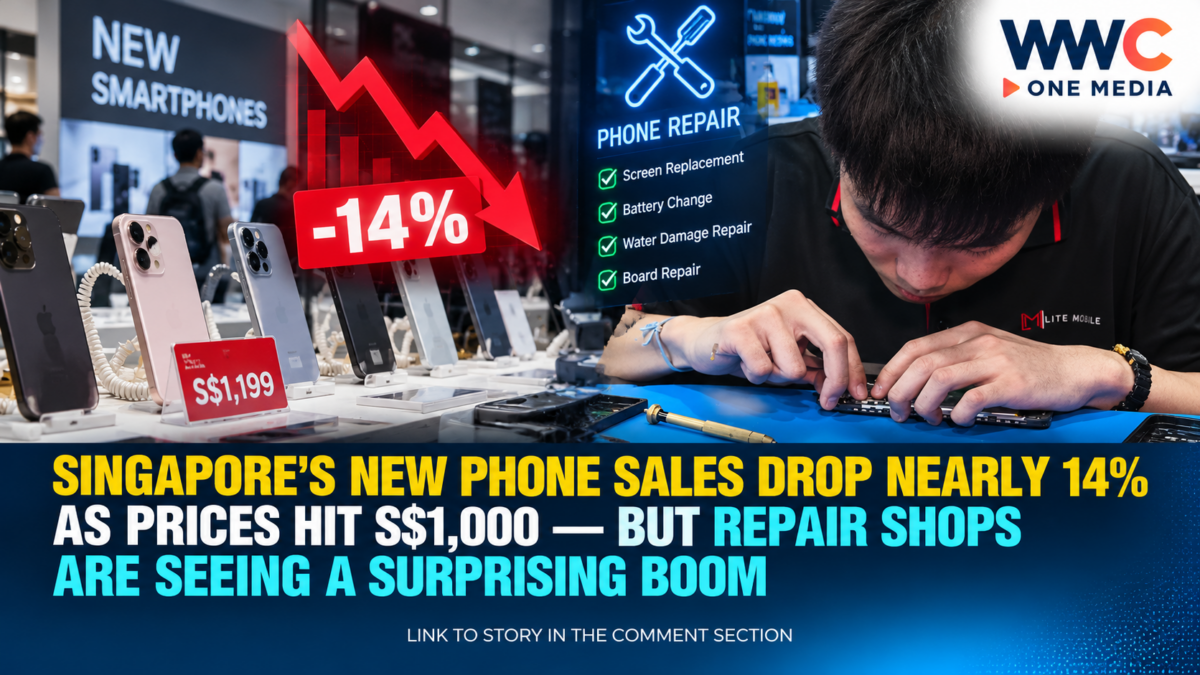
New figures from market research company NielsenIQ show that sales of new mobile phones fell nearly 14% between 2023 and 2025, dropping from 1.34 million to 1.16 million units.
At the same time, the average selling price of a mobile phone rose from S$898 in 2023 to approximately S$1,000 in 2026, an increase of nearly 12%.
The growing cost of replacing a device is changing purchasing habits.
Rather than buying a new phone every two to three years, many Singapore consumers are paying for battery replacements, screen repairs and other maintenance to extend the life of their existing devices.
Repair businesses are benefiting. So are second-hand phone traders and electronics recyclers.
But the trend also raises a larger question: Are consumers simply trying to save money, or is the smartphone industry entering a new era in which people upgrade far less frequently?
Singapore’s Smartphone Market: The Numbers Behind the Shift
SMARTPHONE MARKET — SINGAPORE, 2023–2026
Average new phone price, 2026
S$1,000
Up from S$898 in 2023
New handset sales
−14%
2023–2025, approximately
Typical phone replacement cycle
3–4 years
Previously around 2.5 years
Mister Mobile repair growth
+46%
2023–2025
Based on NielsenIQ market data and repair-business figures reported by CNA on October 22, 2026.
New mobile phone sales in Singapore are falling
Sales volumes from NielsenIQ, as reported by CNA.
0 million0.4 million0.8 million1.2 million1.6 million20232025Sales figures are in millions of units. The decline is approximately 13.4% using the reported rounded totals, described by CNA as nearly 14%.
Why Smartphone Prices Are Rising
Market research firm NielsenIQ reported that more than two-thirds of smartphones sold in Singapore in 2026 cost over S$1,000, compared with slightly more than half in 2023.
Louise Hawley, NielsenIQ’s Asia-Pacific managing director for technology and durables, said consumers are responding by keeping their devices longer.
The change does not necessarily mean everyone is buying the same type of phone at a higher price.
Average selling prices can increase because of a combination of more expensive models, changes in product mix and higher prices within particular market segments.
The figures nevertheless show that the typical purchase is becoming more expensive.
For consumers who do not urgently need a new camera, faster processor or different features, a battery replacement can look much more attractive than spending another S$1,000 on a replacement handset.
Phone Repair Shops Are Seeing a Major Business Boom
Two Singapore repair businesses featured in CNA’s reporting illustrate how the market is changing.
Litemobile handles between 4,000 and 5,000 phones each month across seven outlets.
Its most common repairs involve batteries, followed by screens and charging ports.
Company director Desmond Goi explained that customers frequently replace batteries after approximately two years and continue using their phones.
He also highlighted a longer-term limitation: older devices may eventually become incompatible with new operating-system updates, forcing users to consider replacements.
Meanwhile, Mister Mobile recorded a 46% increase in repair jobs between 2023 and 2025.
The company reported another 12% increase so far in 2026 and is now carrying out approximately 7,000 repairs each month.
Most devices brought in for servicing are three to five years old.
CEO Alan Tan said a simple battery replacement can sometimes extend a phone’s usable life by one or two additional years.
The Second-Hand Phone Market Is Expanding Too

Consumers are also buying and selling more used devices.
Mister Mobile reported that the number of second-hand phones it received rose 33% between 2023 and 2025.
The company now handles more than 10,000 phone trade-ins each month.
According to the retailer, around 95% of trade-in phones are resold, while the remaining 5% are sent for recycling.
These figures demonstrate how used smartphones can continue circulating through the market rather than being discarded when their first owners upgrade.
For budget-conscious consumers, refurbished or pre-owned handsets can provide access to higher-specification devices at a lower price than buying them new.
However, buyers should assess battery health, remaining software support, repair history, warranty terms and whether the device is locked to another account.
A lower purchase price is only a genuine saving when the phone remains functional and secure for a reasonable period.
The Environmental Impact: What Happens to Old Smartphones?
The changing market is also drawing attention to electronic waste.
Phones contain valuable and recoverable materials, including aluminium, copper and small quantities of precious metals.
At Singapore recycling company Virogreen, workers dismantle discarded mobile devices and separate batteries, screens and circuit boards.
The process allows suitable materials to be recovered rather than sending complete phones into the general waste stream.
Vincent Quck, a sustainability and recycling consultant with Virogreen, told CNA that approximately 80% to 90% of a phone’s materials can be recovered, depending on the model and construction.
That is a potential recovery range, not a guarantee that every phone achieves a 90% recycling rate.
Some materials are processed locally, while others are sent to specialised overseas refineries.
Material that cannot be recovered may ultimately require disposal.
Phone Recycling Volumes Are Rising
Virogreen reported that its collection volume for mobile phones during the first eight months of 2026 was 10.7% higher than the volume collected during all of 2025.
This is particularly notable because the 2026 period covers only eight months, compared with the full twelve months of the previous year.
However, the statistic refers to the recycler’s reported volumes, not a national recycling rate for all phones in Singapore.
Higher collections could reflect increased public awareness, the company’s own collection network or changes in the volume of devices reaching recycling facilities.
It would be inaccurate to conclude from this figure alone that Singapore’s total smartphone waste has increased by 10.7%.
What About Personal Data on Recycled Phones?
One important concern is the personal information stored on discarded electronic devices.
Smartphones can contain financial details, private photographs, messages, account information and other sensitive data.
CNA reported that Virogreen uses physical destruction procedures for circuit boards during its recycling process.
The boards are punctured with a hydraulic press and then shredded, according to the company, to prevent the recovery of stored information.
For consumers trading in or donating phones that will be reused, however, physical destruction is not appropriate because the device must remain operational.
Owners should instead follow the manufacturer’s data-removal instructions, back up important information, sign out of relevant accounts, disable device-locking features where appropriate and carry out a factory reset.
They should also remove physical SIM cards and check whether eSIM profiles need deletion.
Deleting individual photographs or apps is not a substitute for properly erasing a device before transferring ownership.
Singapore’s National Environment Agency recommends using designated e-waste collection channels for mobile phones that cannot be repaired or reused.
Why This Matters for the Philippines and Southeast Asia
The change in Singapore reflects a consumer question familiar across Southeast Asia: whether to spend on a brand-new smartphone or extend the life of an existing one.
In the Philippines, where smartphones are essential for communication, digital payments, work and education, affordable repairs and trustworthy second-hand devices can help consumers manage technology costs.
For repair shops and second-hand retailers, the Singapore findings also point to potential business opportunities in battery replacement, diagnostics, refurbishment and responsible recycling.
However, Singapore’s reported 14% decline in new handset sales should not be treated as a measured decline in Philippine phone sales. Consumer incomes, pricing and market conditions differ.