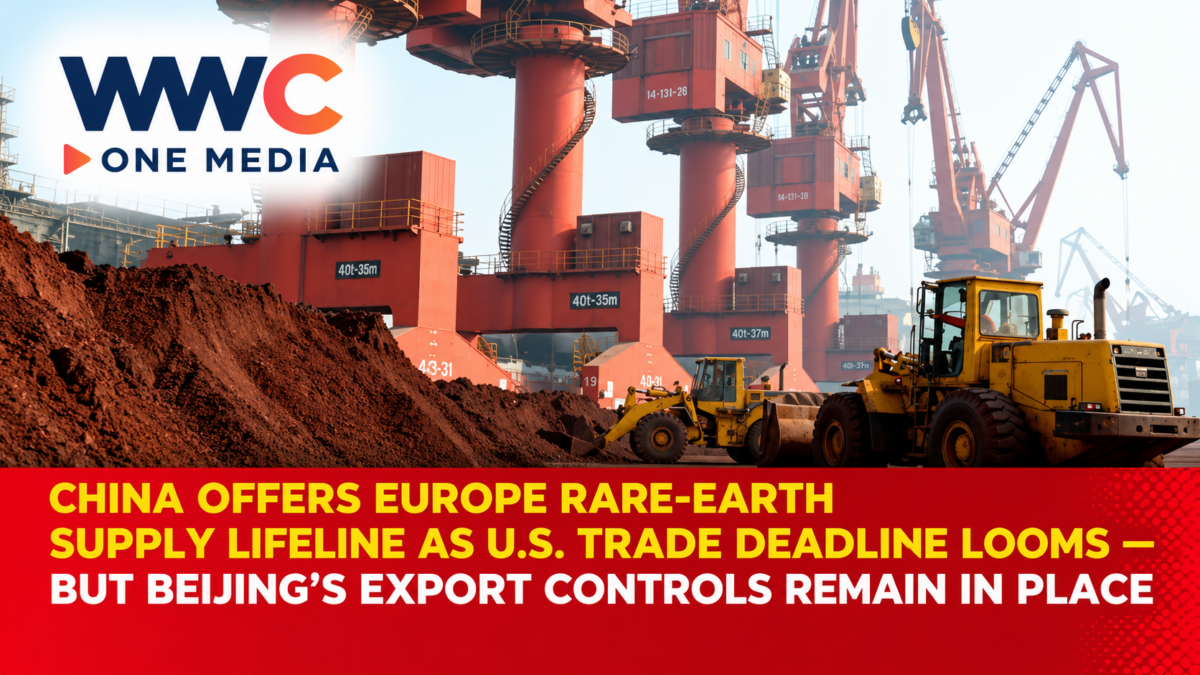
BEIJING — China is signaling that it will continue facilitating rare-earth export approvals for European companies, offering potential relief to industries dependent on critical minerals even as trade tensions with the United States threaten to intensify.
The announcement highlights Beijing’s efforts to manage its economic relationship with the European Union separately from its increasingly complicated trade negotiations with Washington.
On October 15, Chinese Commerce Ministry spokesperson He Yadong said Beijing was prepared to continue facilitating export licenses for rare earths destined for the European Union.
However, China also called on European authorities to help resolve important export licensing issues affecting Chinese companies seeking access to controlled dual-use technologies.
The development could provide greater supply-chain predictability for European manufacturers of electric vehicles, wind turbines, industrial equipment and defense systems.
But the central question remains whether China’s willingness to approve licenses will translate into sufficiently reliable deliveries.
CHINA SIGNALS CONTINUED RARE-EARTH EXPORTS TO EUROPE
According to CNBC’s October 15 report, China indicated it was willing to keep approving rare-earth exports to Europe even if its trade truce with the United States reaches its January deadline without a new agreement.
The development followed discussions between Chinese and European trade officials aimed at easing restrictions affecting critical materials and industrial technologies.
At a regular news conference, Chinese Commerce Ministry spokesperson He Yadong confirmed Beijing’s willingness to continue facilitating the approval of rare-earth export licenses for European customers.
The statement was also reported by China’s official Xinhua news agency.
However, Beijing’s position did not amount to the removal of existing export controls.
European companies must still comply with applicable licensing requirements.
The distinction is critical.
A commitment to facilitate licenses can help reduce uncertainty, but it is not equivalent to unrestricted exports or a guarantee that every application will be approved.
WHY RARE EARTHS ARE SO IMPORTANT
Rare earths are a group of 17 chemical elements used in numerous advanced technologies.
Some are essential to the production of powerful permanent magnets found in electric vehicle motors, wind turbines, industrial machinery and other electronic systems.
Rare-earth materials also have applications in aerospace, telecommunications and defense technology.
Although rare-earth deposits exist in multiple countries, China holds a dominant position in the global processing and magnet manufacturing supply chain.
This gives Beijing significant influence over the availability of materials required by industries around the world.
European manufacturers are particularly concerned about access to specialized materials used in advanced motors and precision equipment.
Delays or shortages can disrupt production schedules, increase costs and complicate long-term investment decisions.
The strategic importance of rare earths has therefore made export licensing a major issue in international trade negotiations.
EUROPE AND CHINA SEEK TO EASE TRADE TENSIONS
China’s latest announcement followed high-level discussions in Beijing on October 8 and 9.
EU Trade Commissioner Maroš Šefčovič and Chinese Commerce Minister Wang Wentao discussed several trade issues, including rare-earth supplies, export controls and vehicle imports.
The discussions produced an understanding intended to improve the predictability of export licensing.
One element involved a fast-track process, commonly described as a green channel, for applications involving rare earths and permanent magnets destined for European customers.
The arrangement is intended to reduce delays that have affected manufacturers dependent on Chinese materials.
However, the discussions did not eliminate the broader disagreements between Beijing and Brussels.
Trade tensions remain over industrial competition, market access, export restrictions and the European Union’s large trade deficit with China.
For both sides, maintaining access to critical products has become increasingly important.
BEIJING SEEKS RECIPROCAL ACCESS TO EUROPEAN TECHNOLOGIES
China’s willingness to facilitate rare-earth exports comes with a request for reciprocal cooperation.
The Chinese Commerce Ministry wants European authorities to help resolve licensing applications involving dual-use technologies destined for Chinese customers.
Dual-use products are goods, software or technologies with potential civilian and military applications.
Because of their possible security implications, they may be subject to export restrictions.
European authorities must balance legitimate commercial interests with their security and regulatory responsibilities.
This makes reciprocal licensing a sensitive issue.
For Beijing, improved access to controlled industrial technologies is part of its broader trade objectives.
For Brussels, securing rare-earth supplies must be balanced against concerns about sensitive technology transfers.
The negotiations demonstrate how critical minerals and advanced industrial technology have become closely connected in modern trade diplomacy.
CHINA’S RARE-EARTH EXPORTS RECOVER IN SEPTEMBER
Fresh customs figures suggest that China’s rare-earth exports recovered in September, although the broader annual trend remained weaker.
Reuters reported on October 14 that China exported 4,269.8 metric tons of rare earths during September 2026.
That represented a 6.7% increase from approximately 4,000 metric tons in September 2025.
However, exports fell 9.8% compared with August’s 4,735 metric tons.
For the first nine months of 2026, China’s rare-earth exports totaled approximately 43,711 metric tons, down 9.6% from the corresponding period a year earlier.
These figures illustrate the mixed conditions affecting the market.
A recovery in one month’s exports does not necessarily establish that supply disruptions have ended.
Licensing requirements, market demand and geopolitical conditions can continue influencing trade flows.
RARE-EARTH MAGNET SHIPMENTS TO EUROPE SURGE 20.5%
More recent data reported by the South China Morning Post on October 20 showed that Chinese exports of rare-earth permanent magnets to the European Union increased significantly in September.
Shipments reached 2,454 metric tons, representing a 20.5% rise from August.
That was the highest monthly level since February 2026.
The rebound came as Beijing and Brussels engaged in negotiations intended to ease tensions over export licensing and market access.
The improvement provides evidence that physical shipments to European customers increased during the reporting period.
However, it does not establish that all licensing delays have been resolved.
Some manufacturers may continue facing difficulties obtaining specific materials, including specialized magnet products required for particular industrial applications.
EUROPE REMAINS VULNERABLE TO SUPPLY DISRUPTIONS
The European Union has spent years seeking to reduce its dependence on concentrated sources of critical raw materials.
The challenge became particularly visible after China introduced export licensing requirements covering selected rare-earth elements and related products in April 2025.
European manufacturers reported delays in obtaining approvals, raising concerns about production continuity.
A European Court of Auditors report published in 2026 examined the European Union’s dependence on imported critical raw materials and the challenges associated with diversifying supply chains.
The report highlighted difficulties experienced by companies attempting to secure Chinese export licenses.
Those problems helped demonstrate how administrative restrictions can affect industrial operations even without a comprehensive export ban.
For manufacturers, delays can be particularly disruptive when critical components are required to complete production.
REUTERS: EUROPE LOOKS TO VIETNAM FOR ALTERNATIVE SUPPLIES
The European Union is also exploring closer cooperation with other countries possessing strategically important mineral resources.
Reuters reported on October 14 that Brussels was considering expanded cooperation with Vietnam involving critical minerals.
Vietnam has significant potential resources, including rare earths, tungsten, antimony and other industrial materials.
The EU is examining ways to strengthen mining, processing and supply-chain partnerships as part of efforts to reduce dependence on China.
However, developing alternative sources is neither immediate nor guaranteed.
Rare-earth projects require mining expertise, processing facilities, substantial financing, environmental approvals and access to specialized technology.
Even countries with significant mineral deposits may need years to develop competitive processing industries.
For Europe, diversification represents a long-term strategic goal rather than an immediate replacement for Chinese supplies.
THE EUROPEAN UNION FACES A MUCH BIGGER TRADE DISPUTE
Rare-earth licensing is only one part of the complex economic relationship between China and Europe.
Reuters reported on October 15 that European leaders were considering stronger responses to Chinese industrial competition and widening trade imbalances.
The EU faces a substantial merchandise trade deficit with China, while European manufacturers have expressed concerns about competition from lower-priced imports.
The automotive industry has become a particularly sensitive area.
China and the EU have held discussions involving restrictions on Chinese hybrid vehicle imports, reflecting broader disagreements about market access and industrial competition.
These negotiations create both pressure and incentives for compromise.
China has an interest in maintaining access to European customers, while European companies need reliable supplies of critical components.
The result is an increasingly complicated relationship involving cooperation in some areas and confrontation in others.
WHY EUROPE MATTERS TO CHINA’S EXPORT ECONOMY
Europe remains an important market for Chinese manufacturers.
As Chinese companies encounter trade restrictions in various international markets, maintaining commercial relationships with European buyers has become increasingly valuable.
The Wall Street Journal reported in October that Beijing faces growing pressure to preserve its access to Europe’s large consumer and industrial markets.
China’s domestic economy has also faced difficulties associated with weak demand and challenges in its property sector.
Strong export performance has helped support economic growth.
Maintaining cooperation with Europe could therefore serve several Chinese economic objectives.
However, commercial incentives do not eliminate geopolitical tensions.
Beijing continues to use export licensing and industrial policy as instruments of economic governance, while European governments seek to protect strategic industries and reduce supply vulnerabilities.
WHAT THIS MEANS FOR GLOBAL AUTOMAKERS AND TECHNOLOGY COMPANIES
A more predictable rare-earth supply could benefit companies across several industries.
Electric vehicle manufacturers depend on rare-earth magnets for certain motor designs.
Wind turbine producers use permanent magnets in some generator technologies.
Electronics and industrial equipment manufacturers also require specialized magnetic components.
If export approvals become more efficient, companies may experience fewer delays in sourcing materials.
However, prices and availability depend on broader market conditions.
Manufacturers must still consider supplier concentration, shipping costs, regulatory requirements and changes in demand.
Companies may continue investing in alternative materials, recycling and diversified sourcing even if Chinese export licensing becomes more predictable.
WHY THIS MATTERS FOR ASIA AND THE PHILIPPINES
The rare-earth dispute also has implications for Asian supply chains.
Japan, South Korea, Taiwan and Southeast Asian manufacturing economies depend on various imported minerals and components used in advanced electronics and industrial production.
Changes in China’s export controls can influence costs, sourcing strategies and production planning across the region.
For the Philippines, the issue is relevant to the country’s electronics manufacturing and semiconductor-related industries.
Although not every Philippine electronics company directly imports Chinese rare earths, the country participates in international supply chains that may be affected by disruptions involving critical materials.
There may also be longer-term opportunities for regional cooperation in mineral processing, component manufacturing and supply-chain diversification.
However, these opportunities depend on commercial investment, technical capabilities and appropriate environmental safeguards.
THE BIGGER QUESTION: CAN EUROPE TRUST THE NEW SUPPLY ARRANGEMENT?
China’s willingness to facilitate rare-earth exports represents a potentially important development for European manufacturers.
The September increase in magnet shipments suggests that trade flows have improved.
But significant uncertainties remain.
The licensing system continues to operate.
China is seeking reciprocal treatment for selected dual-use export applications.
And broader disagreements over industrial competition and trade imbalances remain unresolved.
For Europe, the immediate objective is obtaining reliable deliveries.
The longer-term challenge is developing supply chains that are less vulnerable to disruption.
For China, the balancing act involves preserving commercial relationships while maintaining control over strategically important materials.
Beijing’s latest assurances may ease some European supply-chain concerns, but they do not eliminate China’s ability to regulate critical mineral exports.
And as global manufacturers search for more dependable supplies, one question remains:
Will China’s promise of continued rare-earth licensing become a lasting foundation for cooperation with Europe — or could future trade disputes once again put some of the world’s most important industries at risk?