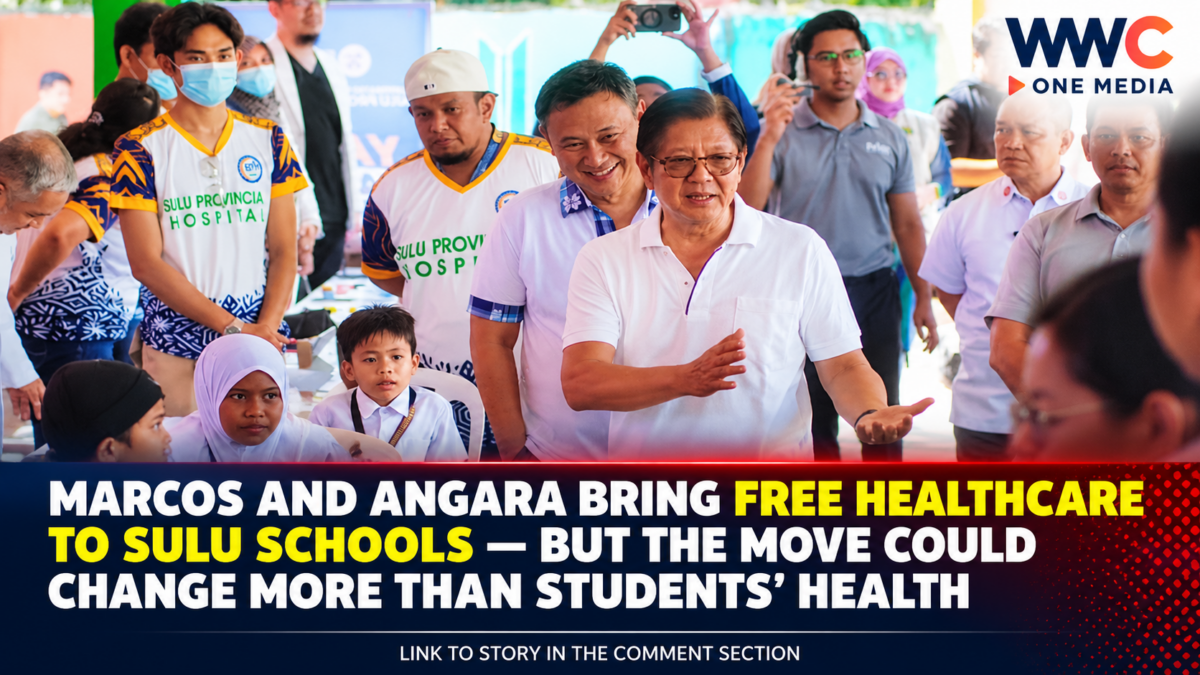
President Ferdinand “Bongbong” Marcos Jr. and Education Secretary Juan Edgardo “Sonny” Angara have brought government healthcare services closer to students, teachers, and families in Sulu through the rollout of the Yaman ng Kalusugan Program (YAKAP) health caravan.
The initiative, held at Kawmpang Elementary School in Patikul on October 20, 2026, delivered free medical services to school communities, including participants from Martirez Elementary School in Jolo. The activity forms part of the government’s effort to improve access to primary healthcare while strengthening support for education in the province.
But the event was about more than bringing doctors and medicines to a school. It also coincided with a significant administrative transition for Sulu’s education system as its Schools Division Office formally integrated into the Department of Education’s Region IX, or the Zamboanga Peninsula.
More than 1,600 people reached by the health caravan
According to reports from GMA News and the Philippine Information Agency, approximately 1,600 students, parents, and teachers benefited from the caravan.
The Philippine News Agency reported that around 1,280 students, parents, and teachers from Kawmpang Elementary School participated, while another 366 participants came from Martirez Elementary School in Jolo. These figures indicate the reach of the initiative across the two school communities.
The services offered included:
- Medical examinations and initial health assessments
- Primary healthcare consultations
- Dental checkups and services
- Vision and mental health screenings
- PhilHealth registration and related assistance
- Distribution of free medicines
The caravan was designed to make basic healthcare more accessible to families who might otherwise need to travel to health centers or hospitals for initial consultations and screening.
Why school-based healthcare matters
Health problems can directly affect a child’s ability to learn. Poor eyesight, hearing difficulties, untreated dental conditions, malnutrition, and developmental concerns may interfere with classroom participation, attendance, and academic performance.
The Philippine News Agency reported that the school-based YAKAP initiative is intended to help identify these concerns early and refer students who need further medical attention to appropriate healthcare providers. It also complements the government’s school feeding and Academic Recovery and Accessible Learning (ARAL) programs.
By bringing preventive care into school communities, the government hopes to reduce barriers to basic medical services and help children receive attention before health problems become more serious.
What is YAKAP, and who can benefit?
YAKAP stands for Yaman ng Kalusugan Program. It is PhilHealth’s primary healthcare initiative designed to encourage preventive care, early detection of illnesses, and access to essential medical services.
According to PhilHealth, the program includes primary care consultations, medically indicated laboratory and diagnostic tests, eligible medicines through its GAMOT benefit, and outpatient cancer screening services. The availability of specific services depends on the program’s rules and applicable medical requirements.
Although the Sulu caravan focused on school communities, the broader YAKAP program serves eligible PhilHealth members and dependents nationwide. People seeking continued care should check registration requirements and available benefits through PhilHealth’s official channels.
Official reference: PhilHealth YAKAP program and benefits.
Sulu’s education system faces a major administrative transition
The health caravan also took place during a significant change in the province’s governance and education administration.
In 2024, the Supreme Court ruled that Sulu was not part of the Bangsamoro Autonomous Region in Muslim Mindanao (BARMM). The government subsequently moved to integrate the province into Region IX, or the Zamboanga Peninsula.
The transition has important implications for public education, including staffing, administrative oversight, and the continuity of services for teachers and students.
The Manila Standard and other reports were not independently verified in this research; however, the Daily Tribune reported on October 20 that the government had approved 84 non-teaching plantilla positions for Sulu’s Schools Division Office. DepEd Region IX was tasked with overseeing recruitment and appointments, with qualified personnel already serving under the former administrative arrangement to be prioritized, subject to Civil Service Commission rules.
Marcos has also assured residents that the government intends to manage the transition without interrupting public services. This makes continuity of education and the welfare of affected personnel important issues to watch alongside the healthcare rollout.
The bigger question: Will the services continue after the caravan?
The rollout represents a concrete effort to bring medical services closer to communities in Sulu. However, a one-day health caravan and a long-term primary healthcare system are not the same thing.
The lasting impact will depend on whether beneficiaries can access follow-up consultations, appropriate referrals, medicines, and continuing care after the event. School-based health programs will also need coordination among education officials, PhilHealth, healthcare providers, parents, and local authorities.
The October 20 caravan brought immediate services to more than 1,600 people, according to government and media reports. The next important measure of success will be whether the initiative translates into sustained access to healthcare for students, teachers, and families.
For now, the rollout combines two public-service priorities: improving access to preventive healthcare and ensuring that Sulu’s education services continue during a major administrative transition.