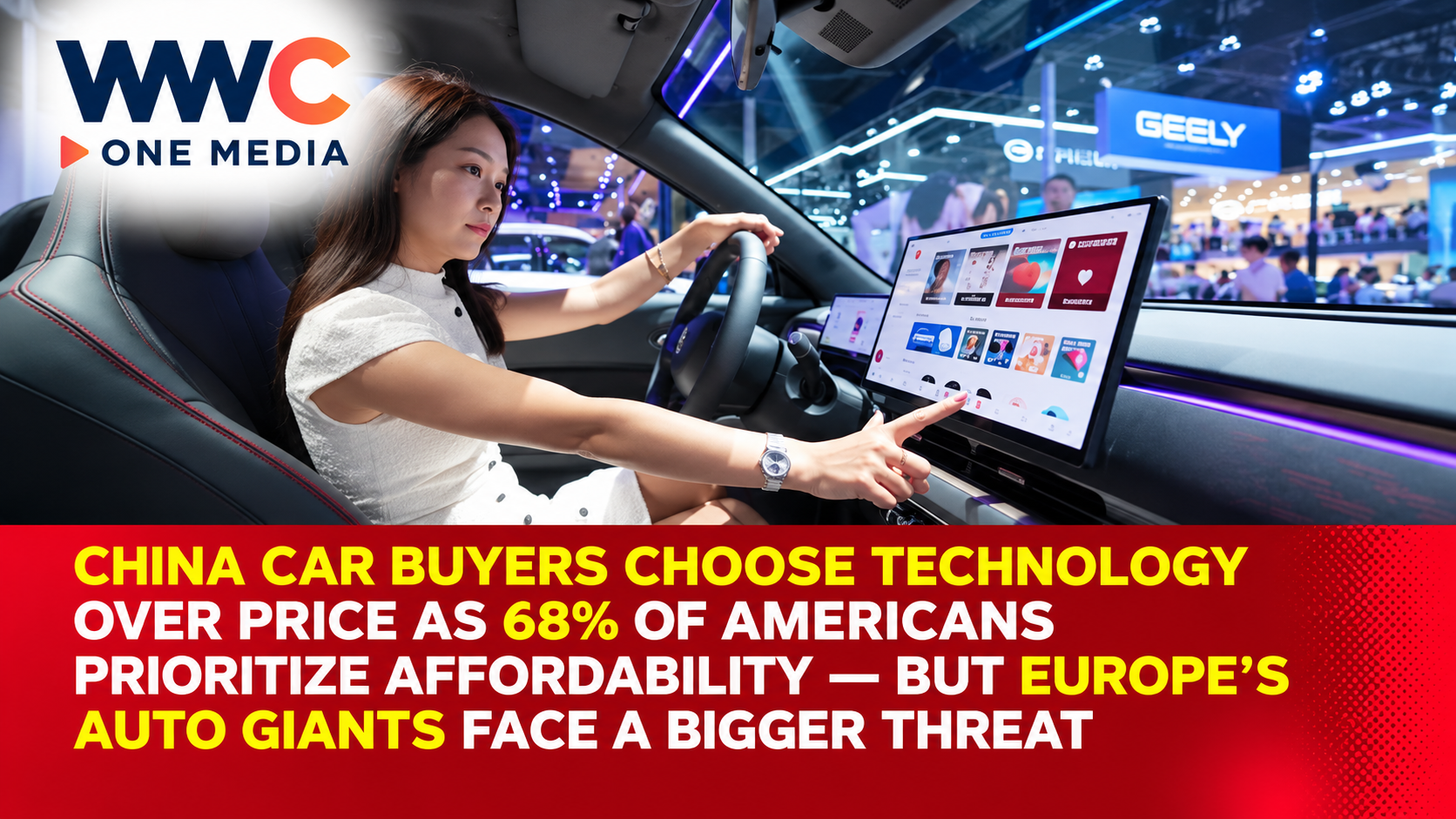
MANILA, Philippines — The global automotive industry is facing a dramatic shift in consumer preferences, with Chinese motorists increasingly choosing cars for their advanced technology while buyers in the United States and Europe continue to put affordability first.
A new worldwide study by management consulting firm Bain & Company found that 68% of American buyers and 62% of European buyers identify price as a leading consideration when purchasing a vehicle, while 58% of Chinese respondents prioritize technology and vehicle features.
The findings, based on responses from more than 12,000 prospective car buyers across 11 markets, reveal a fundamental difference in how consumers assess the next generation of automobiles.
For traditional automotive giants such as Volkswagen, Toyota, BMW, Mercedes-Benz and General Motors, the changing preferences present an important strategic challenge.
Manufacturers can no longer assume that brand recognition, mechanical performance and traditional luxury features will be enough to attract buyers in every major market.
Instead, technology such as artificial intelligence, advanced driver assistance, digital displays, connected software and electric powertrains is becoming increasingly influential.
But as Chinese brands expand into Europe with competitively priced, technology-rich vehicles, the bigger question is whether established automakers can preserve their dominance in a market where the definition of automotive value is rapidly changing.
Price Still Rules in America and Europe
Despite the industry’s growing focus on electric vehicles and advanced software, affordability remains the leading purchasing consideration for many Western consumers.
Bain’s Global Automotive Consumer Survey found that 68% of respondents in the United States cited price as a major consideration when choosing a car.
In Europe, the figure reached 62%.
These results suggest consumers in both markets remain sensitive to vehicle purchase prices, financing costs and the overall financial burden of ownership.
For automakers, the findings create pressure to introduce models that offer attractive technology without becoming unaffordable.
Manufacturers investing heavily in electrification and digital technology must also consider whether buyers are prepared to pay more for those features.
A vehicle may offer sophisticated software, extensive connectivity and advanced driver assistance, but those capabilities may not be sufficient if its price exceeds a buyer’s budget.
The findings reinforce why manufacturers are placing renewed emphasis on affordable electric vehicles, competitive financing and lower-cost model ranges.
China Has a Different Priority: Advanced Vehicle Technology
Chinese consumers demonstrate a notably different set of preferences.
According to Bain, 58% of respondents in China identified technology and features as a leading factor in vehicle selection, placing them ahead of price.
The result reflects the rapid transformation of China’s automotive industry into a highly competitive market for electric vehicles and intelligent mobility.
Domestic manufacturers including BYD, Geely, Xpeng and Nio have invested heavily in vehicle software, digital interfaces, battery technology and advanced driving assistance.
Many Chinese vehicles now emphasize large infotainment screens, voice assistants, connected applications, over-the-air software updates and increasingly sophisticated driver-support systems.
As these capabilities become more widely available, consumers may begin treating features once associated with expensive luxury vehicles as expected equipment.
That raises expectations for manufacturers competing in China.
However, the survey does not establish that Chinese buyers disregard affordability or that technology is the most important consideration for every individual customer.
It shows that technology and features rank ahead of price among the surveyed Chinese consumers.
More Than 12,000 Buyers Reveal a New Automotive Landscape
Bain surveyed more than 12,000 respondents across 11 markets: Canada, the United States, the United Kingdom, Germany, France, Italy, the United Arab Emirates, China, India, Indonesia and Japan.
The research examined purchasing priorities, brand preferences, electric vehicle adoption, dealership behavior, artificial intelligence and interest in autonomous driving.
One major finding was the declining strength of traditional automotive brand loyalty.
More than one-third of consumers surveyed in Western markets indicated openness to considering new automotive brands.
The results suggest that established manufacturers can no longer depend entirely on their historical reputations to retain customers.
For emerging companies, particularly Chinese manufacturers expanding internationally, that creates an opportunity to attract buyers with competitive prices, attractive designs and technological capabilities.
But interest in a new brand does not automatically translate into a completed purchase.
Consumers may still consider vehicle safety, reliability, resale value, service availability and long-term ownership costs before committing.
Chinese Automakers Are Taking Their Technology Advantage to Europe
The survey arrives as Chinese manufacturers intensify their European expansion.
According to Reuters’ October 16 reporting from the Paris motor show, brands including BYD’s Denza, Geely’s Zeekr and Changan’s Avatr are attempting to enter Europe’s premium vehicle segment with an emphasis on intelligent luxury.
Their strategy challenges the traditional dominance of German manufacturers such as BMW, Mercedes-Benz and Audi.
Rather than competing primarily on long-established heritage and prestige, Chinese entrants are presenting advanced software, driver assistance, fast charging and premium cabin technology as their defining strengths.
The shift places pressure on European automakers to defend their market positions through innovation as well as brand recognition.
However, the challenge should not be exaggerated.
European manufacturers retain substantial strengths in engineering, dealership networks, brand reputation and customer relationships.
Chinese brands must still overcome concerns about reliability, data security, after-sales service and residual values.
Their long-term success will depend on whether customers view the overall ownership experience as competitive, not simply whether the vehicles appear technologically impressive.
Research Shows Europeans Are Becoming More Open to Chinese Cars
Additional research from McKinsey & Company supports the view that European consumer attitudes toward Chinese automakers are changing.
In its 2026 mobility research, McKinsey found that European buyers increasingly associate Chinese brands with advanced electric vehicle technology and value for money.
Among surveyed European respondents, 54% identified Chinese manufacturers as leaders in battery electric vehicle technology, while 40% associated them with leadership in plug-in hybrid technology.
Nevertheless, purchase interest varied significantly between markets.
Consumers in the United Kingdom showed greater openness toward Chinese brands than those in Germany.
Younger buyers, current electric vehicle owners and some premium-segment customers were particularly receptive.
McKinsey also highlighted persistent concerns about brand familiarity, servicing networks, quality and data privacy.
These findings reinforce a central lesson for manufacturers: strong technological perceptions can attract interest, but trust and reliable support are necessary to convert that interest into sales.
Artificial Intelligence Is Changing How People Shop for Cars
Technology is influencing automotive purchasing decisions even before consumers enter a showroom.
Bain found that more than 80% of respondents globally combine online and offline channels when researching and purchasing a vehicle.
More than six in ten begin their buying journey online.
Artificial intelligence is also becoming part of that process.
In Indonesia, more than 90% of surveyed buyers reported using AI during their car-buying journey, while adoption in China approached 80% across age groups.
Among younger buyers, AI adoption has also become significant in Europe, the United States and Japan.
Consumers can use AI-powered services to research vehicles, compare specifications, understand financing options and evaluate competing models.
However, the adoption figures measure AI use during the purchasing process, not necessarily ownership of AI-equipped vehicles.
That distinction matters because using an AI assistant to compare cars is different from purchasing a vehicle with advanced AI capabilities.
For manufacturers and dealerships, the growing use of online research means accurate product information and transparent comparisons are becoming increasingly important.
Dealerships Still Matter Despite the Digital Revolution
Although consumers are researching vehicles online, traditional dealerships remain important.
Bain found that approximately nine out of ten respondents still completed their car purchases offline.
More than half of buyers in Europe, China and the United States reported at least two dealership interactions during the buying process.
The findings indicate that consumers continue to value physical inspection, test drives, personal consultations and direct discussions before purchasing an expensive product.
Automakers must therefore balance digital sales channels with effective physical retail networks.
In China, consumers were particularly open to online purchasing, with more than 80% willing to consider completing a vehicle transaction digitally.
However, willingness to buy online should not be confused with the share of buyers who actually complete transactions through digital channels.
The global automotive market is becoming more digital, but physical dealerships have not become obsolete.
Electric Vehicle Adoption Still Faces Price and Charging Barriers
The transition to electric vehicles remains uneven across regions.
Bain found that younger consumers are generally more interested in battery electric vehicles, while Chinese consumers demonstrate broad interest across age groups.
However, many buyers in Europe and the United States remain reluctant to pay a premium for an electric vehicle compared with an equivalent gasoline-powered model.
Around six in ten respondents in these regions said they were unwilling to pay more for an electric car.
Charging time was another concern, identified by almost half of surveyed consumers.
These barriers illustrate why affordable pricing and convenient charging infrastructure remain essential for electric vehicle adoption.
The survey also found that consumers who had already test-driven a battery electric vehicle were up to 2.2 times more willing to consider purchasing one.
That finding suggests direct experience can help buyers understand the technology and overcome uncertainty.
However, the relationship is an association rather than proof that test drives alone cause higher purchase interest.
Autonomous Driving Could Become the Next Brand Loyalty Disruptor
Advanced driver-assistance and automated-driving systems represent another important area of competition.
Bain found that 84% of Chinese respondents would consider buying a vehicle capable of at least Level 3 automated driving.
In Europe, that figure was 47%, while the United States recorded 40%.
Level 3 automation permits a vehicle to perform certain driving tasks under specified operating conditions while requiring the driver to regain control when requested.
It is not the same as unrestricted, fully driverless operation.
The substantial difference in consumer interest suggests that manufacturers may need to develop different technology and marketing strategies for different markets.
In China, advanced driving capabilities may increasingly influence brand switching.
In Europe and the United States, automakers must also address consumer confidence, regulation and the willingness to pay for the technology.
Importantly, survey interest does not establish that Level 3 systems are legally available or technically supported in every market or vehicle model.
Europe’s Carmakers Face a Two-Front Challenge
Traditional European manufacturers face competing pressures.
They must continue developing advanced technology to remain competitive with Chinese automakers.
At the same time, many of their domestic customers remain focused on vehicle affordability.
This creates a difficult balancing act.
Investments in software, batteries, electronics and electrification can increase development costs, while consumers may resist higher prices.
The Financial Times reported in October that European automakers are responding partly by reviving familiar small-car designs in more affordable electric formats.
Manufacturers such as Renault, Volkswagen and Stellantis are seeking to combine recognizable brands with updated technology and competitive prices.
The approach reflects an attempt to meet both priorities: modern innovation and household affordability.
Meanwhile, Chinese manufacturers continue entering European markets with a range of electric, hybrid and premium vehicles.
For Europe’s established carmakers, the strategic challenge is not simply to match Chinese technology but to deliver it at prices consumers are willing to pay.
What This Means for Filipino Car Buyers
Although the Bain survey did not include the Philippines as a surveyed market, the findings raise relevant questions for the country’s automotive industry.
Filipino consumers have an expanding selection of vehicles from Japanese, Korean, American, European and Chinese manufacturers.
The growth of Chinese automotive brands has added alternatives across gasoline, hybrid, plug-in hybrid and battery electric vehicle categories.
However, the priorities identified in the United States, Europe and China cannot automatically be applied to Filipino buyers.
Local purchasing decisions depend on financing costs, vehicle prices, fuel expenses, insurance, road conditions, charging infrastructure, servicing networks and resale values.
Advanced technology can offer meaningful benefits, but consumers must also consider the availability of qualified repair services, replacement parts and manufacturer support.
For Philippine motorists comparing established brands with newer entrants, the most important question is whether the complete ownership proposition justifies the purchase.
A lower advertised price or longer list of digital features does not necessarily produce the lowest long-term ownership cost.
The Bigger Question: Can Traditional Automakers Keep Their Dominance?
The global car market is entering a period of intense change.
American and European consumers continue prioritizing price, Chinese buyers increasingly emphasize technology, and younger buyers across several markets are using AI to research their options.
Meanwhile, Chinese manufacturers are taking their technological expertise into European markets traditionally dominated by long-established brands.
The emerging competition could encourage manufacturers to offer better features, more affordable electric vehicles and improved digital services.
But it also creates difficult choices.
Automakers must decide how to balance manufacturing costs, software development, safety, customer trust and affordability.
For consumers, the ultimate winner may be the company that provides the strongest combination of price, reliability, technology and long-term ownership support.
China’s car buyers are helping push the industry toward a technology-driven future, while motorists in Europe and America continue demanding affordable vehicles. But as Chinese manufacturers challenge the world’s biggest auto brands, the real question is whether traditional giants can adapt before a new generation of connected, intelligent cars changes the global automotive hierarchy.