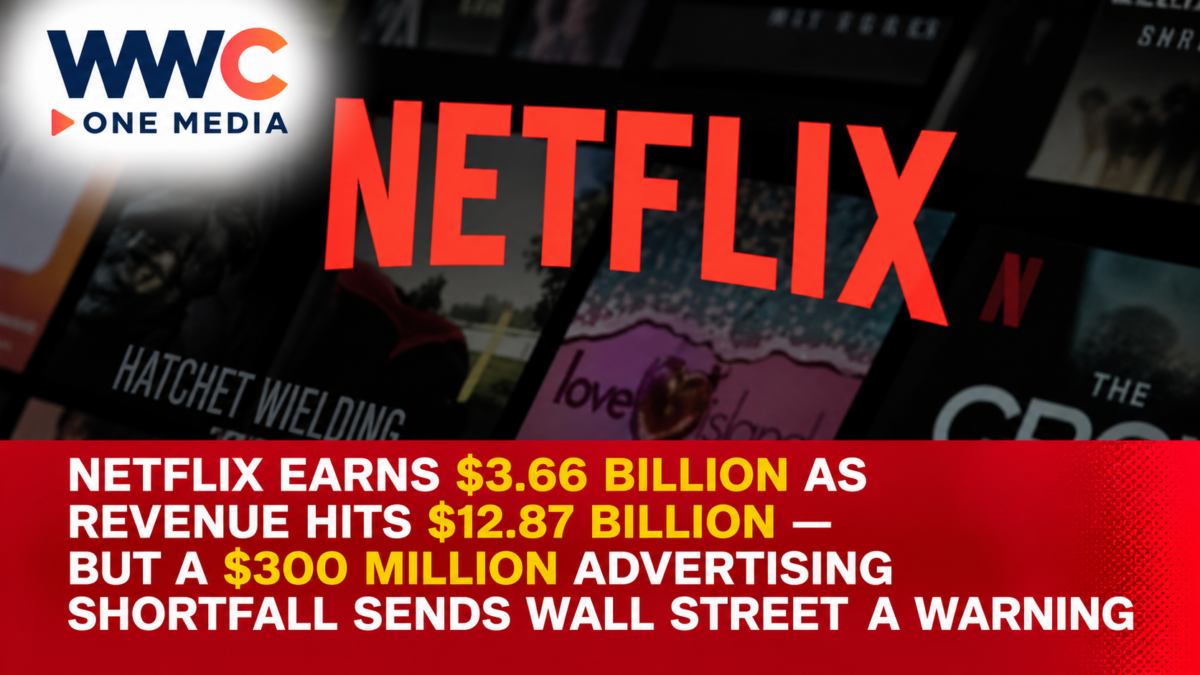
LOS GATOS, California — Netflix is making billions of dollars in profit, but Wall Street is no longer satisfied with financial success alone.
The world’s leading subscription streaming company reported $12.87 billion in third-quarter revenue and $3.66 billion in net income, yet its shares tumbled nearly 6% in after-hours trading on October 20, 2026, after management slashed its annual advertising revenue forecast and issued a disappointing outlook for the final quarter of the year.
The results exposed a growing problem for the entertainment giant: Netflix remains extraordinarily profitable, but competition for viewers is intensifying, revenue growth is losing momentum, and investors are questioning whether its programming strategy can keep subscribers engaged.
Adding to the uncertainty, the company recently announced plans to eliminate approximately 1,000 jobs and overhaul its content leadership, appointing former Disney and Fox executive Peter Rice to lead its global programming operations.
Netflix co-CEO Ted Sarandos acknowledged that the company must improve its performance, particularly in the United States.
But the bigger question extends far beyond one disappointing forecast: Can Netflix keep raising revenue and profits when viewers have more entertainment choices than ever—and its next blockbuster hit is never guaranteed?
Netflix Beats Earnings Expectations With $3.66 Billion Profit
Netflix’s third-quarter financial results initially appeared impressive.
Revenue increased 11.8% to $12.874 billion, compared with $11.51 billion during the same period in 2025.
Net income surged to $3.664 billion from $2.547 billion, representing growth of approximately 44%.
Earnings per share reached $0.87, exceeding the average analyst forecast of $0.82.
Operating income also increased to approximately $4.46 billion, while Netflix’s operating margin improved to 34.6% from 28.2% a year earlier.
The company generated $2.88 billion in free cash flow during the quarter, demonstrating its capacity to generate significant cash after operating expenses and capital expenditures.
These figures suggest Netflix is not confronting an immediate profitability crisis.
However, its improving profit margins conceal a more complicated challenge.
Revenue growth has slowed for three consecutive quarters, declining from 16.2% in the first quarter of 2026 to 13.4% in the second quarter and 11.8% in the third.
The latest figure represents the company’s slowest quarterly revenue growth in approximately three years.
That slowdown is particularly important because investors have historically awarded Netflix a premium valuation based on expectations of sustained expansion.
The $300 Million Advertising Problem
One of the biggest surprises in Netflix’s earnings announcement was its reduced advertising revenue forecast.
The company now expects to generate approximately $2.7 billion from advertising in 2026, down from its previous projection of roughly $3 billion.
The revision represents a $300 million reduction in expected annual advertising revenue.
Netflix attributed part of the shortfall to advertising product capabilities that were introduced more slowly than anticipated.
The company has been developing its advertising business as an additional revenue stream alongside subscriptions.
Its lower-priced, advertisement-supported membership option is intended to attract more price-sensitive customers while allowing Netflix to earn advertising revenue from brands seeking access to its audience.
The opportunity is substantial, but it requires effective advertising technology, a competitive sales operation, and enough engaged viewers to attract advertisers.
The forecast reduction raises questions about how quickly Netflix can scale that business.
Importantly, the $300 million is a reduction in the company’s revenue forecast—not a reported quarterly loss or a confirmed amount of cash already lost.
Wall Street Reacts Despite Stronger Profits
Netflix’s stock fell sharply in extended trading after investors assessed its weaker outlook.
Reuters reported a decline of nearly 6%, with shares trading around $64.66.
The reaction demonstrated how strongly investors are focused on the company’s future growth rather than its latest reported profits.
Netflix forecast fourth-quarter revenue of $13.442 billion, slightly below Wall Street’s expectations of approximately $13.5 billion.
Its projected fourth-quarter earnings per share of $0.67 also fell short of analysts’ roughly $0.73 estimate.
The company expects net income of approximately $2.79 billion in the fourth quarter, compared with market expectations of about $3.07 billion.
For full-year 2026, Netflix is forecasting approximately $51.1 billion in revenue and an operating margin of 31.5%.
These figures indicate that the company expects to remain highly profitable, even as growth faces additional pressure.
But with Netflix shares having declined substantially over the preceding year, investors are looking for evidence that management can restore stronger momentum.
Netflix Cuts Nearly 1,000 Jobs in Major Shake-Up
The disappointing advertising forecast followed one of Netflix’s most significant organizational changes in recent years.
The company announced plans to eliminate approximately 1,000 positions, representing about 6% of its workforce.
The restructuring is part of wider efforts to improve operational efficiency and refocus its entertainment strategy.
At the same time, Netflix is replacing senior executives responsible for its programming and film businesses.
Bela Bajaria, a longtime Netflix executive responsible for global content, is being succeeded by Peter Rice, whose previous experience includes senior leadership positions at Disney and Fox.
Rice is scheduled to assume the global content leadership role on October 26, 2026.
Film executive Dan Lin is also departing, with Rice temporarily overseeing that business while Netflix selects a permanent replacement.
The changes signal that management believes stronger programming execution is necessary to maintain its competitive advantage.
For employees and entertainment-industry partners, the shake-up introduces uncertainty about creative priorities, project approvals, and future investment decisions.
For shareholders, the question is whether replacing senior executives will translate into more successful programming and improved audience engagement.
Netflix Faces a Tougher Battle Against YouTube and TikTok
Netflix’s biggest competition is no longer limited to subscription streaming platforms.
The company faces growing competition from YouTube, TikTok, and other digital entertainment services competing for consumers’ attention.
Short-form video platforms allow viewers to consume large volumes of free content, creating challenges for subscription services that rely on professionally produced films and television series.
Traditional streaming rivals such as Amazon Prime Video and Disney+ also continue investing in exclusive entertainment.
Meanwhile, consolidation in the media industry is creating larger competitors with extensive programming libraries.
Netflix must persuade consumers that its service offers enough valuable entertainment to justify their subscription fees.
Although the company says viewer engagement remains healthy, outside measurements have raised concerns about slowing viewing activity in important markets.
Reuters reported that third-party analytics firm Antenna recorded monthly net subscriber losses for Netflix in the United States during 2026 through September.
However, that data excludes certain subscription channels, and Netflix has challenged its representativeness.
The competing interpretations highlight the difficulty of accurately assessing subscriber momentum without comprehensive company-level disclosures.
Ted Sarandos Admits Netflix Needs Better Execution
Netflix co-CEO Ted Sarandos acknowledged that management sees room for improvement.
During the earnings discussion, Sarandos said Netflix needed to strengthen its programming slate and improve performance in the U.S. market.
However, he rejected the idea that the company needed a fundamental change in its business strategy.
Instead, management intends to focus more intensely on producing compelling series and films while continuing to invest in newer entertainment formats.
The approach places renewed emphasis on the entertainment that originally made Netflix a dominant streaming brand.
The company’s goal is to attract and retain subscribers through programming strong enough to compete against the growing number of viewing options.
But this strategy also creates a financial challenge.
Premium films and television series require substantial investment, and the commercial success of individual productions is difficult to predict.
Even a highly profitable company can face pressure when expensive content fails to generate the expected audience response.
Live Sports, Games and Podcasts: Netflix Searches for Its Next Growth Engine
Netflix is expanding beyond conventional scripted entertainment.
The company has invested in live programming, sports events, video games, video podcasts, and additional licensed content.
The strategy is designed to offer subscribers more reasons to return to the platform.
Its third-quarter shareholder letter highlighted live events and successful programming in India as examples of its broader entertainment ambitions.
Looking toward the end of 2026, Netflix plans additional high-profile programming, including new seasons of established series and live sporting events.
The company also intends to pursue more third-party content licensing arrangements.
A partnership with French broadcaster TF1 illustrates how Netflix is exploring ways to bring additional entertainment services and programming to subscribers.
These initiatives could strengthen engagement, but they also increase the complexity of Netflix’s business.
Management must decide how much investment to allocate to expensive original productions, licensed programming, live events, advertising technology, and emerging entertainment categories.
The challenge is to identify which investments generate enough customer engagement and commercial returns to justify their costs.
Asia Remains an Important Opportunity for Netflix
Netflix’s international operations remain a major part of its long-term growth strategy.
The company’s third-quarter results showed revenue expansion across its geographic regions, including Asia-Pacific.
According to reported financial data, Asia-Pacific revenue grew approximately 12.3% year over year.
The region contains large entertainment markets with significant demand for local-language programming, international productions, and mobile streaming services.
Netflix has highlighted strong audience engagement with selected Indian productions, illustrating the importance of regionally relevant entertainment.
For the Philippines and other Southeast Asian countries, the company’s strategy may translate into continued investment in content designed for local and regional audiences.
However, Netflix has not announced a new Philippine subscription price or a specific local programming commitment as a direct consequence of these earnings results.
Consumer prices and content availability remain subject to separate company decisions.
Why These Results Matter for Subscribers
Netflix’s latest report reveals a broader transformation across the streaming industry.
For years, investors focused heavily on subscriber growth.
Today, attention has shifted toward profitability, advertising revenue, viewing engagement, and the financial returns generated by content spending.
For subscribers, this could mean streaming platforms will place greater emphasis on shows and movies that attract large audiences and encourage continued membership.
It could also lead to more advertising options, licensing arrangements, and live entertainment offerings.
However, there is no guarantee that stronger financial performance will result in cheaper subscription plans.
Companies must balance growth, content investment, pricing, and customer retention.
Netflix’s experience demonstrates that even the biggest streaming platforms cannot depend indefinitely on their existing popularity.
They must continue competing for viewers’ time and attention.
The Bigger Question: Can Netflix Reignite Growth Without Losing Its Audience?
Netflix’s third-quarter performance presents two conflicting narratives.
Financially, the company remains a powerful business.
It generated nearly $13 billion in quarterly revenue, improved profits by 44%, expanded operating margins, and produced billions of dollars in free cash flow.
Yet slower revenue growth, reduced advertising expectations, workforce reductions, and executive changes suggest management faces greater pressure than the headline earnings figures imply.
The streaming market is evolving rapidly.
Consumers can choose among competing subscription services, traditional television, free video platforms, social media, and live entertainment.
Netflix must therefore prove that its investments can continue attracting viewers while supporting the earnings growth investors expect.
The next major test will come in the fourth quarter, when new programming and live events will compete for audience attention during the holiday season.
Netflix has demonstrated that it can generate enormous profits from streaming. But with advertising expectations falling by $300 million and its content strategy undergoing a major overhaul, the bigger question is whether the company can keep audiences watching—and investors believing—in its next chapter.