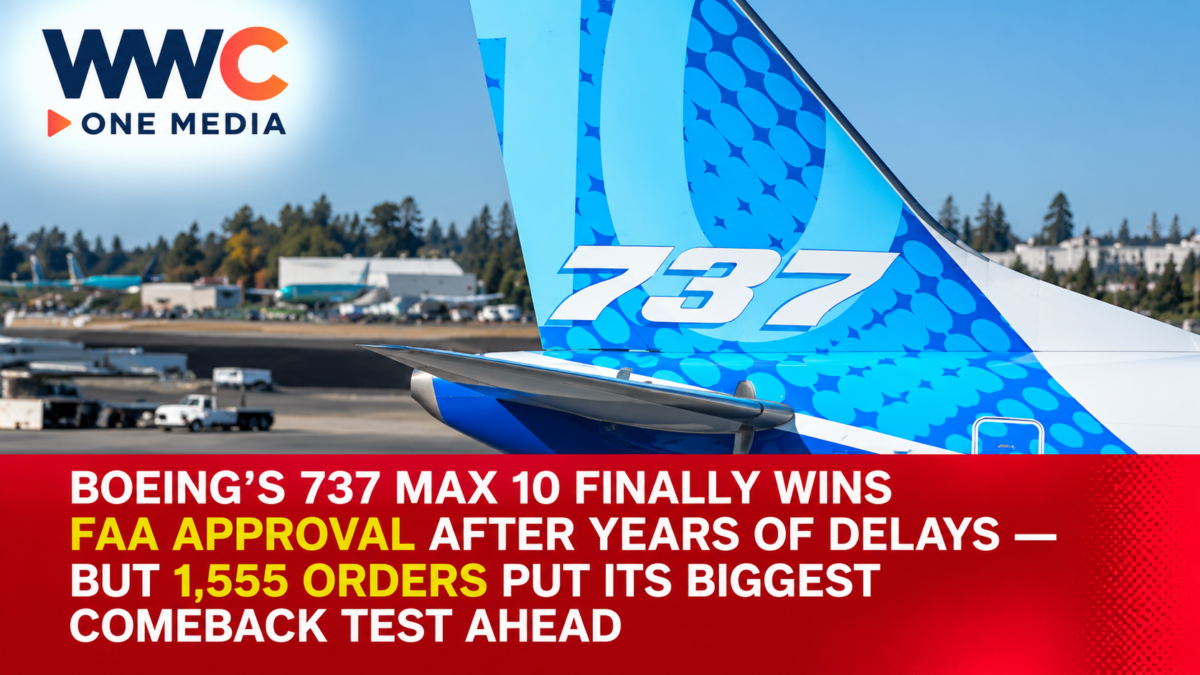
EVERETT, Washington — Boeing has secured one of the most important regulatory victories in its recent history after the U.S. Federal Aviation Administration officially certified the long-delayed 737 MAX 10, clearing the world’s major aircraft manufacturer to begin delivering its largest 737 MAX model to airlines.
The approval, announced October 20, 2026, marks a critical turning point for Boeing after years of production setbacks, heightened safety scrutiny, and mounting competition from European aircraft rival Airbus.
With 1,555 orders from more than 30 customers, the 737 MAX 10 represents a major opportunity for Boeing to generate revenue, strengthen its aircraft delivery pipeline, and regain ground in the global single-aisle aviation market.
The new aircraft can carry as many as 230 passengers in a high-density configuration, giving airlines the ability to transport more travelers on busy routes while potentially lowering operating costs per seat.
However, the regulatory milestone also creates a new challenge.
After years of delays, Boeing must now demonstrate that it can manufacture the jets consistently, deliver them on schedule, meet strict safety requirements, and restore confidence among airlines and travelers.
The biggest question is no longer whether Boeing can secure approval for the MAX 10. It is whether the company can turn that approval into the large-scale aircraft deliveries its financial recovery depends on.
FAA Gives Boeing’s Largest 737 MAX Jet Final Certification
The Federal Aviation Administration formally approved the Boeing 737 MAX 10 on October 20, bringing the aircraft’s prolonged certification process to a conclusion.
The agency issued an amended type certificate confirming that the aircraft met applicable design and safety requirements.
It also approved an updated production limitation record, clearing Boeing to manufacture the aircraft under the authorized production framework.
U.S. Transportation Secretary Sean Duffy and FAA Administrator Bryan Bedford attended the announcement at Boeing’s Everett facility in Washington state.
The FAA emphasized that approval followed extensive technical assessments, design reviews, flight testing, and compliance work.
For Boeing, certification removes a major regulatory obstacle that had prevented the company from delivering the aircraft to commercial operators.
The 737 MAX 10 joins the MAX 7, MAX 8, and MAX 9 as a certified member of the company’s latest narrow-body aircraft family.
The smaller MAX 7 received its FAA certification in August 2026.
The MAX 10 approval completes the certification of the four main aircraft variants in the family.
Nearly 1,000 Test Flights and More Than 2,000 Hours in the Air
The MAX 10’s certification was not a routine regulatory approval.
According to Boeing, the aircraft completed nearly 1,000 test flights covering more than 2,000 flight hours.
It also underwent approximately 1,000 hours of ground testing, extensive system safety assessments, and detailed reviews of human factors and aircraft design.
The program generated tens of thousands of pages of technical documentation.
A major focus involved compliance with the U.S. Aircraft Certification, Safety, and Accountability Act of 2020.
The legislation strengthened aircraft certification requirements following earlier Boeing 737 MAX safety failures.
The MAX 10 is the first commercial aircraft certified under the full requirements of that law.
Among its key improvements is an enhanced angle-of-attack system designed to strengthen aircraft safety.
Angle-of-attack information helps aircraft systems determine the relationship between the airplane’s wing and the airflow around it.
The enhanced system is intended to improve the reliability and handling of critical flight information.
Boeing plans to introduce the new system across the wider 737 MAX family.
Why the MAX 10 Certification Took So Long
The 737 MAX 10 was originally expected to enter airline service years earlier.
Before successive delays, Boeing had anticipated beginning deliveries around 2020.
But the aircraft program became caught in a broader crisis surrounding the 737 MAX family.
Two fatal crashes involving Boeing 737 MAX 8 aircraft—in Indonesia in 2018 and Ethiopia in 2019—killed a combined 346 people.
The tragedies triggered worldwide groundings, investigations, regulatory reforms, and demands for more rigorous oversight of Boeing’s aircraft certification processes.
The company subsequently faced further scrutiny after a door-plug failure on an Alaska Airlines-operated 737 MAX 9 in January 2024.
Although the MAX 10 was not involved in those incidents, the resulting regulatory environment imposed more demanding reviews across Boeing’s aircraft programs.
The MAX 10 also faced additional technical and documentation challenges during its development.
These setbacks delayed deliveries, complicated airline fleet planning, and allowed competing aircraft manufacturers to strengthen their positions.
The October 20 certification represents the conclusion of that extended approval process, but continued regulatory oversight remains essential.
The Software Issue That Threatened Another Delay
One of the final questions surrounding the aircraft involved flight-management software.
A recently identified issue affected certain automated flight-guidance behavior during a missed approach or go-around.
The FAA reviewed the problem and determined that it did not constitute a safety concern requiring correction before certification.
The regulator’s assessment indicated that flight crews retained control of the aircraft and received appropriate indications.
That conclusion allowed the approval process to proceed without another major delay.
However, the decision should not be interpreted as meaning that software monitoring and continued improvements are unnecessary.
Boeing and aviation regulators remain responsible for reviewing technical issues throughout the aircraft’s operating life.
The MAX 10’s approval demonstrates that the FAA concluded the aircraft met the applicable requirements for certification, not that all future technical risks have disappeared.
Why Airlines Want the Boeing 737 MAX 10
The attraction of the MAX 10 is straightforward: more passengers, greater operating efficiency, and compatibility with the broader 737 MAX fleet.
The aircraft typically carries 185 to 210 passengers in a two-class configuration, with a maximum capacity of 230 in a high-density layout.
Its advertised range reaches approximately 3,100 nautical miles, or 5,740 kilometers.
That makes it suitable for many domestic, regional, and medium-haul international routes.
Boeing says technological improvements produce approximately 20% lower fuel use and carbon dioxide emissions compared with the older-generation aircraft category used for its comparison.
Those are manufacturer performance claims, and the actual savings for any airline will depend on seating arrangements, routes, operating conditions, and which aircraft the MAX 10 replaces.
The model also shares common architecture and many components with existing 737 MAX variants.
That commonality can help operators simplify maintenance, pilot training, spare parts management, and fleet planning.
For airlines facing expensive jet fuel and rising operating costs, improved cost per seat could become especially valuable.
Boeing’s 1,555 Aircraft Orders Create a Massive Delivery Challenge
Boeing has secured 1,555 orders for the MAX 10 from more than 30 customers worldwide.
That represents more than 30% of the company’s outstanding 737 MAX order book.
Major airline customers associated with the program include United Airlines, Delta Air Lines, American Airlines, Alaska Airlines, and international operators.
These orders represent a significant future commercial opportunity.
However, aircraft orders are not the same as completed deliveries or recognized revenue.
Airline purchase commitments can be affected by contract terms, delivery schedules, financing arrangements, and customers’ changing fleet requirements.
Boeing must now translate its backlog into manufactured aircraft that pass quality inspections, receive the required documentation, and are accepted by airline customers.
The company has been working to expand production capacity to support that demand.
In July 2026, Boeing opened an additional 737 production line at its Everett facility in Washington.
Its existing operations in Renton continue to play a central role in manufacturing the 737 family.
The additional production capacity could help Boeing meet customer requirements, but output growth will depend on supplier performance, skilled labor availability, manufacturing quality, and regulatory oversight.
United, Delta and Other Airlines Could Benefit
For airline customers, the certification provides a clearer path toward fleet modernization.
Carriers that ordered the MAX 10 have been waiting to deploy the aircraft on routes where larger narrow-body jets can improve passenger capacity and operating economics.
United Airlines is among the major U.S. airlines with significant interest in the program.
The MAX 10 could support high-demand routes where airlines want more seats without moving to larger wide-body aircraft.
Delta and other customers could also benefit from increased aircraft availability as older fleets are replaced or expanded.
But the timing of these benefits depends on actual aircraft deliveries.
Reuters reported that the first MAX 10 delivery is expected in early 2027, with Canada’s WestJet identified as the expected initial recipient.
Additional regulatory approvals may be required before aircraft can enter service in certain countries.
The FAA certification therefore removes a crucial obstacle but does not mean every airline customer can immediately operate the aircraft on all planned routes.
Boeing Faces Airbus in the High-Stakes Aircraft Market
Boeing’s certification victory comes amid intense competition with Airbus.
The European manufacturer has established a strong position in the larger narrow-body aircraft segment through its A321neo family.
The A321neo has attracted substantial interest from airlines seeking additional passenger capacity and longer-range single-aisle operations.
Boeing’s MAX 10 is intended to compete for a share of that market.
However, the two aircraft have different performance characteristics.
The MAX 10’s advertised range of approximately 3,100 nautical miles is shorter than that of the standard A321neo.
Airlines selecting between the aircraft will consider passenger capacity, route requirements, acquisition cost, operational compatibility, and delivery availability.
The MAX 10 certification gives Boeing a stronger commercial position because customers now have greater certainty that the aircraft is approved for commercial service.
But reversing Airbus’s competitive gains will require Boeing to deliver aircraft reliably and demonstrate attractive operating economics.
Why the FAA Approval Matters for Boeing’s Financial Recovery
Boeing has spent years addressing financial and operational damage associated with safety crises, delayed programs, production disruptions, and aircraft delivery constraints.
Commercial aircraft deliveries are a critical source of cash flow.
When new aircraft remain uncertified, completed or partially completed jets may be unable to generate the expected customer payments.
The MAX 10 approval reduces an important source of uncertainty.
The company can now move toward delivering aircraft that customers have ordered, potentially improving cash generation as production increases.
However, certification does not guarantee an immediate financial recovery.
Boeing must still manage manufacturing expenses, supplier costs, aircraft quality, financing requirements, and the delivery schedules of multiple programs.
The company’s long-delayed 777X wide-body aircraft remains another important component of its commercial aviation strategy.
Investors will be watching whether the MAX 10 milestone contributes to a sustained improvement in deliveries and financial performance.
What the Certification Means for Airline Passengers
For travelers, the FAA’s approval means the 737 MAX 10 has satisfied the applicable U.S. regulatory requirements for commercial aviation.
Airlines may eventually introduce the aircraft on domestic and international services as deliveries begin.
Passengers could experience newer cabins, modern onboard systems, and seating configurations tailored to each airline.
The aircraft’s larger capacity may also help airlines accommodate more travelers on high-demand routes.
But lower airline operating costs do not automatically translate into cheaper airfares.
Ticket prices depend on demand, competition, route availability, fuel costs, and airline pricing strategies.
For passengers concerned about safety, the most important distinction is that the FAA conducted extensive certification reviews and required improvements before granting approval.
Continued manufacturing oversight, maintenance, crew training, and operational compliance will remain essential after aircraft enter service.
The Bigger Question: Can Boeing Turn Certification Into a Lasting Comeback?
The 737 MAX 10 certification is a significant milestone for Boeing.
After years of delays and regulatory challenges, the company can finally move toward delivering its largest single-aisle jet.
The approval strengthens Boeing’s competitive position, provides greater certainty for airline customers, and offers a potential path toward improved financial performance.
But the hardest part of the recovery may still lie ahead.
Boeing must demonstrate that it can build aircraft at higher volumes without compromising quality, manage a complicated international supply chain, and deliver on commitments to dozens of airline customers.
The certification also comes at a time when airlines are under pressure from fuel prices, operating costs, and competition for passengers.
For Boeing, the MAX 10 offers an opportunity to meet that demand with a higher-capacity aircraft.
Yet confidence in the company will ultimately depend on consistent execution rather than a single regulatory victory.
Boeing has finally won approval for the aircraft that airlines have been waiting years to receive. Now, with 1,555 orders on its books and Airbus fighting for the same customers, the real question is whether the American aerospace giant can turn this breakthrough into a safe, reliable, and profitable comeback.