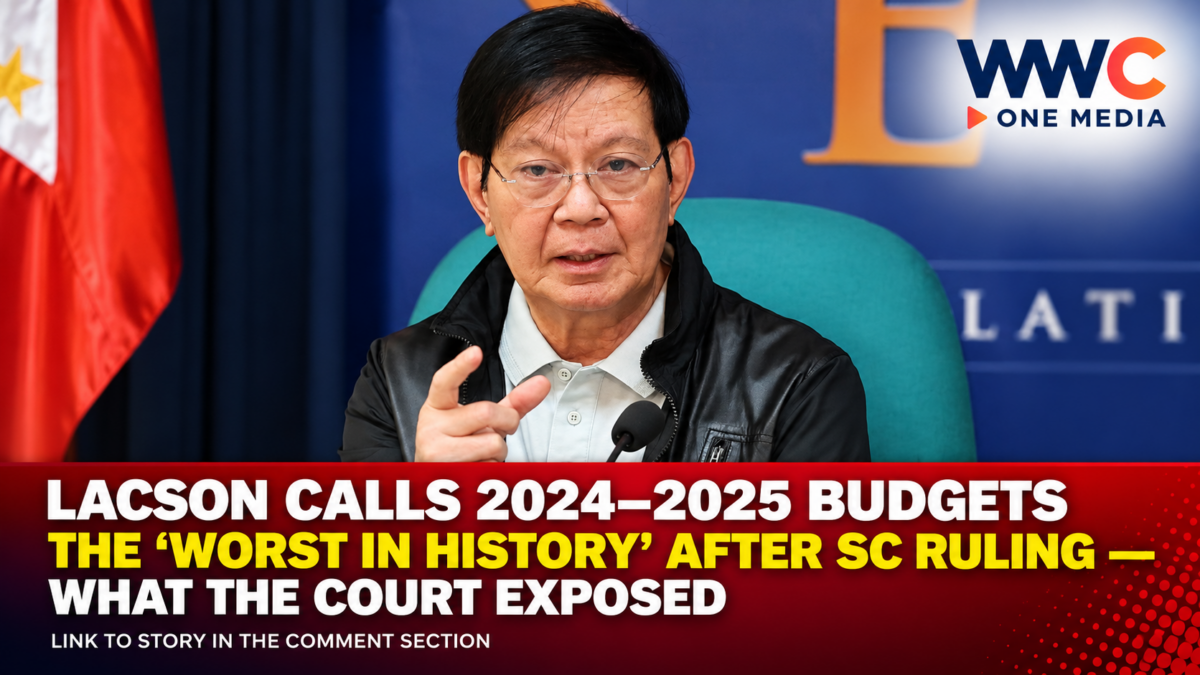
MANILA, Philippines — Senator Panfilo “Ping” Lacson has described the Philippines’ 2024 and 2025 national budgets as among the worst in the country’s history following a Supreme Court ruling that struck down unconstitutional budget provisions and reinforced limits on Congress’ power to increase government appropriations.
The ruling, which also invalidated certain provisions governing unprogrammed appropriations in the 2026 national budget, has renewed scrutiny of how lawmakers revise spending proposals, allocate public funds and ensure accountability in the use of taxpayers’ money.
Lacson said the decision was particularly timely as the Senate examines the House of Representatives’ version of the proposed 2027 national budget.
According to the senator, the Supreme Court’s decision reinforces constitutional restrictions on Congress’ authority to increase the total appropriations recommended by the President in the National Expenditure Program (NEP).
He also compared the controversy surrounding the 2024 and 2025 budgets with the Disbursement Acceleration Program (DAP), which the Supreme Court previously declared unconstitutional in connection with the 2013 national budget.
Lacson clarified that he was not a senator when Congress passed the 2024 and 2025 General Appropriations Acts (GAAs).
Billions in additional appropriations questioned
The Supreme Court’s 121-page decision identified major issues involving increases in unprogrammed appropriations and other budget allocations.
In the 2024 budget, Congress increased unprogrammed appropriations by approximately ₱449.5 billion, bringing the amount from the executive branch’s proposed level to a substantially higher figure in the enacted budget.
The Court found that the increase violated constitutional restrictions on congressional adjustments to the President’s recommended appropriations.
For the 2025 budget, the Court also struck down a ₱17.99-billion increase in the Department of Public Works and Highways’ Special Road Fund, along with other challenged increases involving special accounts.
The decision further addressed provisions in the 2026 GAA that gave the executive branch broad discretion over the release and allocation of unprogrammed funds.
The Court stressed that such appropriations must comply with constitutional requirements and clear standards governing when and how the funds may be released.
Importantly, the ruling does not mean that every unprogrammed appropriation is automatically unconstitutional. The Court recognized that these funds may serve a legitimate fiscal purpose, provided their authorization and release comply with constitutional safeguards.
Why unprogrammed appropriations matter
Unprogrammed appropriations are standby funds intended for release only when specified conditions are met, such as government revenues exceeding established targets or other legally defined funding requirements being satisfied.
They can provide flexibility when additional resources become available. However, concerns arise when the rules governing their use are too broad, when allocations are increased beyond constitutional limits, or when spending decisions lack adequate transparency and accountability.
In its decision, the Supreme Court raised concerns about provisions that could allow broad discretion in deciding which projects receive funding and how much money is released.
The Court also scrutinized the Strengthening Assistance for Government Infrastructure and Social Programs (SAGIP), finding that the challenged arrangement involved prohibited lump-sum appropriations that allowed post-enactment allocation decisions constitutionally reserved for Congress.
These findings put renewed attention on how budget changes are negotiated and documented during the legislative process.
Ruling comes as Senate reviews the 2027 budget
Lacson said the decision came at a critical time, with the Senate reviewing the House version of the proposed 2027 national budget.
He previously warned that senators could seek to restore hundreds of billions of pesos in cuts and realignments introduced in the House version, including changes affecting foreign-assisted projects and additional allocations for flood-control initiatives.
The Supreme Court ruling adds another constitutional benchmark for lawmakers as they examine proposed spending increases and determine whether budget changes comply with the law.
It also underscores the importance of documenting budget negotiations, explaining changes to appropriations and ensuring that public funds are allocated according to established rules.
What happens to funds already allocated?
The consequences for money covered by the ruling depend on the specific provisions and expenditures involved.
Lacson said his understanding was that funds that remain unspent may no longer be disbursed under the affected provisions, while expenditures already made would not necessarily be invalidated automatically.
The distinction is significant because the legal treatment of unspent appropriations, completed transactions and ongoing projects may differ depending on the Court’s directives and the circumstances of each expenditure.
Government agencies and budget officials must therefore determine how the ruling applies to the affected funds and comply with the Supreme Court’s orders.
A warning for future national budgets
The decision places the relationship between Congress and the executive branch under renewed scrutiny, particularly when lawmakers revise spending proposals submitted by the President.
It also raises questions about how future budgets can balance legislative oversight, flexibility in responding to funding needs and constitutional limits on public spending.
For taxpayers, the central issue is not only how much the government allocates but also whether public money is authorized, released and spent according to the law.
As the Senate continues reviewing the proposed 2027 budget, the Supreme Court’s ruling serves as a reminder that budget negotiations must be supported by transparency, accountability and compliance with constitutional requirements.
The key question moving forward is whether the ruling will lead to stronger safeguards in future budget deliberations — and prevent similar constitutional disputes from recurring.