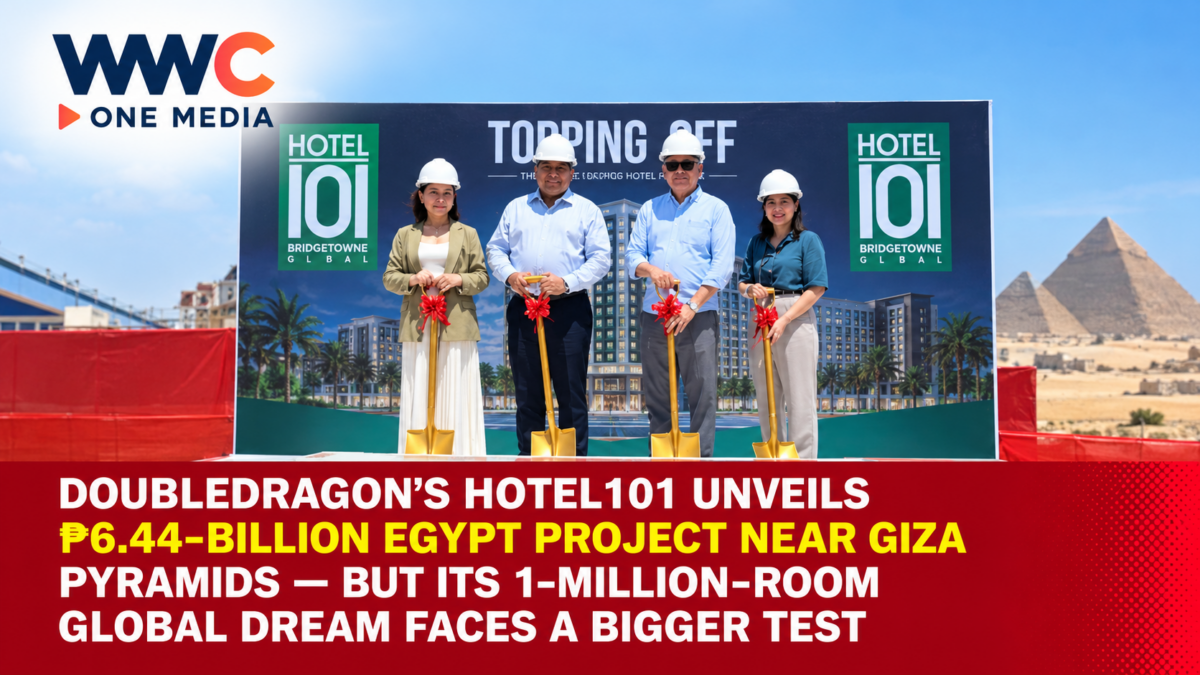
MANILA, Philippines — Filipino billionaire Edgar “Injap” Sia II is taking his Hotel101 hospitality brand to Africa, with DoubleDragon-backed Hotel101 Global announcing a landmark expansion agreement in Egypt anchored by a proposed ₱6.44-billion, 750-room hotel near the world-famous Giza Pyramids.
The development marks Hotel101’s first planned entry into the African continent and another major step in its ambitious strategy to establish a standardized hotel network spanning 100 countries and eventually one million rooms worldwide.
Hotel101 Global Holdings Corp., which trades on the Nasdaq under the symbol HBNB, announced on October 20, 2026, that it had signed definitive binding agreements with WNTR Property & Hospitality, an affiliate of Egyptian conglomerate IGI Holding, for a countrywide joint venture.
The partnership’s first project, Hotel101-Cairo West, is expected to rise in Giza’s rapidly developing 6th of October City, approximately 10 minutes from the Pyramids of Giza and the Grand Egyptian Museum, according to the developer.
With an estimated project value of 5.465 billion Egyptian pounds, equivalent to approximately US$102.09 million or ₱6.44 billion, the proposed hotel could become one of Cairo’s three largest hotels by room count when completed.
But the announcement also brings a formidable challenge: transforming Hotel101’s bold global expansion plans into completed hotels, sustained occupancy, and recurring revenue across different international markets.
A ₱6.44-Billion Hotel Near One of the World’s Most Famous Tourist Attractions
Hotel101-Cairo West will occupy a planned 15,984-square-meter site in Hay Al Ashgar along Ahmed Zewail Road in 6th of October City, Giza.
The location was selected for its access to major roads connecting western Cairo with surrounding business districts, residential communities, tourist destinations, and transportation facilities.
According to Hotel101, the proposed site will benefit from connections to El Wahat Road and the Cairo Ring Road, as well as access to Sphinx International Airport.
Its proximity to the Pyramids of Giza and the Grand Egyptian Museum represents a potentially significant commercial advantage.
These attractions draw international travelers interested in Egypt’s archaeological heritage, while the surrounding Greater Cairo region generates business, domestic tourism, and events-related demand.
The developer expects the approximately 750-room property to rank among Cairo’s three largest hotels by room count.
However, that ranking remains a company projection rather than an established fact because the hotel has yet to be constructed.
Completion is targeted for 2029, subject to government, regulatory, corporate, and other customary approvals.
What Guests Can Expect From Hotel101-Cairo West
The proposed property is designed to bring Hotel101’s standardized hospitality format into the Egyptian market.
Plans call for four-star facilities aimed at leisure travelers, families, business guests, and corporate events.
The development is expected to include a ballroom, meeting rooms, a conference center, all-day dining, swimming pools, a full-size gym, a business center, a children’s playground, parking facilities, and around-the-clock reception services.
These amenities would allow the hotel to serve more than just tourists visiting the pyramids.
Business conferences, group travel, corporate meetings, and family stays could also become important sources of demand.
Hotel101 is positioning its model around standardized accommodations and service offerings, allowing the company to replicate a familiar guest experience across different international locations.
The concept aims to achieve a balance between affordability, predictable hotel operations, and consistent room standards.
Whether the same approach can succeed in Egypt will depend on local market conditions, pricing, customer preferences, and competition.
Injap Sia Joins Forces With Egyptian Property Group
The agreement represents a strategic alliance between Hotel101 Global and an established Egyptian corporate group.
The signing ceremony featured Hotel101 founder Edgar “Injap” Sia II and Khaled Sheta of IGI Holding, with the Giza Pyramids serving as the backdrop.
Other senior representatives from Hotel101 and IGI Holding participated in the event.
The Egyptian partnership provides Hotel101 with a local business connection as it enters a new international property market.
Working with an established domestic partner could help the company navigate market-specific property development requirements, regulatory processes, and commercial relationships.
The announcement covers a broader countrywide joint venture, meaning the companies intend to pursue opportunities beyond the first Cairo West property.
However, no complete pipeline of additional Egyptian hotel locations, construction schedules, or individual project budgets has been publicly confirmed.
The Cairo project is therefore the first identifiable development under the agreement, rather than evidence that a nationwide chain has already been built.
Why Egypt Is an Attractive Market for Hotel101
Egypt’s tourism industry is one of the key commercial reasons behind the company’s decision to enter Africa.
According to figures cited in Hotel101’s announcement, Egypt welcomed nearly 19 million tourists in 2025.
The country’s tourism appeal is supported by its ancient historical landmarks, Red Sea resort destinations, major urban centers, and expanding cultural attractions.
The Grand Egyptian Museum and the Pyramids of Giza are particularly relevant to Hotel101-Cairo West because of the property’s planned location.
Hotel101 is also positioning the project within a district that has experienced residential, commercial, and infrastructure development.
That combination of international tourism, domestic travel, and business activity could create multiple sources of hotel demand.
Nevertheless, visitor arrivals at the national level do not automatically translate into strong occupancy at a particular hotel.
Hotel101 will need to demonstrate that its pricing, location, facilities, and distribution strategy can compete with existing hospitality operators in Greater Cairo.
Hotel101’s Unusual Business Model: Selling Rooms Before Operating the Hotel
Unlike traditional hotel companies that depend primarily on accommodation revenue, Hotel101 uses a standardized condotel business model designed to generate income at different stages of development.
Its model combines the advance sale of individual hotel units with recurring revenue from ongoing hotel operations.
This creates two potential revenue streams.
The first comes from the sale of hotel units during the development phase.
The second comes from revenue associated with operating the completed property over time.
The company also intends to expand internationally through joint ventures and, in the future, licensing arrangements with local developers.
The model could allow Hotel101 to extend its geographic reach without directly funding every international development on its own.
However, this approach carries execution risks.
Property sales, construction financing, regulatory approval, development costs, and hotel demand can vary substantially across countries.
Advance sales do not guarantee construction completion, while opening a hotel does not guarantee profitable operations.
Investors will therefore need to examine how individual projects move from announced agreements to construction, completion, and revenue generation.
From Spain to Japan and Now Egypt: Hotel101’s Global Expansion Accelerates
Hotel101’s planned African expansion follows its entry into the European hospitality market.
In March 2026, the company opened Hotel101-Madrid in Spain, establishing its first operating hotel outside the Philippines.
The Madrid development provided Hotel101 with an initial opportunity to test its standardized hospitality offering in an international market.
The company has also been developing Hotel101-Niseko in Hokkaido, Japan.
That 482-room property is targeted to open in December 2026, extending the company’s planned operating presence into Asia beyond the Philippines.
Separately, Hotel101 has announced a partnership in Thailand involving a proposed large hotel development in Bangkok.
Together, these initiatives illustrate how the company is expanding through multiple overseas markets rather than relying on a single international destination.
However, the projects remain at different stages.
Madrid is already operating, while Egypt and other announced developments still require execution before they can generate hotel accommodation revenue.
One Million Rooms Across 100 Countries: How Big Is Hotel101’s Ambition?
Hotel101’s long-term ambition is striking.
The company aims to establish operations across 100 countries, with a target of one million standardized rooms worldwide.
It has also outlined a medium-term goal of reaching 25 countries.
For comparison, the proposed 750-room Cairo West hotel represents only a small fraction of that eventual target.
Reaching one million rooms would require substantial development activity, multiple local partnerships, reliable financing, and successful hotel operations across numerous countries.
The scale of the ambition also raises important questions about growth management.
Hotel101 would need to maintain consistent service standards while adapting to different regulations, labor markets, tourism patterns, and consumer preferences.
Its ability to sign agreements will matter, but actual hotel completions and operating performance will provide stronger measures of its progress.
The Egypt partnership is therefore a meaningful expansion milestone—not proof that the company’s long-term global targets have been achieved.
What the Egypt Deal Means for DoubleDragon and Philippine Business
Hotel101 Global is a subsidiary of Philippine-listed DoubleDragon Corporation, the property development company associated with Edgar “Injap” Sia II and Tony Tan Caktiong.
Its expansion introduces a Filipino-developed hospitality concept into another major international market.
For DoubleDragon, the strategy offers the possibility of broadening its business exposure beyond domestic real estate and generating revenue from a larger international hotel network.
The Nasdaq listing also provides Hotel101 with a presence in the American public equity market.
As of October 16, 2026, Hotel101 Global reported an approximate market capitalization of US$1.1 billion.
However, the announced ₱6.44-billion Egypt project value should not be confused with guaranteed revenue, net profit, or an immediate cash investment by DoubleDragon.
The figure represents the developer’s estimated value for the planned project.
The announcement does not establish the exact funding contribution of each partner, nor does it provide an audited forecast of future project profitability.
The ultimate financial impact will depend on the venture’s ownership arrangements, development financing, unit sales, construction progress, and hotel operating results.
The Bigger Question: Can Hotel101 Deliver on Its Global Promise?
The proposed Hotel101-Cairo West development represents another significant milestone for the Filipino hospitality brand.
With a major Egyptian property partner, a planned location near world-renowned landmarks, and a target of approximately 750 rooms, the company has outlined an ambitious first step into Africa.
For investors, the project offers another indicator of Hotel101’s international expansion strategy.
For Philippine businesses, it highlights how homegrown brands are attempting to compete in markets far beyond Southeast Asia.
But the real test is still ahead.
Hotel101 must secure the required approvals, execute the development, manage costs, attract guests, and build sustainable revenue from the completed property.
Its longer-term challenge is even bigger: repeating that success across dozens of countries.
From Spain’s first international opening to an ambitious hotel development near Egypt’s pyramids, Hotel101 is building the foundations of a global brand. But whether it can transform its one-million-room ambition into a profitable worldwide hospitality empire remains the question that will ultimately define its success.