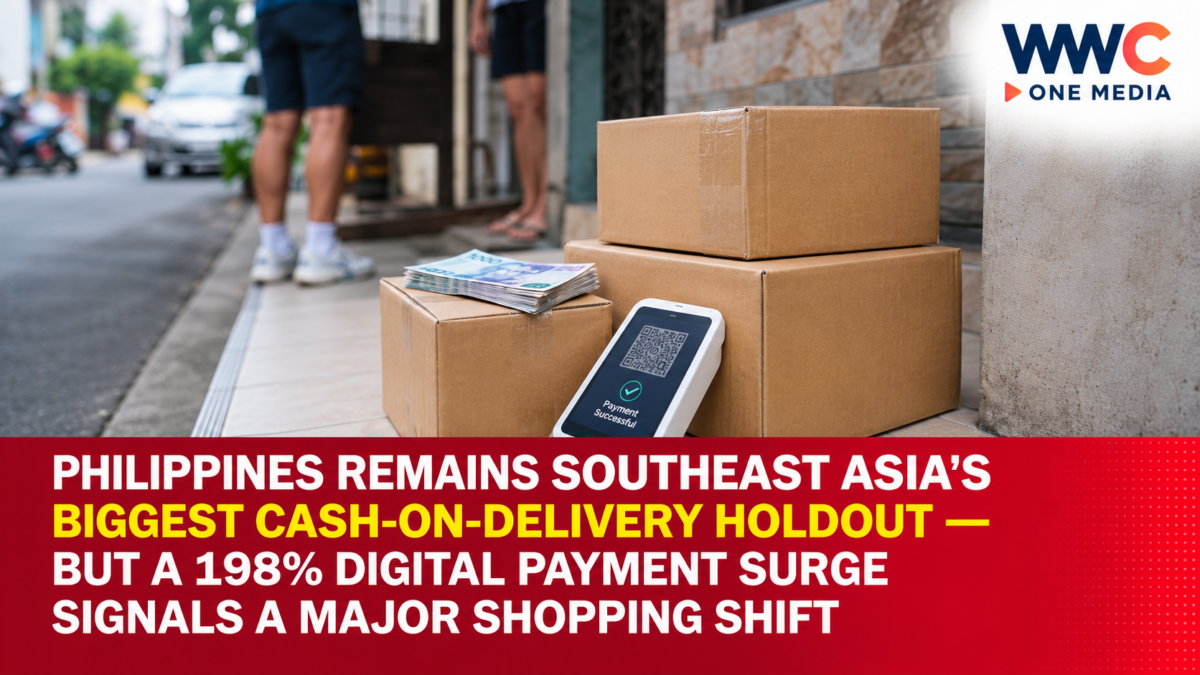
MANILA, Philippines — While Southeast Asia moves deeper into digital payments, millions of Filipino online shoppers continue to rely on an old-fashioned payment method: handing over cash only when their purchases arrive.
A new regional study reveals that the Philippines has the highest cash-on-delivery (COD) share among six Southeast Asian e-commerce markets, even as bank transfers and QR-based payments experience rapid growth.
According to the Xendit E-commerce Payments Momentum Report 2026, prepared with market intelligence company Cube, cash-on-delivery accounts for about 23% of Philippine online shopping transaction value in Xendit’s data.
That is significantly higher than Vietnam’s approximately 16%, the second-highest share among the surveyed markets.
And the gap could persist.
The researchers expect the Philippines to remain the only country among the six markets where COD accounts for more than one-fifth of e-commerce value in 2027.
But the report also presents a very different picture of Filipino payment habits.
Transactions using QR Ph and InstaPay surged 198% on Xendit’s Philippine platform between January 2025 and April 2026.
The bigger question is whether faster digital payments, stronger security and better shopping incentives can finally change Filipino consumers’ preference for paying only after receiving their orders.
Philippines Leads Southeast Asia in Cash-on-Delivery Usage
The latest Xendit and Cube report examined online shopping and payment patterns across six Southeast Asian markets.
The research surveyed 6,000 online shoppers, including 1,000 Filipino respondents.
It also analyzed transaction data from Xendit’s payment platform.
The findings show that COD continues to play a relatively large role in Philippine e-commerce.
Approximately 23% of the online shopping value captured in Xendit’s Philippine dataset involved cash-on-delivery.
Vietnam followed at around 16%.
This makes the Philippines the largest COD holdout among the six countries covered by the study.
However, the statistic should not be misunderstood.
It does not mean 23% of all Philippine consumers use only cash.
It also does not mean COD accounts for 23% of every online transaction conducted through every Philippine marketplace.
The percentage refers to the value of transactions represented in the study’s platform data.
That distinction is important when measuring the country’s overall progress toward digital payments.
One in Eight Filipino Shoppers Refuses to Give Up COD
Perhaps the most revealing finding concerns shoppers who are unwilling to change.
According to the survey, 12% of Filipino online shoppers said nothing would convince them to abandon cash-on-delivery.
That was roughly twice the proportion observed in most of the other surveyed markets.
For some consumers, COD provides a familiar way to control when money leaves their hands.
They may prefer paying after a parcel physically arrives rather than transferring money before delivery.
Others may find cash easier to manage because they do not regularly use bank accounts, payment cards or digital wallets.
Security concerns may also influence consumer behavior.
However, the study did not establish that every COD user chooses the method because of fraud fears.
The reasons for payment preferences can vary among consumers, and no single explanation applies to everyone.
COD Is Declining, But Filipinos Are Switching More Slowly
Cash-on-delivery use is gradually falling across Southeast Asia.
Yet Philippine consumers appear to be changing their habits more slowly than shoppers in several neighboring countries.
The report found that 33% of Filipino respondents were using COD much less frequently than one year earlier.
That compares with 45% in Thailand, 40% in Indonesia and 37% in Vietnam.
The figures indicate that fewer consumers are relying heavily on COD.
But the shift is occurring at different speeds.
In the Philippines, approximately one-third of surveyed shoppers reported a substantial reduction in COD use.
This demonstrates that the country is not standing still.
Rather, it is adopting digital alternatives while retaining a larger cash-dependent segment than its regional peers.
The challenge for payment companies is to make digital transactions attractive without excluding customers who continue to rely on cash.
QR Ph and InstaPay Transactions Jump 198%
The same report identifies a major growth opportunity for electronic payments.
Transactions involving QR Ph and InstaPay on Xendit’s Philippine platform rose 198% over the 15 months ending April 2026.
That means the recorded number of transactions nearly tripled during the period.
QR Ph provides an interoperable QR-code payment framework, while InstaPay supports near-real-time fund transfers through participating financial institutions.
Together, these services allow consumers to make payments without necessarily using cash or payment cards.
Their growing adoption reflects the expanding role of digital financial infrastructure in Philippine commerce.
But the 198% figure requires careful interpretation.
It measures growth in transactions on Xendit’s platform, not the nationwide growth rate of every QR Ph and InstaPay transaction.
It also does not mean that 198% of Filipino shoppers use digital payments.
The increase occurred from a smaller transaction base.
Digital Wallets Remain Important
Despite the rapid growth of QR Ph and InstaPay, electronic wallets remain a major payment method.
Xendit described the Philippines as a wallet-first market, with GCash occupying a leading position.
However, wallet payments on Xendit’s platform increased by only 3% during the same 15-month period.
The slower growth rate does not necessarily mean digital wallets are losing users.
Established payment methods can experience slower percentage growth because they already account for a substantial portion of transaction activity.
Newer services can register faster percentage increases when they begin from smaller volumes.
QR Ph and InstaPay together now account for approximately 13% of Philippine e-commerce transaction value in Xendit’s data.
That remains below the approximately 23% share attributed to COD.
For online sellers, the findings reinforce the importance of supporting several forms of payment rather than relying on just one.
Missing Payment Options Are Costing Merchants Sales
Another major finding highlights how payment preferences influence online shopping decisions.
Among Filipino respondents who abandoned an online purchase during the previous three months, 41% identified the absence of their preferred payment method as the main reason.
That suggests some consumers are willing to leave a checkout rather than use a payment option they do not prefer.
For online merchants, the impact can be significant.
A business may successfully attract a customer through advertising, product listings or promotions.
But if the shopper cannot pay through the preferred method, the transaction may never be completed.
This is why offering COD, electronic wallets, cards and appropriate bank-transfer options can matter for e-commerce performance.
However, the 41% finding applies to surveyed shoppers who abandoned a purchase.
It does not mean that 41% of all Philippine online orders fail because of payment limitations.
It is a measure of the reported reasons behind checkout abandonment within the research sample.
Discounts and Cashback Could Convince More Shoppers
For consumers willing to consider alternatives to COD, financial incentives could make a difference.
The regional study found that discounts and cashback were among the most common reasons shoppers would consider switching to digital payment methods.
A modest price reduction may encourage a consumer to try paying through an e-wallet or QR-code transfer.
But attracting a shopper with a discount is only the first step.
Customers must also trust that their money is secure, their payment will be recognized and refunds will be handled properly if a transaction goes wrong.
Temporary incentives cannot substitute for reliable payment services.
If consumers encounter unsuccessful transfers, unclear charges or difficult refund procedures, they may return to cash-on-delivery.
Merchants therefore need to consider the overall shopping experience rather than focusing exclusively on promotions.
Business Leaders See QR Payments Gaining Momentum
Xendit’s research also surveyed 25 business leaders across Southeast Asia.
Among them, 32% identified QR payments as the method experiencing the strongest increase in customer demand.
Electronic wallets and bank transfers were each selected by 20%.
This suggests that businesses are seeing wider use of interoperable and bank-linked payment options.
However, the survey covered a relatively small group of business leaders.
Its findings should be treated as indications of business sentiment rather than a comprehensive census of the entire region.
The larger consumer survey and platform transaction data provide separate evidence of changing payment behavior.
Together, these findings suggest that businesses may need more flexible payment systems as consumers diversify the ways they pay.
BSP Data Shows the Philippines Is Already Becoming More Digital
The continued popularity of cash-on-delivery does not mean the Philippines is failing to adopt electronic payments overall.
Separate data from the Bangko Sentral ng Pilipinas shows substantial progress.
Digital payments accounted for 64.7% of the country’s retail payment transactions by volume in 2025.
That was up from 57.4% in 2024.
The figure exceeded the lower end of the government’s 60% to 70% digital payment target under the Philippine Development Plan.
BSP Governor Eli Remolona Jr. has emphasized the importance of interoperability in expanding the use of electronic payments.
Systems such as InstaPay and QR Ph allow participating providers and consumers to transact across different financial institutions.
These developments show that digital payments are becoming more deeply integrated into the Philippine economy.
The apparent contradiction between strong overall digital payment adoption and continued COD use is explained by the different measurements.
BSP data covers a broad range of retail payments, while Xendit’s study focuses on e-commerce behavior and transactions represented in its research.
Both trends can occur at the same time.
Why the Philippines Still Needs Cash-Based Payment Options
Cash-on-delivery remains useful for consumers who have limited access to digital financial services or prefer physical cash management.
Some customers may not maintain active bank accounts.
Others may encounter unreliable internet connectivity or unfamiliar payment procedures.
For small businesses, accepting cash can also be straightforward.
But COD creates operational requirements that merchants must manage.
Delivery personnel may need to collect money, issue appropriate documentation and reconcile payments.
Sellers may also face additional complications when customers reject parcels or are unavailable to receive orders.
These issues can affect costs and efficiency.
However, the Xendit report does not establish a single nationwide COD rejection rate or quantify the total cost of abandoned COD shipments.
Any such claim would require separate data.
The practical challenge is balancing consumer choice with efficient and secure payment operations.
Payment Fraud Could Become a Bigger Business Concern
Security is another important dimension of the report.
Although only 8% of the surveyed business leaders currently ranked fraud among their top two payment concerns, 48% expected it to become a major issue within five years.
This suggests that companies anticipate greater pressure to strengthen fraud prevention as more payments move online.
Digital transactions can create risks involving phishing, fraudulent account access, deceptive checkout pages and other forms of financial abuse.
But COD is not automatically fraud-proof.
Cash-based delivery transactions can also be associated with deceptive sellers, fake goods and other consumer disputes.
The more important question is whether each payment channel provides suitable safeguards, clear dispute procedures and reliable records.
Merchants must balance convenience, security and consumer confidence when choosing their payment options.
Philippine Cross-Border Shopping Remains Relatively Limited
The Philippine Star’s coverage of the Xendit report provides additional insight into regional online commerce.
Cross-border transactions accounted for an estimated 9% of Philippine e-commerce sales in 2026.
That compared with 19% in Singapore, 15% in Thailand, 14% in Vietnam, 12% in Malaysia and 6% in Indonesia.
The relatively low Philippine share suggests room for international e-commerce growth.
But cross-border shopping involves additional challenges.
Customers may encounter foreign exchange costs, shipping fees, import duties and longer delivery times.
Merchants also need payment systems capable of handling international transactions and suitable settlement arrangements.
Xendit and Cube expect cross-border e-commerce in Southeast Asia to expand through 2030, depending on payment connectivity and regulatory developments.
For Philippine businesses, international expansion will require more than offering a digital checkout.
Logistics, product competitiveness and customer protection will also matter.
Southeast Asia’s Online Shopping Market Keeps Expanding
The wider regional market provides an important backdrop.
According to the research reported by The Philippine Star, Southeast Asian e-commerce reached an estimated $197 billion in 2025.
That represented substantial growth from approximately $3 billion in 2012.
Cube expects the region’s e-commerce market to exceed $400 billion by 2031.
These figures reflect the expanding economic significance of online retail.
As more consumers shop through digital platforms, payment infrastructure becomes increasingly important.
A business can lose sales if transactions are difficult to complete.
It can also face higher costs if payment operations are inefficient or poorly integrated.
For payment providers, the opportunity lies in helping merchants accept different payment methods securely and reliably.
But market projections are forecasts, not guaranteed future outcomes.
Actual growth will depend on consumer spending, business conditions, regulations and technology adoption.
The Next Challenge Is Payment Choice, Not Eliminating Cash Overnight
The Philippine findings suggest that businesses should avoid assuming every shopper wants the same payment experience.
Some consumers prefer e-wallets.
Others use QR Ph, bank transfers or cards.
A substantial group continues to rely on COD.
For merchants, offering a suitable combination of methods may be more effective than pushing all customers toward one payment channel.
Secure payment processing, transparent refund procedures and clear transaction confirmation can help build trust.
Incentives may encourage people to try digital options.
But long-term adoption will depend on whether those methods consistently meet consumers’ needs.
The shift toward cashless commerce is therefore likely to be gradual rather than immediate.
The Bigger Test: Can Digital Payments Finally Overtake COD?
The Philippines is moving toward a more digital economy, but the e-commerce market remains unusually dependent on cash-on-delivery compared with its regional peers.
The Xendit and Cube study shows that 12% of surveyed Filipino shoppers are unwilling to abandon COD under any proposed incentive.
At the same time, more consumers are reducing their reliance on cash, and QR Ph and InstaPay transactions are expanding rapidly.
For fintech companies, the opportunity is to build secure and accessible payment services.
For merchants, the challenge is to prevent lost sales while keeping transaction costs manageable.
For consumers, the most important factors remain convenience, confidence and choice.
The Philippines is projected to remain Southeast Asia’s last major cash-on-delivery holdout in 2027. But with QR Ph and InstaPay transactions nearly tripling on Xendit’s platform, the next battle in online shopping may not be cash versus digital payments — it may be which payment providers and merchants can earn enough consumer trust to make digital checkout the preferred option.