
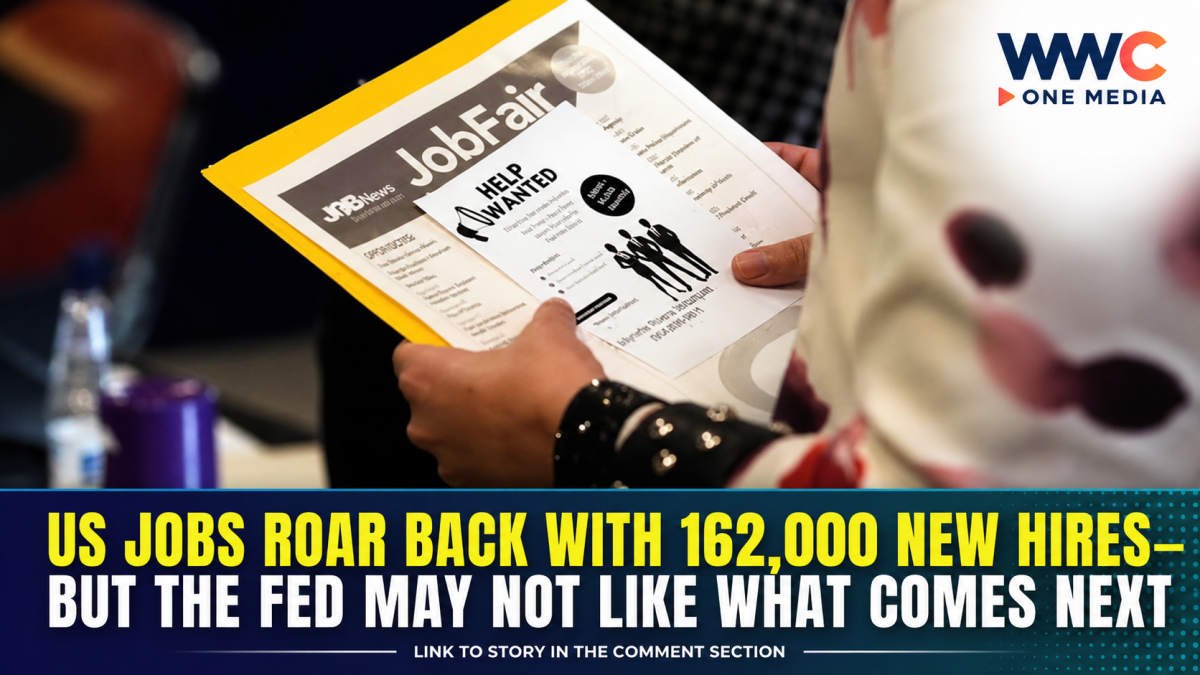
WASHINGTON — The U.S. labor market delivered a much stronger-than-expected rebound in August, adding 162,000 jobs as the unemployment rate held steady at 4.1%, in a report that could complicate the Federal Reserve’s next interest-rate decision.
The latest figures, released Friday by the U.S. Bureau of Labor Statistics, dramatically exceeded economists’ expectations. Analysts surveyed ahead of the report had generally anticipated a much smaller gain of roughly 55,000 to 65,000 jobs.
The surprise strength immediately put renewed attention on the Federal Reserve, with markets reassessing the outlook for interest rates ahead of the central bank’s September meeting. Reuters reported that Treasury yields rose following the release as investors adjusted their expectations.
Jobs comeback was broader than expected
The August increase marked a sharp improvement from the weak hiring picture seen earlier in the summer.
According to the BLS, food services and drinking places added 59,000 jobs, while local government education gained 42,000. Manufacturing employment increased by another 16,000, continuing an upward trend that has added 58,000 positions since its recent low in December 2025.
Health care also continued to add workers, although at a slower pace than its recent average, gaining 13,000 jobs in August.
The strength in restaurants and bars was particularly notable. The sector’s 59,000-job increase was more than four times its average monthly gain over the previous 12 months.
But the recovery was not universal.
The information sector lost 23,000 jobs, including declines in computing infrastructure, data processing, web hosting, publishing and broadcasting-related industries.
July wasn’t as bad as first reported
One of the biggest surprises was not just August’s hiring number—but the government’s revisions to earlier data.
The BLS revised June’s payroll gain from 20,000 to 31,000 and July’s figure from an initially reported 23,000-job decline to a 21,000-job increase.
Together, those revisions lifted employment for June and July by 55,000 jobs compared with previous estimates.
That means the U.S. labor market entered August on somewhat stronger footing than earlier reports had suggested.
Unemployment stays at 4.1%
The unemployment rate remained unchanged at 4.1%, with approximately 7.0 million Americans unemployed.
The labor-force participation rate, meanwhile, edged higher to 61.6%, up from 61.4% in July. The number of people in the labor force increased by 683,000 during the month.
The report also showed a decline in the number of people working part time for economic reasons. That figure fell by 414,000 to 4.4 million.
However, the participation rate remains below where it stood at the beginning of the year, highlighting a continuing challenge beneath the headline employment numbers.
The wage-growth puzzle
For workers, the picture was more complicated.
Average hourly earnings for private-sector employees increased by 10 cents, or 0.3%, in August, reaching $37.75.
On a year-over-year basis, wages were up 3.1%.
Reuters and The Straits Times noted that the annual wage-growth pace was considerably softer than the rapid wage increases seen during the post-pandemic period.
That creates an unusual combination: employers are hiring more than expected, but wage growth is cooling.
Why the Federal Reserve is watching closely
The jobs report arrives at a particularly important moment for the Federal Reserve.
A stronger labor market can reduce pressure on policymakers to cut interest rates because a weakening economy is one of the traditional reasons for monetary easing.
At the same time, slower wage growth could provide some reassurance on inflation.
That leaves the Fed facing a complicated balancing act: the economy is showing resilience, but inflation remains a concern and wage growth is cooling.
Reuters reported that the stronger employment figures increased market expectations for a possible rate move at the Fed’s September 15–16 meeting, although the jobs report alone does not determine the central bank’s decision. Inflation data and other economic indicators will also be critical.
A strange labor market underneath the headline
Despite August’s impressive payroll increase, the broader U.S. labor market has not returned to the explosive hiring environment seen during the post-pandemic recovery.
AP noted that employers have generally been reluctant both to lay off existing workers and to aggressively recruit new employees—a situation that has produced an unusual “low-hiring, low-layoff” environment.
Recent labor-market data also showed gross hiring falling by about 5%, even as layoffs remained relatively uncommon.
That distinction matters.
A worker who already has a job may enjoy relatively strong job security, while someone trying to enter the workforce or change jobs may find opportunities harder to secure.
Demographic changes, including the retirement of baby boomers, and tighter immigration policies have also contributed to a smaller pool of available workers, while some businesses are increasingly turning to technology and artificial intelligence to perform tasks traditionally handled by employees.
What happens next?
The August jobs report has delivered a clear message: the U.S. labor market is more resilient than many expected.
But the numbers do not provide a simple all-clear signal for the economy.
Job creation remains uneven across industries. Wage growth has cooled. Labor-force participation remains below January levels. And the Federal Reserve still has to weigh employment against inflation before deciding where interest rates should go next.
For financial markets, the question is therefore no longer simply whether the U.S. economy is slowing.
It is whether this unexpected burst of hiring is strong enough to change the Fed’s calculations.
And that answer could become clearer when the next major inflation readings arrive—and when policymakers meet in September.
The jobs market may have just surprised Wall Street. The bigger surprise could be what the Federal Reserve does next.




Leave a Reply