
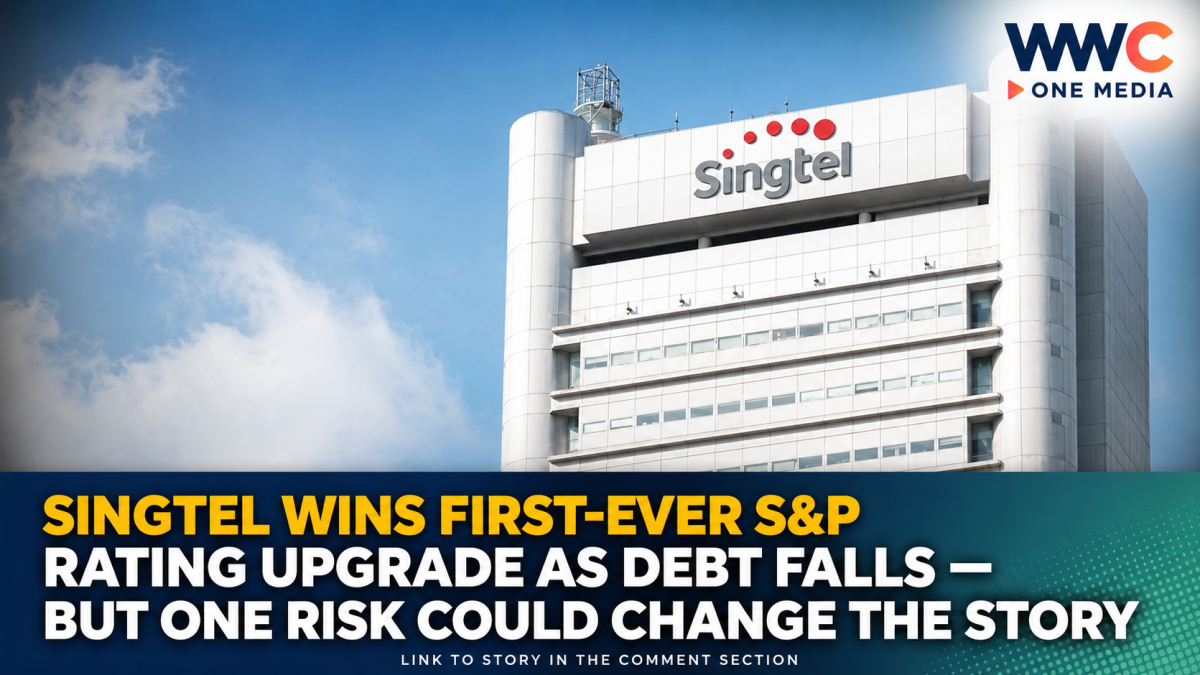
SINGAPORE — Singapore Telecommunications Limited (Singtel) has secured its first-ever credit-rating upgrade from S&P Global Ratings, marking a major vote of confidence in the telecommunications giant’s balance sheet and financial strategy.
S&P upgraded Singtel’s issuer credit ratings to A+/A-1 from A/A-1, while maintaining a stable outlook. The agency also raised the rating on Singtel’s senior unsecured notes to A+ from A, and its guaranteed subordinated perpetual securities to BBB+ from BBB.
Singtel confirmed the development in a media statement filed with the Singapore Exchange on Aug. 19, saying the upgrade was the first by S&P since the company was initially rated by the agency. The company said it remains focused on maintaining a strong balance sheet and financial discipline while pursuing long-term growth.
The number behind the upgrade: debt has fallen sharply
One of the biggest factors behind S&P’s decision is Singtel’s substantial reduction in debt.
According to S&P, Singtel’s adjusted debt dropped to S$7.5 billion at the end of fiscal 2026, down from a peak of S$12.3 billion at the end of fiscal 2021.
Its adjusted debt-to-EBITDA ratio also improved from 2.5 times to 1.7 times over the same period.
That improvement has been driven largely by Singtel’s asset-recycling strategy.
Since fiscal 2022, the company has generated more than S$12 billion through asset monetisation, including the sale of minority stakes, telecom towers, non-core businesses and its Comcentre office properties. S&P also noted an equity contribution from KKR related to Singtel’s data-centre platform.
S&P expects Singtel to complete the remaining S$2.2 billion of its current S$9 billion asset-recycling programme by fiscal 2028, ending March 31, 2028.
More cash could still be unlocked
The rating agency believes Singtel has additional financial flexibility beyond the current S$9 billion programme.
The company continues to hold significant stakes in Bharti Airtel and Gulf Development, while a potential minority investment in Australian subsidiary Optus could also provide additional cash.
S&P highlighted Singtel’s stated intention to eventually equalise its Bharti Airtel shareholding with the Mittal family. The difference of more than three percentage points in their respective holdings represents more than S$5 billion in value, based on Bharti Airtel’s market capitalisation at the time of S&P’s assessment.
That gives Singtel another potential source of financial flexibility without necessarily having to rely entirely on additional borrowing.
Investors could see bigger shareholder returns
The upgrade comes as Singtel prepares to increase spending while also returning more capital to shareholders.
S&P expects Singtel’s annual shareholder distributions to rise to approximately S$4.1 billion to S$4.3 billion in fiscal 2027 and fiscal 2028, compared with S$3.3 billion in fiscal 2026.
The figure includes dividends and the company’s share-buyback programme, with approximately S$1.9 billion of the S$2 billion buyback scheme remaining over the following two years, according to S&P’s assessment.
At the same time, Singtel is expected to maintain elevated capital expenditure.
S&P forecasts fiscal 2027 capex of S$2.9 billion to S$3.1 billion, compared with S$2.5 billion in fiscal 2026. Spending is expected to support telecommunications networks in Singapore and Australia, as well as expansion in data centres, AI cloud services, GPU-as-a-Service and satellite infrastructure.
Earnings recovery is another piece of the puzzle
S&P is also expecting Singtel’s earnings to recover.
The agency forecasts adjusted EBITDA of approximately S$5.5 billion to S$5.7 billion in fiscal 2027, compared with S$4.5 billion in fiscal 2026.
For fiscal 2028, adjusted EBITDA is forecast at S$5.1 billion to S$5.3 billion.
S&P said the expected improvement would be supported by factors including lower regulatory and remediation costs at Optus, price increases in Australia, NCS contract wins, and increased utilisation of data-centre and AI-cloud businesses.
The forecast for fiscal 2027 also incorporates approximately S$700 million in special dividends from Advanced Info Service and Gulf Development.
DBS Vickers likewise described the upgrade as reflecting Singtel’s stronger balance sheet, financial flexibility and continued asset monetisation, while noting the stable outlook assumes leverage remains below two times debt-to-EBITDA.
But Singtel still faces pressure at home
The A+ upgrade does not mean Singtel is without challenges.
S&P specifically pointed to continued pricing pressure in Singtel’s Singapore consumer telecommunications business.
The agency noted that Singapore’s average revenue per user declined to S$23 in fiscal 2026 from S$30 in fiscal 2020, reflecting intense competition in the domestic market.
The competitive landscape was also affected by the termination of the proposed merger between SIMBA Telecom and M1 following a regulatory investigation involving SIMBA.
Meanwhile, Optus continues to face competition from TPG Telecom and costs associated with regulatory and remediation matters following its 2025 network outage.
These risks help explain why S&P has kept Singtel’s outlook at stable, rather than moving it immediately to positive.
What could threaten the A+ rating?
This is where the story gets more interesting.
S&P said it could consider lowering Singtel’s ratings if the company’s debt-to-EBITDA ratio remains above 2 times.
That could happen if shareholder distributions and growth spending remain high without sufficient improvement in operating cash flow and asset monetisation.
Greater-than-expected competitive pressure in Singapore or Australia could also weaken the company’s financial performance and put pressure on the rating.
On the other hand, there is a potential path to an even higher rating.
S&P said it could consider an upgrade if Singtel adopts a more conservative and clearly documented financial policy committing to a debt-to-EBITDA ratio of below 1.5 times, while maintaining its competitive position in Singapore and Australia.
The bigger picture
Singtel’s A+ upgrade represents more than a routine ratings adjustment.
It signals that S&P sees the company’s aggressive asset-recycling strategy, debt reduction and financial flexibility as strong enough to support a higher credit profile—even as Singtel increases investment in data centres, AI and other growth businesses while returning billions of dollars to shareholders.
Singtel’s official investor-relations information now lists its long-term S&P rating at A+ with a stable outlook, while its Moody’s long-term rating is A1 with a stable outlook.
The challenge now is execution.
Singtel has to balance three competing priorities: cutting leverage, funding its next wave of growth and delivering larger returns to shareholders.
For now, S&P believes the company can do all three.
But with leverage projected to move back toward roughly 1.8 to 2.0 times in fiscal 2027 and 2028, the margin for error may be narrower than the headline A+ upgrade suggests.
For investors, that makes Singtel’s next phase particularly important: the company has earned the upgrade—but its ability to preserve that stronger credit profile may depend on what it does with the billions still available from asset sales and how aggressively it spends on its next growth cycle.
Leave a Reply