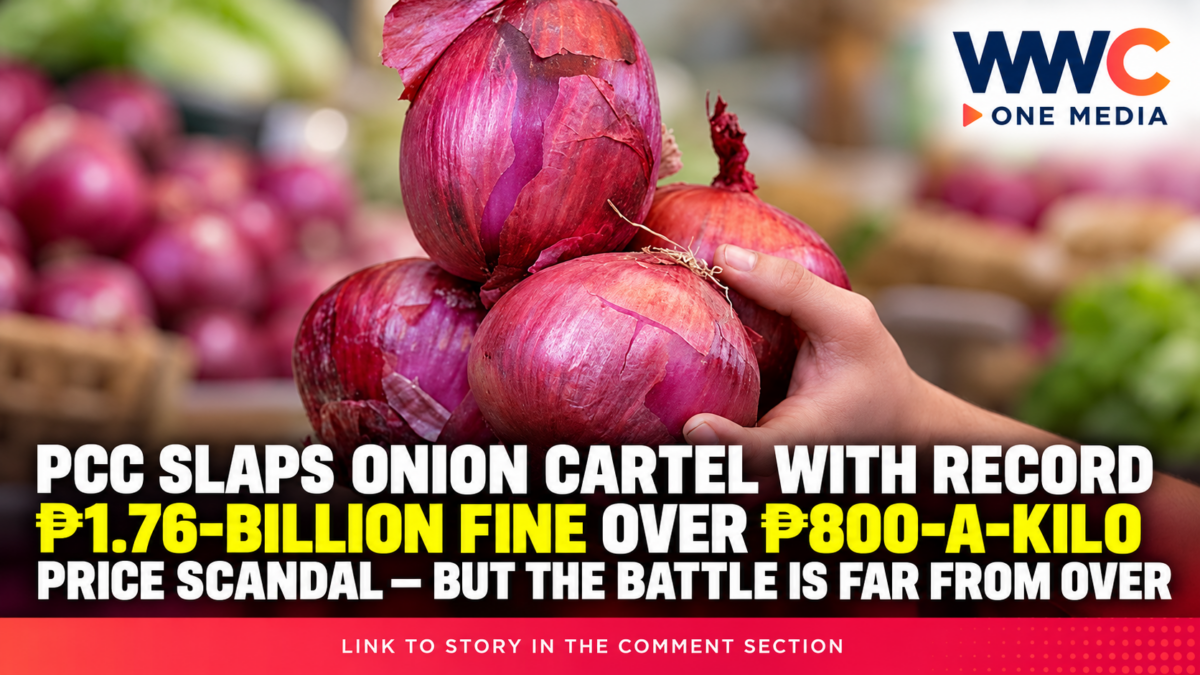
MANILA, Philippines — The Philippine Competition Commission (PCC) has imposed a record ₱1.76-billion fine on six businesses and their responsible officers after finding that they participated in an illegal onion importation and distribution cartel linked to the country’s notorious 2022 onion-price crisis.
The landmark decision, announced on October 15, 2026, comes nearly four years after Filipino consumers faced onion prices reaching approximately ₱800 per kilogram — a crisis that sparked public outrage, congressional scrutiny and demands for stronger government action against possible manipulation of food supplies.
According to the competition regulator, the respondents operated an illegal market-allocation arrangement that allowed them to collectively control nearly half of approved import clearances for red and yellow onions in 2020 and 2021.
The scheme involved coordinated import permits, cargo shipments, cold storage and wholesale distribution.
But the latest development shows that the case is far from finished.
By October 19, nearly all respondents had filed motions asking the PCC to reconsider its decision, setting the stage for another round of legal proceedings.
The bigger question: Will the government’s biggest-ever competition fine result in lasting accountability — and can authorities prevent another food-price scandal from hurting Filipino households?
PCC Imposes Its Biggest Competition Penalty in History
The PCC’s ₱1.76-billion penalty is the highest combined fine imposed by the agency under the Philippine Competition Act.
The commission found the respondents liable for violating Section 14(b)(2) of Republic Act No. 10667, which prohibits anti-competitive agreements involving the division or allocation of markets.
In the onion case, the regulator concluded that businesses appearing to operate separately had coordinated key parts of their importing and distribution activities.
The arrangement allowed the group to concentrate access to imported onions through permits issued under different business identities.
Instead of functioning as independent competitors, the businesses were found to have participated in a common market-allocation scheme.
The commission said the conduct undermined competition in a food commodity essential to Filipino households.
PCC Executive Director Kenneth Tanate emphasized that the record penalties demonstrate the agency’s commitment to holding cartels accountable and protecting consumers from harmful anti-competitive practices.
However, the administrative ruling remains subject to the respondents’ available legal remedies.
Six Businesses and Responsible Officers Named
The PCC found six business entities or proprietorships liable:
Golden Shine International Freight Forwarders Corp. — A freight-forwarding company identified as central to the coordination of import clearances and shipments.
Tian Long Corp. — The cold-storage operator whose facilities were used to store imported onions before their nationwide distribution.
La Reina Fresh Vegetables & Young Indoor Plants Inc. — One of the respondent onion importers.
Yom Trading Corp. — Another importer implicated in the market-allocation arrangement.
Vegefru Producing Store — A sole proprietorship operated by Mark Castro Ocampo.
Rosal Fruit and Vegetable Trading — A sole proprietorship operated by Nancy Callanta Rosal.
The PCC also held several corporate officers responsible in their capacities connected with the liable businesses.
These included Lilia Cruz, Eric Pabilona, Renato Francisco Jr. and Letty Baculando.
Their inclusion demonstrates that administrative liability was not limited to corporate entities.
But the penalties must be distinguished from criminal convictions.
The PCC’s findings were made through administrative competition-law proceedings, while separate criminal charges would require further legal action by the appropriate authorities.
How the Onion Import Scheme Allegedly Worked
The investigation uncovered a coordinated system for securing onion import clearances.
According to the PCC, Golden Shine systematically applied for sanitary and phytosanitary import clearances using credentials associated with the other respondent importers.
It also assigned those importers as consignees, monitored permit allocations and coordinated shipments.
The onions were then directed to cold-storage facilities operated under Tian Long before entering wholesale distribution networks.
By accumulating permits across separate corporate identities, the group controlled nearly 50% of all approved import clearances for red and yellow onions in 2020 and 2021.
The concentration was significant because import clearances are a key gateway for businesses seeking to bring onions into the country.
Where separate competitors coordinate access to imports and distribution, competitive pressures may be weakened.
The PCC concluded that the arrangement constituted illegal market allocation under the Philippine Competition Act.
However, control of nearly half of approved import clearances should not be confused with proof that the respondents physically possessed half of all onions sold in the Philippines.
Approved permits, actual shipments, domestic harvests and retail sales are different measures.
The ₱800 Onion Crisis That Triggered the Investigation
The case gained national significance because of the extraordinary onion-price surge in late 2022.
At the height of the crisis, some retail prices reached approximately ₱800 per kilogram, making onions unusually expensive for households and food businesses.
For Filipino consumers, the spike became a symbol of food inflation and frustration over supply management.
Restaurants, carinderias, market vendors and ordinary households struggled with the cost of an ingredient commonly used in Filipino cooking.
The crisis raised difficult questions about agricultural production, imports, supply forecasts, storage facilities and trading practices.
The PCC’s investigation focused on anti-competitive conduct involving onion importation and distribution.
Its findings provide evidence of illegal market allocation, but they should not be interpreted as establishing that the cartel alone caused every peso of the 2022 price increase.
Weather conditions, domestic harvests, seasonal demand and other supply-chain factors can also influence retail prices.
A responsible assessment must distinguish proven anti-competitive conduct from the full range of factors contributing to food inflation.
Court-Ordered Raid Uncovered Critical Evidence
A major turning point came on September 6, 2023.
PCC investigators carried out a court-ordered search and inspection of offices located at the Golden Shine Corporate Center.
The operation, sometimes described as a dawn raid, was conducted to obtain evidence relevant to the commission’s investigation.
Investigators examined documents and other materials relating to import clearances, shipment coordination and the roles of the participating businesses.
According to the regulator, the evidence helped establish that businesses identified as separate importers were operating through a coordinated arrangement.
This allowed the PCC to reconstruct how the import clearances were accumulated and how shipments moved through the distribution chain.
The commission subsequently pursued administrative proceedings that culminated in its 2026 decision.
The case illustrates how competition authorities can use documentary evidence and business records to investigate suspected collusion.
Why the Fine Reached ₱1.76 Billion
The unusually large penalty reflects both the scale of the conduct and the legal treatment of onions as prime commodities.
The Philippine Competition Act requires the automatic tripling of basic fines for certain anti-competitive conduct involving prime commodities.
The PCC also found that the audited financial statements submitted by the respondent importers significantly understated their financial activity.
As a result, the regulator calculated the fines using actual import-clearance volumes and wholesale prices reported by the Philippine Statistics Authority.
Five respondent groups were each ordered to pay ₱330 million.
Those groups involved La Reina and Renato Francisco Jr.; Yom Trading and Francisco Jr.; Vegefru proprietor Mark Castro Ocampo; Rosal Fruit and Vegetable Trading proprietor Nancy Callanta Rosal; and Golden Shine together with responsible officers.
Tian Long and Eric Pabilona were separately ordered to pay approximately ₱118.33 million.
The combined penalties amount to approximately ₱1.76 billion.
Where the ruling specifies solidary liability, the responsible parties within that particular group share the legal obligation to satisfy the group’s assessed penalty.
This does not mean each named individual owes an additional ₱330 million on top of the full group penalty.
Two Other Organizations Were Cleared of the Charges
One important detail in the PCC’s decision is that not every organization initially implicated in the investigation was found liable.
The commission dismissed charges against Philippine Vieva Group of Companies Inc. and the Vegetable Importers, Exporters & Vendors Association of the Philippines Inc.
According to the PCC, the evidence was insufficient to establish their participation in the illegal market-allocation agreement.
Certain officers or incorporators associated with those organizations were nevertheless held liable in their separate capacities connected with businesses found to have violated the law.
The distinction is important for accurate reporting.
The dismissed entities should not be described as having been found guilty of cartel conduct simply because some individuals with overlapping affiliations were penalized.
Respondents Challenge the Record Fine
The legal dispute intensified after the decision was made public.
On October 19, specialist competition-law publication MLex reported that the PCC had confirmed reconsideration motions from all respondents except Mark Castro Ocampo of Vegefru Producing Store.
Ocampo, who was declared in default, had not sought reconsideration, according to that report.
The development means that the decision is being challenged by most of the businesses and individuals ordered to pay.
Respondents whose reconsideration motions are rejected may pursue further judicial review through the Court of Appeals, subject to applicable procedural rules.
The filing of a motion for reconsideration does not itself establish that the PCC’s findings were incorrect.
Likewise, the commission’s decision should not be presented as beyond challenge while the available legal processes remain ongoing.
The outcome will depend on how the regulator and, if necessary, the courts evaluate the evidence and arguments.
Unpaid Fines Could Trigger Additional Penalties
At the October 15 briefing, PCC officials said the respondents had not yet paid the combined fine.
BusinessMirror reported that respondents had 15 days from receipt of the decision to pay or file for reconsideration.
The commission warned that noncompliance could eventually result in additional penalties.
Reported sanctions include a fine ranging from ₱60,000 to ₱2.5 million, together with a possible daily penalty of ₱55,000, subject to applicable enforcement procedures.
The regulator also ordered the respondents to permanently cease and desist from the anti-competitive market-allocation arrangement.
However, the existence of a fine does not mean the government has already collected the amount.
As of the latest reporting reviewed, the record penalty remained subject to reconsideration proceedings.
Any collection or enforcement measures must be reported according to their actual procedural status.
Could the Onion Cartel Case Lead to Criminal Charges?
The PCC’s administrative ruling may lead to additional legal consequences.
Under Section 30 of the Philippine Competition Act, certain prohibited anti-competitive agreements can expose responsible individuals to criminal liability.
The PCC has indicated that the case could be referred to the Department of Justice’s Office for Competition for evaluation of possible prosecution.
Criminal proceedings would be separate from the administrative fines.
They would require the appropriate legal process, including the filing of charges where warranted and proof under the applicable criminal standard.
The possibility of criminal prosecution should not be reported as though any named respondent has already been convicted or sentenced to imprisonment.
The status of the case will depend on future action by the DOJ and the courts.
Why Onion Cartels Matter to Consumers and Farmers
The importance of the case extends beyond a large regulatory penalty.
Competition in agricultural trading helps determine how goods move from farms and importers to wholesalers, retailers and households.
When businesses coordinate to divide markets or restrict independent competition, consumers may face fewer options and less competitive pricing.
Farmers may also be affected by supply-chain arrangements that influence purchasing practices and market access.
But the precise economic effect depends on the structure of the market and the conduct involved.
The PCC’s decision identifies a specific illegal market-allocation arrangement in onion imports and distribution.
It does not automatically resolve every problem involving Philippine agricultural prices.
Broader reform may still require accurate production forecasts, improved logistics, sufficient storage, clear import policies and effective agricultural market monitoring.
Will Record Fines Prevent Another Onion-Price Crisis?
The ₱1.76-billion decision is a major milestone for the country’s competition regulator.
A penalty of this magnitude sends a strong warning that coordination among businesses can carry serious legal and financial consequences.
But deterrence depends on enforcement.
Authorities will need to resolve reconsideration proceedings, collect penalties where legally enforceable and continue monitoring markets for new violations.
The government must also ensure that legitimate importers and traders can compete fairly without unnecessary barriers.
Competition enforcement is one part of protecting food affordability.
A more resilient agricultural supply system also requires dependable domestic production, appropriate storage capacity and transparent supply information.
For consumers, the ultimate measure will be whether the country can avoid future episodes of extreme and unexplained food-price volatility.
The Bigger Question: Justice for Filipinos Who Paid ₱800 per Kilo
The PCC’s decision brings official accountability findings to one of the country’s most memorable food-price scandals.
Six businesses and their responsible officers have been ordered to pay a record ₱1.76 billion for illegal market allocation.
The investigation found coordinated import practices, concentrated permit access and a distribution chain involving shared cold-storage arrangements.
But the process remains unfinished.
Most respondents have challenged the penalties, and potential criminal proceedings have not yet resulted in convictions.
The fines are also not a direct refund program for consumers who paid exceptionally high onion prices in 2022.
That leaves the public with two separate concerns.
Will those found administratively liable ultimately face enforceable consequences?
And will Philippine authorities strengthen competition and agricultural supply management enough to prevent a similar crisis?
The PCC has issued the biggest fine in its history over an onion cartel linked to the ₱800-a-kilo price scandal. But the larger test now is whether the penalty survives legal challenges — and whether Filipino consumers will be protected from another devastating food-price shock.