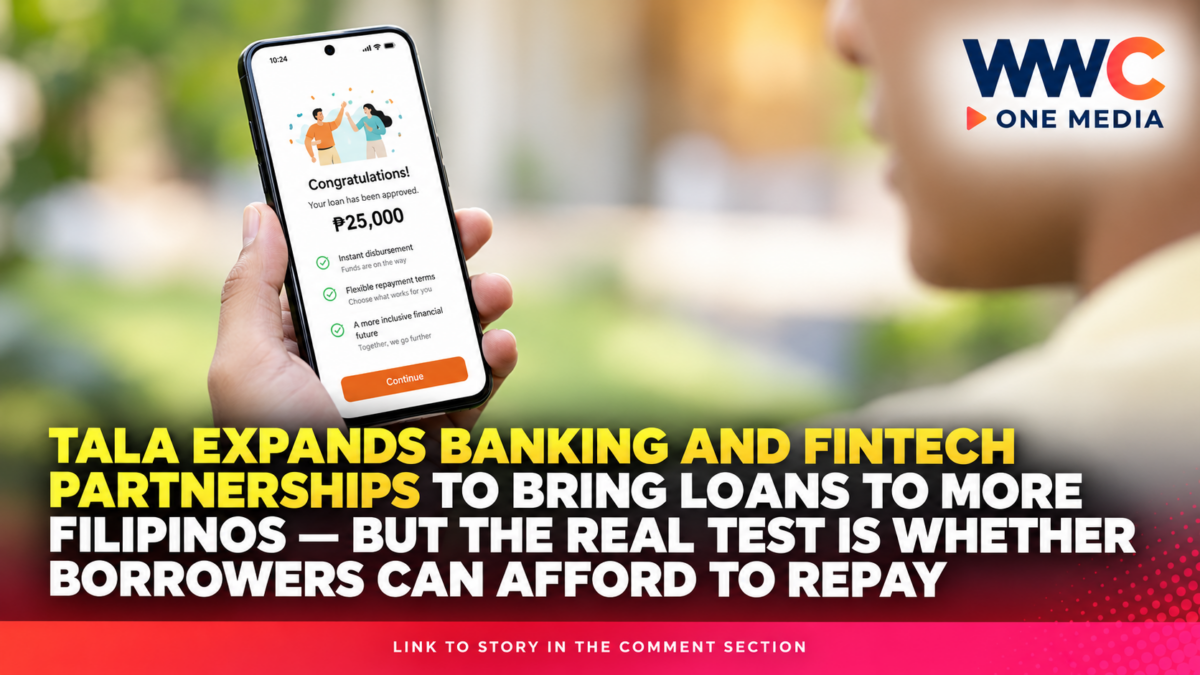
MANILA, Philippines — Digital lending company Tala is expanding its network of banking, financial technology and payment partners in the Philippines, seeking to provide more Filipinos with access to formal loans even when they lack the traditional credit records required by many financial institutions.
The company is positioning its artificial intelligence-powered credit technology as a service that banks, electronic wallets and other financial platforms can integrate into their own systems.
The objective is to help underserved borrowers, including small entrepreneurs and financially active Filipinos with limited borrowing histories, access credit through the digital platforms they already use.
But Tala’s push also raises an important question for the country’s rapidly expanding digital lending industry.
Will faster and more accessible loans strengthen financial inclusion — or could easier borrowing create greater financial pressure for consumers who are already struggling with rising household and business expenses?
Tala Wants to Make Borrowing Accessible Beyond Its Own App
Tala’s latest Philippine strategy goes beyond attracting more users to its own digital lending platform.
Instead, the company is pursuing arrangements that allow financial institutions and other businesses to use its credit assessment technology within their existing applications and customer networks.
Tala Philippines President and General Manager Moritz Gastl said broader cooperation between financial institutions is necessary to reach customers who remain underserved by conventional lending systems.
The company brings experience in alternative-data credit assessment and automated decision-making, while partners contribute customer relationships, distribution channels, funding and other resources.
This strategy is designed to make credit available closer to the point where consumers and businesses already manage their finances.
For example, a participating financial platform could potentially offer eligible customers a loan without requiring them to download a separate lending application.
However, the company’s announcement does not mean every bank or e-wallet operating in the Philippines has already integrated Tala’s services.
The rollout depends on specific partnership agreements and the technical and regulatory readiness of participating institutions.
How Tala’s Credit-as-a-Service Platform Works
At the center of the expansion is Tala’s Credit-as-a-Service, or CaaS, offering.
The platform allows other financial services companies to integrate Tala’s credit technology using application programming interfaces (APIs) or software development kits (SDKs).
These tools enable participating businesses to connect their existing systems with automated credit assessment and lending infrastructure.
Tala says the technology can deliver credit decisions within minutes.
Its models are designed to evaluate applicants using alternative information that may help assess repayment ability even when conventional credit histories are limited.
This approach targets so-called thin-file borrowers — individuals whose available credit records provide limited information for traditional underwriting.
For banks and fintech companies, using an established credit infrastructure provider may reduce the need to build an entirely new lending system.
For borrowers, the potential benefit is a more convenient process for obtaining formal financing.
But an automated lending decision should not be confused with guaranteed approval.
Loan eligibility, available amounts, interest rates and repayment terms remain subject to lender policies, regulatory requirements and individual assessments.
Why Millions of Filipinos Still Struggle to Access Formal Finance
Tala’s expansion comes at a time when financial account ownership is improving across the Philippines.
According to a Social Weather Stations survey cited by the Bangko Sentral ng Pilipinas in May 2026, 58% of Filipino adults aged 18 and older owned a formal financial account during the first quarter.
That was higher than the 51% recorded in the BSP’s 2025 Consumer Finance and Inclusion Survey.
The increase reflects greater use of formal financial services, particularly electronic money accounts.
The survey found that 43% of adults had an e-money account, while 21% had a bank account.
These categories overlap because some consumers maintain more than one type of account.
Despite the progress, approximately 42% of adults still lacked a formal financial account under the survey’s measure.
The BSP identified lack of money, unemployment and limited knowledge of account-opening procedures among the barriers to inclusion.
However, owning a bank account or digital wallet does not automatically make someone eligible for a loan.
Financial institutions must still determine whether applicants can repay their obligations.
This is the gap Tala wants to address.
Small Entrepreneurs Could Benefit From Alternative Credit Assessment
For nanoentrepreneurs and microbusiness owners, obtaining formal credit can be particularly difficult.
Some operate largely in cash, maintain limited financial records or lack the conventional documents requested by lenders.
A food vendor may need additional inventory before a busy sales period.
An online seller may need capital to fulfill customer orders.
A small service provider may need equipment or working capital to continue operations.
Even when these businesses generate income, their financial histories may not fit conventional lending models.
Alternative-data credit assessment could help evaluate some applicants more effectively.
But the value of such technology depends on its accuracy and fairness.
A useful model should help distinguish borrowers who can reasonably manage repayment from those who may face an unsustainable debt burden.
Approving more loans is not automatically a positive outcome if borrowers become trapped in repeated borrowing or high financing costs.
Tala Expands Bank and Payment Partnerships
Beyond credit scoring, Tala is strengthening the channels through which borrowers can receive loan proceeds and manage payments.
The company is working with electronic wallets, banks and over-the-counter payment networks.
This reflects the mixed financial habits of Filipino consumers.
Many people regularly use digital payments, but cash remains important, particularly for small businesses and households that operate outside fully digital environments.
A wider payment network may make loans more convenient for eligible customers.
For example, borrowers could potentially receive approved funds through an existing financial account or use participating payment channels according to the applicable service arrangement.
Tala is also pursuing loan-channeling partnerships with financial institutions.
Under this model, a funding institution provides capital while Tala contributes underwriting technology, risk evaluation and its established lending infrastructure.
According to the company, a significant partnership established in 2024 demonstrated how institutional financing could support borrowers who have limited conventional credit histories.
However, Tala did not disclose the identity, size or financial performance of every partnership in its October announcement.
The expansion should therefore not be interpreted as confirmation of a specific new multibillion-peso lending agreement.
Tala’s Global Strategy Is Moving Toward Embedded Finance
Tala’s Philippine initiatives are part of a larger international strategy.
In an October 7 company article, Tala founder and chief executive Shivani Siroya explained that the business increasingly wants to provide credit infrastructure through financial platforms already used by customers.
Rather than requiring every borrower to use Tala’s own application, the company wants its technology to work within other digital ecosystems.
The approach is known as embedded finance.
It involves integrating services such as credit, payments or insurance into applications whose primary purpose may be something else.
Tala said multiple wallet and payment providers had already gone live with integrations across its broader ecosystem.
However, the company did not establish that every global integration described in the article had been launched in the Philippines.
This distinction matters because the availability of a service in one country does not necessarily establish that it has received local authorization or been released to Philippine customers.
Global Partnership With Crossmint Shows the Bigger Technology Ambition
Another development provides context for Tala’s international direction.
On September 9, 2026, Tala announced a partnership with Crossmint, a company providing digital wallet and stablecoin-related infrastructure.
The collaboration combines Tala’s embedded credit capabilities with Crossmint’s wallet technology for participating fintech firms and businesses.
The initial rollout included Tala credit infrastructure becoming available to companies using Crossmint, while Crossmint’s smart wallet technology was introduced within Tala’s customer experience in Mexico.
The companies said the arrangement initially involved more than one million Tala customers in Mexico.
This illustrates Tala’s interest in combining lending with broader digital financial infrastructure.
But it should not be misrepresented as a Philippine stablecoin-lending launch.
The announced consumer rollout began in Mexico, and no equivalent nationwide Philippine implementation was confirmed in the October 15 report.
Responsible Lending Becomes Central to Tala’s Expansion
As Tala broadens access to borrowing, the company is also emphasizing customer protection.
It participates in the Consumer Lending Association of the Philippines and supports efforts to improve fraud prevention, transparency and responsible lending practices.
Tala has also promoted its Debt with Dignity advocacy, which focuses on respectful treatment of borrowers.
The initiative opposes abusive collection methods and promotes standards intended to protect consumers during the borrowing and repayment process.
These issues are particularly important in digital lending.
Borrowers may experience difficulty understanding fees, repayment schedules or the consequences of missing a payment.
In more serious cases across the wider lending industry, consumers have reported harassment, public shaming and misuse of personal information during debt collection.
Tala’s stated consumer-protection commitments are relevant to the industry’s development.
However, corporate policies and advocacy statements should be evaluated alongside actual lending practices, compliance records and customer outcomes.
SEC Tightens Rules for Online Lending Platforms
The Securities and Exchange Commission has been strengthening oversight of financing and lending companies in the Philippines.
In July 2026, the SEC issued Memorandum Circular No. 20, which established prudential, disclosure and market-conduct requirements while lifting the moratorium on new online lending platforms under specified conditions.
The rules form part of efforts to encourage responsible innovation while strengthening consumer safeguards.
Regulatory requirements are especially important when technology providers and financial institutions work together to offer loans.
Consumers should be able to identify the entity legally responsible for the loan, the terms of repayment and the procedure for handling complaints.
Before borrowing, applicants should check the total amount they will receive, all applicable fees, repayment obligations and the identity of the authorized lending company.
The SEC maintains public information on registered financing and lending companies and their disclosed online lending platforms.
The regulator also provides a complaint process for borrowers who believe applicable lending rules have been violated.
The Real Cost of Borrowing Matters More Than Loan Approval Speed
Digital lending platforms often emphasize convenience and faster processing.
For consumers facing urgent financial needs, quick access to funds may be useful.
But speed is not the same as affordability.
A borrower should understand the full cost of a loan, including interest, service charges, deductions from proceeds, late-payment charges and other applicable costs.
The repayment amount and due date must also fit within the borrower’s expected cash flow.
For small businesses, credit may support inventory purchases, equipment and other productive activities.
But borrowing can become harmful when the financing cost exceeds the income it helps generate.
For households, taking a loan to cover recurring expenses without a sustainable repayment plan may create financial pressure.
The objective of responsible lending is not simply to increase the number of approved borrowers.
It is to provide financing that people can use productively and repay without unreasonable hardship.
AI Lending Also Raises Questions About Data Privacy
Tala’s use of alternative-data and artificial intelligence models also raises important questions about how borrower information is collected and evaluated.
Automated systems can potentially improve credit assessment for people with limited traditional records.
But lending companies must ensure that personal information is handled lawfully, securely and appropriately.
Consumers should understand what information is requested, why it is needed and how it will be used.
The use of AI also raises questions about the accuracy of automated decisions and the risk that certain customers may be unfairly disadvantaged by data or model limitations.
These concerns are not allegations that Tala has violated privacy rules.
They are broader issues that lenders and regulators must address as digital credit technology becomes more widespread.
Greater financial inclusion must be accompanied by transparency and suitable safeguards for consumers.
Can Embedded Credit Change the Philippine Lending Industry?
Tala’s partnership-based strategy could change how some Filipinos encounter formal lending services.
Instead of treating loans as a standalone product accessed through a specialized app, credit could increasingly become part of existing financial relationships.
Banks, wallets and other businesses may be able to use outside technology providers to develop lending services more efficiently.
This could help underserved consumers who have limited credit histories but maintain regular economic activity.
However, the commercial benefits remain uncertain.
Tala has not disclosed verified October figures showing how many additional Filipinos received loans specifically because of the newly expanded partnerships.
The company also has not published the total additional lending capacity created by these arrangements.
The strategy is therefore a significant business development, but its measurable impact on Philippine borrowers remains to be established.
The Bigger Financial Inclusion Test
The Philippines has made progress in bringing more adults into the formal financial system.
Electronic wallets and bank accounts are becoming increasingly common.
But meaningful financial inclusion requires more than opening an account or approving a loan.
Filipinos also need affordable financial services, clear information, secure payments and fair treatment.
Tala’s expansion is intended to address part of that challenge by connecting alternative credit technology with established financial institutions and consumer platforms.
If implemented effectively, the partnerships could widen formal borrowing opportunities for households and entrepreneurs who have been overlooked by conventional lenders.
But the ultimate measure of success will not be the speed of an AI credit decision or the number of financial platforms integrating the technology.
It will be whether borrowers receive appropriate credit at transparent and manageable costs.
Tala wants to make formal loans accessible through the digital services Filipinos already use. But as AI-driven lending expands, the question is whether greater access to credit will create greater financial security — or simply make it easier for vulnerable borrowers to take on debt they cannot comfortably repay.










