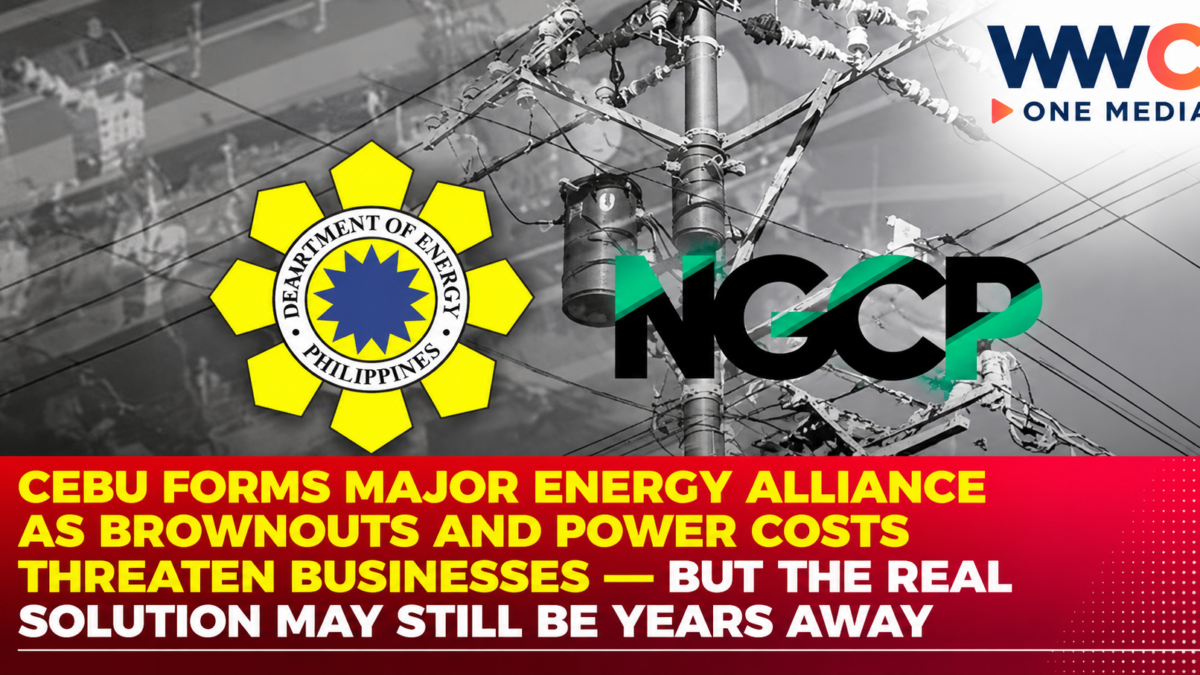
CEBU CITY, Philippines — Cebu’s provincial government, national energy regulators, power companies and business leaders have formed a new alliance to confront recurring electricity shortages, costly power bills and growing concerns that unreliable energy supply could undermine one of the Philippines’ most important regional economies.
The Cebu Energy Alliance was formally established on October 12, 2026, during the Cebu Energy Summit at the Cebu Provincial Capitol, through a commitment manifesto led by Governor Pamela Baricuatro and supported by Energy Secretary Sharon Garin.
The initiative brings together major power industry stakeholders, including the National Grid Corporation of the Philippines (NGCP), Energy Regulatory Commission (ERC), AboitizPower, Visayan Electric and representatives of local electric utilities and business organizations.
Its objective is to strengthen coordination, improve electricity reliability and develop a common strategy for addressing the province’s increasingly urgent energy challenges.
But behind the signing ceremony is a troubling reality.
Government officials have warned that the Visayas could continue experiencing power supply constraints through 2027, with significant new generating capacity not expected until 2028.
The bigger question: Can Cebu’s new alliance deliver meaningful relief to households and businesses before the next wave of power shortages threatens the local economy?
Cebu’s Power Crisis Pushes Government and Businesses to Act
The Cebu Energy Summit was organized by the Cebu Chamber of Commerce and Industry (CCCI) together with the provincial government.
It brought together representatives of power generators, transmission operators, distribution utilities, regulators, local government units and business associations.
The discussions focused on electricity supply shortages, the reliability of the Visayas grid, rising energy costs and the infrastructure needed to support economic growth.
Governor Baricuatro emphasized that dependable electricity is essential not only for factories and commercial establishments but also for healthcare, tourism, employment and public services.
Recurring brownouts have created uncertainty for businesses that depend on continuous operations.
When electricity interruptions occur, manufacturing plants may lose production time, stores may close temporarily and companies may have to rely on expensive backup generators.
Hospitals and other essential services also require reliable power to protect patients and maintain critical operations.
The alliance seeks to bring these concerns into a coordinated framework rather than leaving individual sectors to address the problems separately.
Major Power Companies and Regulators Join the Alliance
Among the participants and signatories identified in the agreement are representatives of:
- Department of Energy (DOE)
- Energy Regulatory Commission (ERC)
- National Grid Corporation of the Philippines (NGCP)
- AboitizPower
- Acciona Energia Philippines
- Visayan Electric
- Cebu Electric Cooperative
- Mactan Electric Company
- Cebu Chamber of Commerce and Industry
- Provincial and local government units
- Consumer advocacy organizations
The diverse membership reflects the complexity of Cebu’s electricity problems.
Power generators produce electricity, NGCP operates the high-voltage transmission network, and distribution utilities deliver electricity to customers.
Regulators oversee different aspects of the industry’s operations and pricing.
Local governments and business groups can help identify community needs and advocate infrastructure development.
By bringing these organizations together, the alliance hopes to improve information sharing and accelerate agreement on practical priorities.
However, each institution retains its existing legal and regulatory responsibilities.
The alliance does not replace the ERC, DOE, NGCP or other bodies responsible for operating and regulating the electricity industry.
Cebu’s Electricity Demand Is Growing Much Faster Than the National Average
One of the most concerning developments is the speed at which Cebu’s electricity demand is increasing.
Energy Secretary Garin said Cebu’s demand has been growing by approximately 14% annually, compared with around 6% in other parts of the Philippines.
This growth places additional pressure on generating facilities, transmission infrastructure and electricity distribution systems.
Across the wider Visayas grid, demand has climbed significantly over the past two decades.
NGCP data cited at the summit showed demand reaching approximately 2,779 megawatts in 2026, compared with 1,241 MW in 2009.
Yet the pace of new power generation development has not kept up with rising demand.
When several generating plants experience outages or operate below capacity at the same time, the available supply can become insufficient to meet electricity requirements.
This increases the likelihood of yellow and red grid alerts and, in more severe conditions, rotating power interruptions.
The reported 14% rate is an estimate presented by energy officials and should not be confused with a verified year-end result for every Cebu utility.
DOE Warns Major Power Relief May Not Arrive Until 2028
The new alliance was formed amid warnings that long-term electricity supply solutions will take time.
During the energy summit, Garin acknowledged that new generating facilities expected to strengthen the Visayas grid would not be ready immediately.
Major additional capacity is targeted for 2028, leaving the region vulnerable to supply constraints before those projects begin operating.
The DOE has identified interim measures such as battery energy storage systems, temporary power barges and the restoration of unavailable generating capacity.
These options could help reduce supply pressure during critical periods.
However, their effectiveness will depend on deployment schedules, operating readiness, available capacity and supporting transmission infrastructure.
Power barges and batteries are not automatic substitutes for new permanent generating plants.
Battery storage can provide fast-response reserve capacity and help stabilize the grid, but its contribution depends on its storage duration and the availability of electricity for charging.
For Cebu’s households and businesses, this means improvements may arrive in stages rather than through one immediate solution.
New Coal and Gas Projects Are Being Considered
Separate energy planning discussions have identified several proposed generating projects for Cebu.
According to the DOE’s presentation reported by InsiderPH on October 15, two coal-fired projects with a combined planned capacity of 257 megawatts could provide additional baseload electricity.
The projects include:
150-MW Therma Visayas expansion: A proposed additional generating facility in Toledo City, targeted for commercial operations in 2028.
107-MW Cebu Energy Development Corporation project: A planned coal-fired facility with a targeted commercial operation date in 2029.
Energy officials have also discussed a proposed 500-MW gas-fired power plant that could begin operations between 2028 and 2030.
The gas facility is intended to provide flexible generation capacity that could complement intermittent renewable energy sources.
These projects are part of the wider electricity supply outlook and should not be presented as projects already funded or approved through the Cebu Energy Alliance manifesto.
Their actual completion dates will depend on investment decisions, permits, construction and grid connection arrangements.
The potential expansion of fossil-fuel capacity also raises questions about how Cebu can balance energy security, affordability and the Philippines’ longer-term environmental objectives.
The Biggest Concern for Businesses: Expensive and Unreliable Electricity
For Cebu’s business community, the problem is not simply whether electricity is available.
It is whether power can be supplied reliably at a price that companies can afford.
CCCI vice president for business mobilization Bernard Sia said recurring power problems were contributing to business uncertainty and concerns about the province’s competitiveness.
Companies can absorb some additional expense to ensure reliable operations.
But continuously rising energy costs can become particularly difficult for micro, small and medium enterprises.
High electricity bills affect restaurants, hotels, manufacturing operations, cold-storage facilities, retail establishments and other businesses.
The financial burden becomes more severe when companies must also pay for backup generators, fuel and maintenance to protect against unexpected outages.
For energy-intensive industries, unreliable electricity can influence decisions about expansion, hiring and future investment.
The Cebu Energy Alliance therefore faces a challenge extending beyond repairing infrastructure.
It must help create conditions that support both reliability and sustainable electricity costs.
Consumer Advocates Demand Protection Against Price Spikes
Cebu Electricity Rights Advocates (CERA), which joined the alliance, emphasized that consumer welfare should remain central to any energy solution.
Its lead convenor, Nathaniel Chua, raised concerns over unpredictable electricity charges and excessive exposure to volatile spot-market prices.
The group wants electricity bills to reflect reasonable generation and delivery costs, with stronger regulatory safeguards against unnecessary charges.
It also supports transparent long-term power supply agreements, a more diversified generation mix and stronger inter-island transmission connections.
These issues have become especially important because electricity costs can increase sharply when utilities depend heavily on expensive short-term market purchases.
For households, higher electricity bills reduce the money available for food, transportation, education and other essential expenses.
For businesses, higher power costs can force difficult choices involving prices, wages, expansion plans and profitability.
Consumer advocates argue that improving electricity reliability should not come at the expense of unchecked increases in customer bills.
Visayas Reserve Market Costs Add to the Pressure
The formation of the Cebu Energy Alliance coincides with regulatory action over the cost of electricity reserves.
The ERC suspended commercial operations of the Philippine Reserve Market effective October 14, 2026, following concerns about elevated reserve charges.
The Reserve Market is designed to help secure backup electricity used to stabilize the power system when supply and demand unexpectedly change.
However, regulators found that reserve procurement through the market had generated unusually high costs, particularly in the Visayas.
The suspension is intended to limit exposure to volatile reserve prices while allowing the grid to secure required backup power through other arrangements.
This regulatory intervention is separate from the Cebu Energy Alliance.
It illustrates why Cebu’s energy challenge involves both physical supply shortages and the financial cost of maintaining reliable electricity.
Lower reserve costs may help reduce some electricity charges, but the market suspension does not guarantee immediate reductions in every consumer’s bill.
Alliance Manifesto Has No Specific Funding or Construction Deadlines
Despite the significance of bringing major stakeholders together, the Cebu Energy Alliance remains at an early stage.
Its commitment manifesto establishes principles for cooperation, continued dialogue and information sharing.
It does not identify specific power projects approved for construction.
It also does not establish a total investment commitment, dedicated funding allocation or binding implementation deadline.
Instead, participating organizations will conduct further discussions to identify projects and policy priorities.
CCCI officials have indicated that the chamber plans to develop a position paper outlining specific proposals and recommendations.
The next stage will therefore be important in determining whether the alliance evolves from a coordination platform into a mechanism that produces measurable results.
For consumers and businesses, the key indicators will include fewer brownouts, more dependable reserve capacity, faster project development and transparent electricity pricing.
Can Cebu Protect Its Economic Growth?
Cebu’s importance to the Philippine economy makes electricity reliability a major regional development issue.
The province supports significant activity in tourism, property development, manufacturing, information technology, logistics and commercial services.
Many of these industries depend on stable electricity to maintain operations and attract investment.
Power shortages can disrupt production, increase costs and weaken confidence in the ability of infrastructure to support business expansion.
If supply fails to keep pace with demand, new investments could face additional operational risks.
The Cebu Energy Alliance creates an opportunity for policymakers, businesses and energy providers to develop a more coordinated response.
But economic growth will depend on practical improvements rather than institutional agreements alone.
The Bigger Test: Will the Alliance Deliver Results Before 2028?
The Cebu Energy Alliance represents a significant attempt to bring together organizations responsible for different parts of the electricity system.
Its formation acknowledges that Cebu’s power problems cannot be solved by a single agency, company or local government.
The initiative could help identify urgent priorities, improve coordination and develop proposals for additional energy infrastructure.
But difficult questions remain.
How quickly can the province secure more dependable electricity?
Will proposed power projects proceed on schedule?
Can regulators keep electricity costs manageable while supporting new investments?
And will businesses and households see fewer disruptions before major new generating plants become operational?
The answers will determine whether the alliance becomes a turning point in Cebu’s power sector or another initiative whose promises take years to materialize.
Cebu has formed a broad coalition to confront its electricity problems. But with demand rising rapidly and major new power capacity still years away, the most important question is whether the alliance can turn its commitments into affordable, reliable electricity before the next crisis strikes.