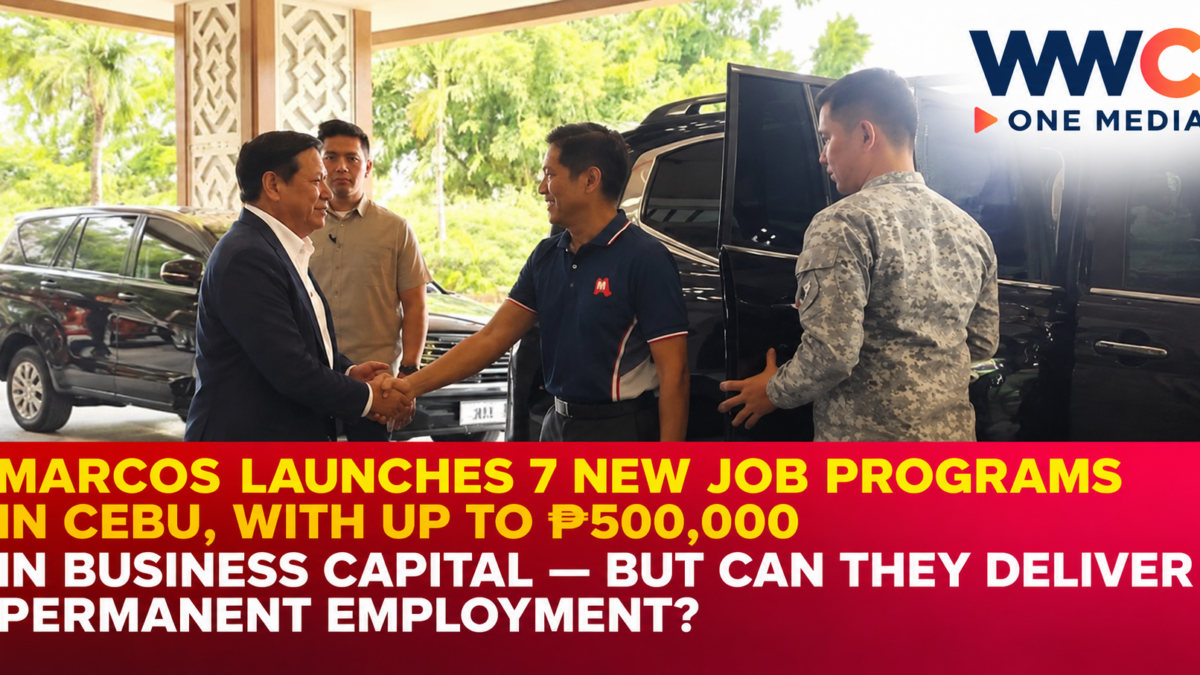
LAPU-LAPU CITY, Cebu — President Ferdinand Marcos Jr. has launched seven government employment and livelihood initiatives aimed at helping disadvantaged Filipinos secure more stable jobs, build small businesses and develop skills that match the needs of employers.
The programs, unveiled on October 14, 2026, during the 26th National Public Employment Service Office (PESO) Congress at Jpark Island Resort and Waterpark in Lapu-Lapu City, represent a major expansion of the Department of Labor and Employment’s Tulong Panghanapbuhay sa Ating Disadvantaged/Displaced Workers (TUPAD) program.
Among the new measures are business capital assistance ranging from ₱50,000 to ₱500,000 for qualified groups, wage subsidies for eligible micro, small and medium enterprises (MSMEs), and opportunities for workers to gain formal skills certification and practical employment experience.
The government is also introducing targeted support for fisherfolk, coastal communities, academic mentors and municipalities with limited resources.
But beyond the announcement lies a question affecting millions of Filipino workers:
Can these initiatives turn temporary government assistance into lasting employment and sustainable income — or will beneficiaries continue to struggle once the support ends?
Marcos Expands TUPAD Beyond Temporary Employment
TUPAD has traditionally provided emergency, short-term employment to disadvantaged, displaced and underemployed workers.
Beneficiaries typically receive temporary income through approved community projects and other qualifying activities.
The new initiatives seek to build on that assistance by helping participants acquire practical skills, establish enterprises and connect with potential employers.
The seven programs were established through DOLE Department Order No. 239-E, Series of 2026, issued on September 22, before their public launch in Cebu.
Labor Secretary Francis Tolentino presented the programs to Marcos, who met at least 75 beneficiaries during the event.
Many were fisherfolk who received assistance involving fishing boats, fish pens and other livelihood support.
The government says the expanded approach is intended to reduce dependence on temporary employment by providing pathways toward more sustainable sources of income.
The 7 New TUPAD Programs and Who Can Benefit
1. SkillPass — Turn Work Experience Into Recognized Skills
SkillPass helps qualified beneficiaries document skills and experience acquired through work.
Participants may undergo assessment and certification through the Technical Education and Skills Development Authority (TESDA).
The program addresses a common challenge among workers who possess practical abilities but lack formal certificates recognized by employers.
With suitable certification, qualified beneficiaries may improve their prospects for training or employment.
However, certification itself does not guarantee that a job will be available.
2. Tropa Negosyo Trabaho — Up to ₱500,000 in Business Capital
Also called Puhunan Ko, this initiative provides capital assistance ranging from ₱50,000 to ₱500,000 to groups of at least five qualified beneficiaries who want to establish microenterprises.
The assistance is accompanied by business training, mentoring and market support.
Potential beneficiaries include eligible disadvantaged workers interested in building businesses rather than relying entirely on short-term employment.
The program is designed to encourage entrepreneurship while helping participants develop business-management capabilities.
The ₱500,000 figure is the maximum assistance for an eligible group, not a guaranteed amount for every applicant or an individual cash payout.
3. Sagip-Trabaho — Wage Subsidies to Help Businesses Keep Workers
Sagip-Trabaho provides wage subsidies for up to 90 days to qualified MSMEs affected by mandated minimum-wage increases.
The initiative aims to reduce the immediate burden of higher labor costs while helping participating businesses retain employees.
During the Cebu rollout, Tolentino said the government would cover the additional ₱42 daily minimum-wage increase for eligible Central Visayas MSMEs under the program.
The subsidy could provide short-term financial relief to small businesses adjusting to higher payroll expenses.
However, assistance is limited to qualifying employers and the applicable subsidy period.
It does not permanently transfer all wage obligations from businesses to the government.
4. KaHANAP — Connect Jobseekers With Employers
KaHANAP matches job-ready TUPAD beneficiaries and other qualified workers with MSMEs.
Participants can receive up to 90 days of supervised workplace experience, allowing them to develop skills and demonstrate their capabilities.
For employers, the arrangement provides an opportunity to assess potential recruits.
For workers, it offers experience that may support a transition into regular employment.
But successful placement after the supervised period is not automatic.
The program’s effectiveness will depend on how many participants eventually secure lasting jobs.
5. Match Fund LGU — More Local Employment Opportunities
Match Fund LGU strengthens cooperation between DOLE and local government units by pooling resources for temporary employment projects.
The program focuses particularly on fourth-, fifth- and sixth-income-class municipalities.
Supported activities may include environmental protection, improvements in public services and local government digitalization.
By involving LGUs, the initiative aims to make employment projects more responsive to community needs.
Its reach will depend partly on the funding, project capacity and implementation resources available to participating local governments.
6. Tulong-Aral — Employment for Academic Mentors, Support for Young Learners
Tulong-Aral creates opportunities for qualified education graduates and academic mentors to help children in Grades 1 to 3.
The focus is on foundational reading, writing and mathematics skills.
Mentors must undergo appropriate training before being deployed to public schools or authorized learning locations.
The initiative links two government priorities: improving employment opportunities and supporting basic education.
Its impact will depend on mentor preparation, sustained implementation and measurable improvements in pupils’ learning outcomes.
7. Trabahong-Dagat — Livelihood Support for Fisherfolk
Trabahong-Dagat provides employment, training and enterprise opportunities for fisherfolk, coastal youth and other qualified workers.
The program is particularly relevant during closed fishing seasons, when fishing restrictions can interrupt the incomes of coastal households.
Supported activities may include aquaculture, fisheries production, maritime-related work and small-business development.
The initiative forms part of the government’s effort to strengthen the blue economy while supporting communities that depend on marine resources.
Successful implementation could provide alternative income opportunities, although the sustainability of these activities will depend on equipment, market access, training and continuing support.
₱42 Daily Wage Increase Takes Effect in Central Visayas
The Cebu launch coincided with new minimum-wage rates taking effect in Central Visayas on October 14.
Covered private-sector minimum-wage earners are entitled to an additional ₱42 per day, while covered domestic workers receive an additional ₱500 in their monthly minimum wage.
The government introduced Sagip-Trabaho as a temporary support mechanism for eligible MSMEs affected by the increase.
For workers, the wage adjustment is intended to help address rising household expenses.
For small businesses, however, higher wage costs can create financial pressure, particularly when sales are weak or operating expenses are already elevated.
The subsidy is intended to ease the adjustment without removing the employer’s obligation to comply with applicable wage regulations.
Workers and employers should consult the official regional wage orders to determine coverage, exemptions and the resulting minimum-wage rates.
More Than 1,300 Job Vacancies Offered in Lapu-Lapu City
The government also organized a job fair at Island Central Mactan during the Cebu event.
According to the announcement, the fair offered more than 1,300 local and overseas employment vacancies, including 275 maritime-related positions.
These vacancies provided an immediate opportunity for jobseekers to explore work possibilities.
However, advertised vacancies should not be confused with confirmed hires.
Actual employment results depend on employer selection, applicant qualifications and successful completion of recruitment requirements.
The event was part of a broader government effort to improve job matching and address the gap between workers’ skills and employers’ requirements.
Government Reports 65,534 Hired Through Job Fairs
Marcos highlighted employment-related results from existing government initiatives.
From January through August 2026, the government conducted 1,554 job fairs nationwide.
The events resulted in 65,534 individuals being hired on the spot, according to the administration.
The President also reported that more than 91% of qualified jobseekers under the PESO program were successfully placed in employment.
During the first half of 2026, the Special Program for Employment of Students supported 111,509 students and out-of-school youth.
Nearly 20,000 individuals also gained experience through the Government Internship Program.
These figures illustrate the scale of government employment assistance.
However, they do not establish how many beneficiaries secured permanent jobs, how long they remained employed or whether their wages provided sufficient income.
TUPAD Has Reached More Than 14 Million Beneficiaries
According to the Philippine News Agency, TUPAD provided emergency employment assistance to approximately 14.04 million beneficiaries from July 2022 through August 2026.
The figure demonstrates the scale of the government’s short-term employment support.
But reaching millions of beneficiaries is not the same as creating millions of permanent positions.
Because the program historically provides temporary work, its longer-term success must be assessed through outcomes such as employment retention, skills development and business survival.
The seven new initiatives appear intended to address this gap by expanding the program beyond emergency income assistance.
Small Businesses Could Become Critical to the Strategy
MSMEs play an important role in Philippine employment, making them central to the government’s expanded livelihood strategy.
Sagip-Trabaho is designed to help eligible firms manage wage adjustments.
KaHANAP seeks to connect job-ready workers with these businesses.
Tropa Negosyo Trabaho encourages qualified groups to develop enterprises of their own.
Together, these initiatives attempt to tackle different stages of employment and entrepreneurship.
One example highlighted by the Presidential Communications Office is John Paul Maunes, founder of Dubby’s Burger Restaurant.
Maunes welcomed Sagip-Trabaho as a way to help his business manage higher wages and protect employment.
His restaurant employs 10 regular workers, all persons with disabilities.
The example illustrates how wage support may help qualifying businesses retain staff.
But the economic impact of the programs will depend on implementation across a much wider population of employers and workers.
Can the New Programs Address Skills Mismatches?
During the Cebu congress, Marcos identified skills mismatches as a major obstacle to employment.
Workers may struggle to qualify for vacancies even when employers are actively hiring.
The administration has directed agencies including DOLE, the Department of Education, Department of Trade and Industry, Commission on Higher Education and TESDA to improve coordination between education, training and labor-market requirements.
Programs such as SkillPass and KaHANAP are intended to strengthen that connection.
But skills matching also depends on practical factors, including the location of available jobs, transportation costs, compensation and employers’ willingness to hire.
For many workers, earning a certificate or completing workplace training will be only the first step toward securing stable income.
The Bigger Challenge: Turning Assistance Into Permanent Jobs
The new TUPAD initiatives represent an effort to shift government employment assistance toward longer-term economic opportunities.
Their design includes skills certification, enterprise support, workplace experience, wage assistance, education and coastal livelihood development.
But these initiatives face an important implementation test.
Will businesses created with government support survive beyond their initial funding?
Will workers completing supervised placements be hired permanently?
Will wage subsidies help prevent layoffs after the 90-day assistance period ends?
And will coastal communities gain dependable sources of income when seasonal fishing restrictions or severe weather interrupt their work?
These questions require measurable results rather than announcements alone.
The public will need clear information on approved beneficiaries, funds released, jobs retained, businesses created and longer-term employment outcomes.
Cebu Rollout Could Set the Stage for Nationwide Implementation
The October 14 launch positions Cebu as an early venue for presenting the government’s expanded TUPAD framework.
But the seven initiatives are national DOLE programs, not employment benefits exclusively reserved for Cebu residents.
Their implementation will depend on eligibility rules, available appropriations, local project arrangements and agency capacity.
For disadvantaged workers, the new opportunities may provide a path toward greater economic independence.
For small businesses, temporary wage assistance and access to trained workers could help manage operating challenges.
For government agencies, the challenge will be proving that the expanded system produces sustainable economic outcomes.
Marcos has introduced seven new programs offering skills training, business capital, wage subsidies and employment pathways. But the real test will come after the ceremonies and temporary assistance end: can these programs create lasting jobs and stable incomes for the Filipinos who need them most?