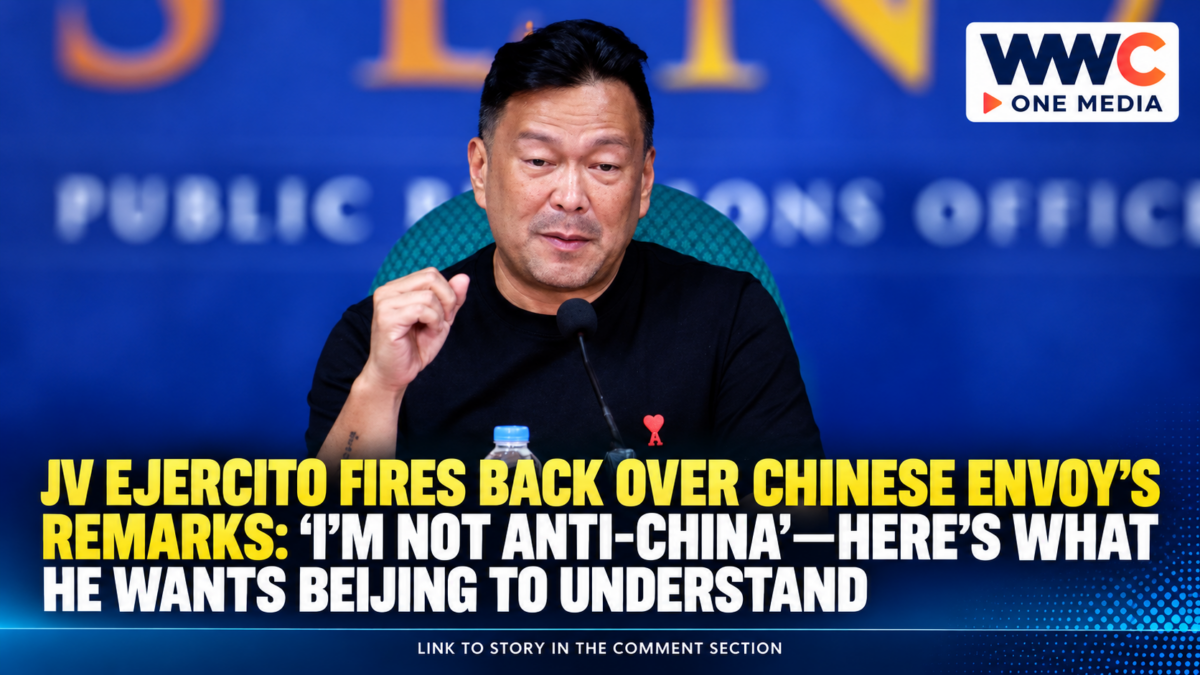
MANILA, Philippines — Senator JV Ejercito has pushed back against accusations that his criticism of China reflects anti-China sentiment, insisting that his objection is directed at what he considers the undiplomatic and hostile behavior of Chinese Ambassador Jing Quan.
The controversy has intensified tensions between Manila and Beijing, with the senator arguing that foreign diplomats should help maintain constructive relations instead of making statements that could further inflame the dispute over the West Philippine Sea.
Ejercito has criticized Jing’s remarks about China’s military superiority, particularly the ambassador’s statement that Beijing could “easily win” if it chose to use force against the Philippines. The Chinese envoy also said China would not choose force and that Beijing valued peace.
For Ejercito, the issue is not about hostility toward Chinese nationals or ordinary Chinese citizens. It is about how a foreign representative should conduct himself while serving in the Philippines.
JV Ejercito Draws the Line Between China and Its Government
Ejercito’s position centers on the distinction between opposing a government’s policies and harboring prejudice against its people.
The senator has maintained that the Philippines wants peaceful relations with China but must also defend its sovereignty and maritime rights. He has criticized what he describes as the expansionist policies of Chinese President Xi Jinping’s administration.
His comments come amid persistent friction in the West Philippine Sea, where the Philippines and China maintain competing maritime claims and have repeatedly clashed over activities at sea.
In a separate report published by the Daily Tribune on October 17, Ejercito described Jing’s remarks as aggressive and hostile, urging the ambassador to exercise greater diplomatic restraint. He also emphasized the need to pursue diplomatic solutions while strengthening the Philippines’ capacity to protect its maritime interests.
Why the Chinese Ambassador’s Remarks Sparked Outrage
The dispute escalated after Jing made his comments on October 15, 2026, in response to Philippine Defense Secretary Gilberto Teodoro Jr.’s description of China as a regional troublemaker.
Jing challenged that characterization and asserted that China could prevail in a conflict if it used force, while also insisting that Beijing preferred peace.
The remarks drew criticism from Philippine officials, including the Department of Foreign Affairs (DFA), which said the ambassador’s choice of words appeared to convey a thinly veiled threat of force.
The DFA subsequently summoned Jing on October 19 to convey the Philippines’ serious concern and strong objection. Foreign Affairs Secretary Ma. Theresa Lazaro described the statement as provocative and unacceptable, warning that it could aggravate an already sensitive bilateral relationship.
The department also stressed that foreign envoys should not intimidate Philippine officials and lawmakers exercising their democratic responsibilities.
President Ferdinand Marcos Jr. had likewise described the ambassador’s remarks as sounding like a threat, adding to calls for a diplomatic response.
Calls Grow for China to Replace Its Envoy
Ejercito has joined lawmakers urging Beijing to replace Jing, arguing that the ambassador’s public statements risk worsening relations instead of improving them.
According to a Philippine Star report published on October 19, the Senate majority bloc was preparing a resolution condemning the envoy’s remarks. Ejercito also called for Jing’s immediate replacement.
However, lawmakers are not unanimous on how the Philippines should respond.
Senator Jinggoy Estrada has cautioned against hastily declaring the ambassador persona non grata, warning that expelling a foreign diplomat could carry significant diplomatic consequences. Although he acknowledged concerns over Jing’s remarks, he argued that the government should protest firmly without closing the door to dialogue.
The disagreement highlights a broader question facing Manila: how can the Philippines respond forcefully to statements it considers threatening while preserving diplomatic channels needed to manage tensions with Beijing?
West Philippine Sea Dispute Remains at the Center
The diplomatic dispute is unfolding against the backdrop of the long-running South China Sea conflict.
The Philippines calls the maritime areas on the western side of its archipelago the West Philippine Sea. China claims extensive areas of the South China Sea, bringing the two countries into repeated disagreements over maritime rights and jurisdiction.
In 2016, an arbitral tribunal ruling in a case brought by the Philippines rejected the legal basis for China’s expansive claim to historic rights within its so-called nine-dash line where those claims exceeded the limits permitted under international law. China rejected the ruling, while Manila continues to invoke it in defending its maritime rights.
The latest controversy underscores the delicate balance between maintaining dialogue with Beijing and responding to statements Philippine officials consider unacceptable.
For Ejercito, criticizing the ambassador does not mean rejecting relations with China. His argument is that diplomacy must be conducted with restraint and respect, especially when disputes over sovereignty and maritime security remain unresolved.
As the Philippine government considers its next steps, the question is whether diplomatic protests and calls for a change in China’s representation will ease tensions—or further complicate an already strained relationship.