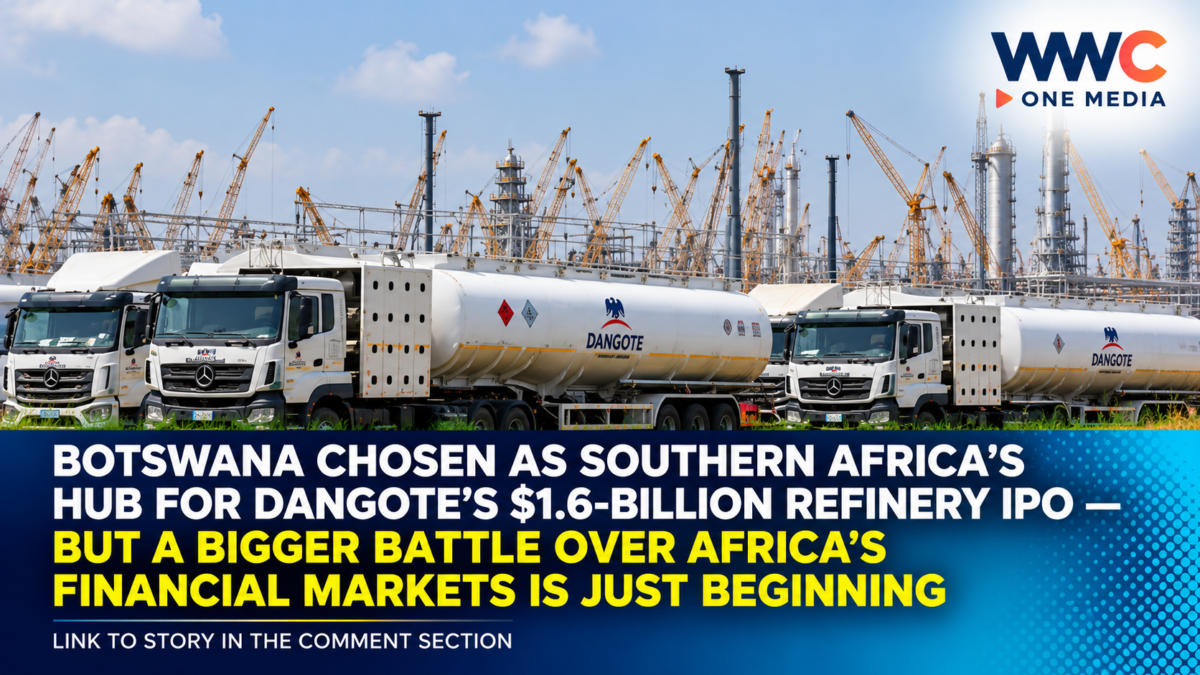
GABORONE, BOTSWANA / LAGOS, NIGERIA — October 14, 2026 — Botswana has been selected as the Southern African trading hub for billionaire Aliko Dangote’s US$1.6-billion oil refinery initial public offering, handing the country’s financial market a potentially historic role in one of the continent’s largest-ever share sales.
The move is intended to make it easier for investors across Southern Africa to participate in the offering of Dangote Petroleum Refinery and Petrochemicals, which operates Africa’s largest refinery near Lagos, Nigeria.
According to Bloomberg, the decision was made through the Committee of Southern African Development Community (SADC) Stock Exchanges, which represents 14 regional exchanges.
The committee selected Botswana as a single host venue for the Southern African component of the transaction, potentially reducing the complexity of coordinating participation across multiple national stock markets.
But the agreement comes with a major challenge.
Africa’s financial markets remain fragmented, with different securities laws, trading systems and investor-access requirements making cross-border investing difficult.
The Dangote IPO is exposing those weaknesses even as it creates an opportunity to transform how African investors finance major industrial projects.
For Botswana, the development could elevate its position in regional capital markets.
For Dangote, it represents another step toward his ambition of building a refinery owned not only by wealthy institutions but also by millions of African retail investors.
And for Africa’s financial system, the bigger question is whether one historic IPO can help overcome decades of barriers separating the continent’s stock exchanges.
Botswana Selected to Lead Southern African Trading Arrangements
The Committee of SADC Stock Exchanges has chosen Botswana as the host venue for the Southern African component of Dangote’s refinery IPO.
Collen Tapfumaneyi, chairman of the regional committee, confirmed the arrangement in reporting published by Bloomberg on October 14.
The committee coordinates cooperation among stock exchanges throughout the Southern African Development Community.
Rather than requiring every participating market to develop a completely separate trading arrangement, the committee opted for a single regional venue to help simplify the process.
For Botswana, the selection represents an opportunity to strengthen its financial-market profile and play a more prominent role in regional investment.
The country’s stock exchange is considerably smaller than the largest African markets, including Johannesburg and Lagos.
Nevertheless, it has established financial institutions and experience serving domestic and regional investors.
The arrangement could eventually help connect Southern African investors with major investment opportunities originating elsewhere on the continent.
However, the final operating structure, settlement arrangements and regulatory permissions have not all been publicly detailed.
The designation should therefore be understood as a regional coordination decision, not proof that the IPO has already completed a separate Botswana listing.
Dangote’s $1.6-Billion IPO Could Become Africa’s Largest
The refinery IPO is one of Africa’s most closely watched financial transactions of 2026.
Dangote Petroleum Refinery and Petrochemicals launched its share offering on September 14, seeking to raise approximately US$1.6 billion.
The fundraising could increase to approximately US$2.1 billion if an over-allotment option is exercised.
Earlier marketing reports placed the company’s valuation at approximately US$49 billion to US$50 billion.
The offering is designed to provide investors with access to a large industrial asset that has already transformed Nigeria’s domestic fuel market.
Dangote, Africa’s richest businessman, has presented the IPO as an opportunity to spread ownership of major African industries more broadly among the continent’s population.
The company aims to attract as many as 10 million shareholders.
However, the ambitious investor target should not be mistaken for the number of confirmed subscribers.
The final participation level and total capital raised will only become clear after the relevant subscription and allocation processes are completed.
Africa’s Cross-Border Investing Problem Takes Center Stage
The decision to establish a regional hub follows difficulties encountered during the initial rollout of the IPO.
Reuters reported on October 9 that the offering had been registered as a public share sale in Nigeria, but not across every African country.
This created complications for investors in other markets.
Individuals seeking to participate faced different regulatory requirements depending on where they lived.
Some markets required additional permissions, while investors elsewhere had to use eligible international brokerage arrangements.
The offering’s Nigerian prospectus identified Ecobank and Standard Bank-owned SBG Securities as channels for investors from other African countries.
By comparison, investors in Nigeria had access to dozens of subscription channels, including banks, brokers and financial technology applications.
The difference shows why a major industrial project can attract continent-wide interest without automatically becoming accessible to everyone.
The problem is not simply a lack of investor demand.
It is also the absence of a fully integrated framework for cross-border securities offerings.
Dangote Extends IPO Deadline to October 27
In response to strong investor interest and the challenges facing potential subscribers outside Nigeria, Dangote extended the IPO application deadline.
The offering had originally been scheduled to close on October 13.
However, the company announced that the deadline would be extended to October 27, 2026, following approval from Nigeria’s Securities and Exchange Commission.
Dangote said the additional time was intended to allow more African investors to participate.
The extension is particularly important for investors in countries where additional regulatory steps or account-opening requirements are necessary.
It also gives regional stock exchanges and authorized brokers more time to address operational issues.
But the deadline extension does not automatically make the shares available through every African exchange.
Investors must still comply with the rules and eligibility requirements that apply in their respective jurisdictions.
Why Botswana Could Benefit From the Historic Share Sale
Hosting the Southern African component of Dangote’s IPO could bring several strategic advantages to Botswana.
First, it may increase the country’s visibility among international banks, institutional investors and companies considering regional fundraising.
Second, it could encourage improvements in stock-market infrastructure and connections with neighboring exchanges.
Third, it may provide a practical example of how smaller financial markets can cooperate rather than competing individually for every major transaction.
Botswana has traditionally been associated with its diamond industry and a relatively stable financial and institutional environment.
A higher-profile role in capital-market transactions could support its efforts to diversify economic activity beyond natural resources.
However, the designation does not guarantee that Botswana will receive the IPO proceeds or that its stock exchange will immediately experience a large increase in trading volumes.
The ultimate economic benefits will depend on how the regional arrangement operates and how many investors successfully participate.
Dangote Refinery Reports $4.73 Billion in Profit
The IPO has received additional attention following a sharp improvement in the refinery’s financial performance.
On October 13, Reuters reported that Dangote Petroleum Refinery posted a net profit of US$4.73 billion during the first nine months of 2026.
That compared with a US$117.2-million loss over the same period in 2025.
Revenue more than doubled to US$22.48 billion from US$9.19 billion.
Earnings before interest, taxes, depreciation and amortization, or EBITDA, increased to approximately US$5.52 billion.
The refinery also reported operating cash flow of US$3.68 billion and cash holdings of approximately US$6.69 billion at the end of September.
The company moved from a net debt position of US$1.73 billion a year earlier to a net cash position of approximately US$650.8 million.
These results demonstrate a substantial turnaround as the refinery increases production and benefits from stronger demand for petroleum products.
However, the figures were reported as unaudited results.
Investors should also recognize that refining profits can be highly sensitive to crude oil prices, fuel demand and processing margins.
Exceptional earnings during a period of global energy disruption do not guarantee similar profits in future years.
Africa’s Largest Refinery Plans to Double Its Capacity
Dangote’s refinery is located in the Lekki Free Zone near Lagos.
Built at an estimated cost of approximately US$20 billion, the facility began operations in 2024.
Its current processing capacity is approximately 700,000 barrels of crude oil per day.
Dangote plans to double that capacity to 1.4 million barrels per day by 2029.
If completed, the expansion would place the facility among the world’s largest oil-refining complexes.
The project is intended to strengthen Nigeria’s fuel self-sufficiency while expanding sales to other African markets and international buyers.
Nigeria historically relied heavily on imported refined petroleum products despite being a major crude oil producer.
The Dangote refinery has begun changing that structure by increasing domestic fuel production.
Its expansion could further influence regional fuel supply chains.
However, doubling capacity will require substantial additional capital, construction work and reliable access to feedstock.
The IPO is one component of the broader financing strategy.
The Middle East Energy Crisis Boosts Refinery Earnings
The refinery’s strong recent financial results have also been influenced by global energy-market conditions.
According to Reuters, disruptions associated with the conflict involving Iran have increased demand for alternative refined fuel supplies.
Dangote has benefited from stronger refining margins and greater international demand for products such as jet fuel.
The facility has expanded sales beyond Nigeria, including exports to Western Europe.
This has strengthened its role in international energy markets.
But the development also introduces risks.
Refining margins can decline when supply disruptions ease, oil prices change or competing refineries increase production.
Investors evaluating the IPO must therefore consider whether the company’s recent earnings are sustainable under more normal market conditions.
A large refinery can remain commercially valuable even when margins weaken, but its valuation should reflect the industry’s cyclical nature.
Kenya and Other African Markets Want Greater Access
Botswana is not the only country interested in broadening participation in the Dangote share sale.
Kenya has also been pursuing arrangements to make the IPO accessible to local investors.
Reuters reported that Kenya approved an offering of global depositary receipts linked to the refinery IPO.
These financial instruments can allow investors to gain exposure to shares through structures designed for international participation.
However, their availability and trading conditions depend on the applicable regulatory framework.
Other African markets have also expressed interest in creating more efficient channels for regional investment.
The enthusiasm reflects a broader desire among African investors to own stakes in major industrial businesses instead of relying exclusively on foreign investment flows.
The challenge is turning that ambition into functioning market infrastructure.
Could Dangote’s IPO Transform African Capital Markets?
The IPO has become a test of whether Africa can mobilize domestic savings to finance large-scale industrial development.
Many African economies have historically depended on foreign loans, development finance and international investors to fund major infrastructure projects.
Building stronger local capital markets could create an additional source of long-term funding.
Banks and policymakers argue that broader public investment could also help spread the financial benefits of industrial expansion.
Citi’s head of banking for Sub-Saharan Africa, Akin Dawodu, said the Dangote IPO could encourage deeper capital-market participation across the continent.
According to Reuters, fewer than 5% of Nigerian adults currently participate in capital markets.
The Dangote transaction has already generated significant interest among retail investors.
However, wider participation also raises questions about financial literacy, valuation and investor protection.
Encouraging ordinary people to buy shares must be accompanied by clear disclosures about financial risks.
A widely promoted IPO is not necessarily a low-risk investment.
The Bigger Problem: Africa Still Lacks a Unified Securities Market
The Dangote offering exposes a longstanding challenge for African financial integration.
Although the continent has pursued closer economic cooperation through initiatives such as the African Continental Free Trade Area, its securities markets remain governed by different national regulatory systems.
This makes it difficult to launch a single public offering across multiple countries.
Stock exchanges may use different settlement systems, investor-identification rules and compliance procedures.
Companies seeking to raise capital regionally can therefore face significant administrative costs and delays.
The selection of Botswana as a regional hub represents one attempt to address part of that problem.
But building a fully integrated African investment market will require much more than choosing a host exchange.
It will likely require greater cooperation among securities regulators, market operators, banks and governments.
Questions involving investor protection, currency conversion, taxation and settlement arrangements will also need to be addressed.
For the Dangote IPO, these challenges are immediate.
For Africa’s capital markets, they are structural.
What Happens Next?
The immediate focus will be on the October 27 IPO application deadline and the next steps in implementing Botswana’s regional trading arrangement.
Investors will also watch for details of the offering’s final subscription results, share allocations and trading arrangements.
Dangote’s financial performance will remain central to the investment case, particularly as the company pursues its ambitious refinery expansion.
Meanwhile, regional stock exchanges may face pressure to improve cooperation after the difficulties encountered during this offering.
The transaction has already demonstrated that investor interest in major African industrial businesses can extend far beyond national borders.
But it has also shown that regulatory systems are not yet fully equipped to support frictionless investment across the continent.
For Botswana, the selection offers an opportunity to become more influential in regional finance.
For Dangote, it could help advance his goal of attracting millions of investors.
And for Africa, it raises a question that may shape the future of its capital markets.
Botswana may have secured a central role in Africa’s biggest refinery IPO — but the true breakthrough will come only if the continent can turn fragmented stock exchanges into an investment system capable of connecting millions of Africans to major businesses across national borders.