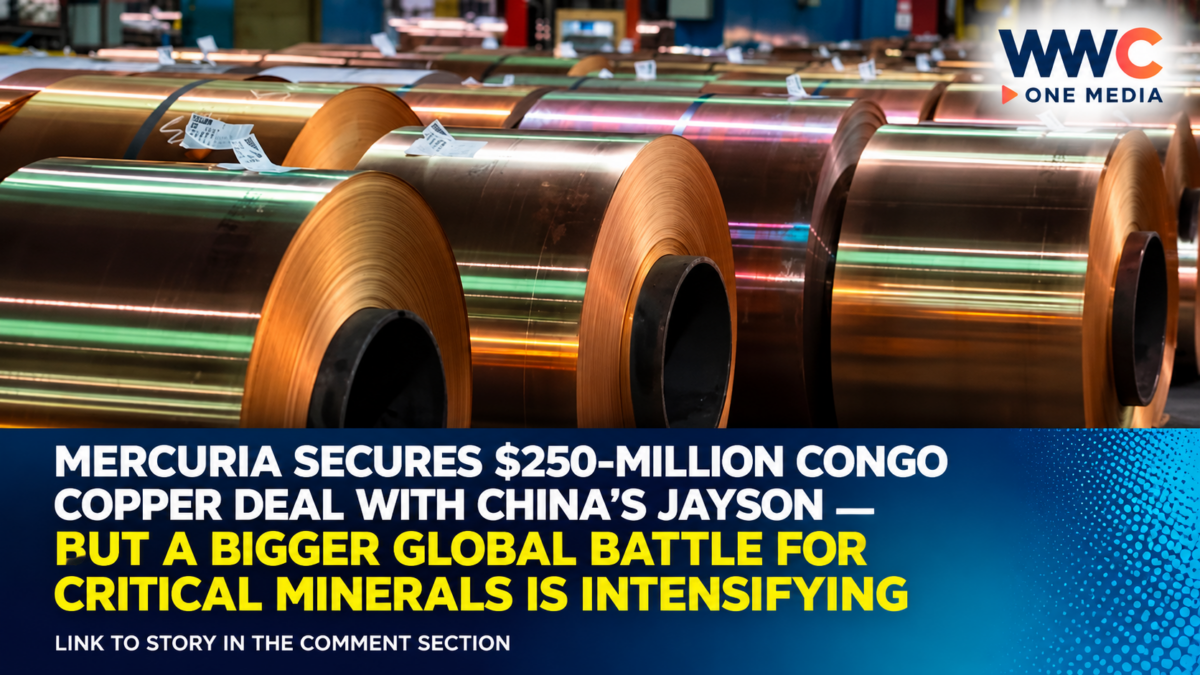
KINSHASA / GENEVA / SHANGHAI — October 14, 2026 — Global commodities giant Mercuria Energy Group has reportedly reached an agreement worth up to US$250 million to secure copper supplies from mining businesses connected to China’s Shanghai Jayson New Energy Materials Group, underscoring the intensifying international competition for one of the world’s most strategically important industrial metals.
The agreement covers three years of copper production from operations in the Democratic Republic of Congo, including the newly operating Kinga Kila project.
According to Bloomberg, citing people familiar with the confidential transaction, Mercuria will make advance payments to Jayson’s subsidiaries, Hongkong Excellen Mining Investment Co. and Singapore Excellen.
The arrangement strengthens Mercuria’s position in Congo, which has become the world’s second-largest copper producer after Chile and a key supplier of minerals used in electric vehicles, electricity networks, electronics and industrial infrastructure.
But the deal carries greater significance than its US$250-million headline value.
It comes as China, the United States and major international commodities traders compete for access to Africa’s copper and cobalt resources, while mining companies increasingly turn to advance-payment agreements to fund operations and secure long-term buyers.
The bigger question is whether control over future mineral supplies will become as strategically important as ownership of the mines themselves.
Mercuria Locks In Three Years of Copper Supply
The agreement reportedly allows Mercuria to purchase copper produced by operations controlled through units of Shanghai Jayson New Energy Materials Group.
The Chinese company is involved in manufacturing precursor materials for lithium-ion batteries and has investments in Congo’s mining sector.
Under the arrangement, Mercuria will provide up to US$250 million in prepayment financing in exchange for access to three years of production.
The deal includes copper originating from the Kinga Kila project, which began exporting metal in May 2026.
The arrangement is structured around future copper deliveries rather than Mercuria purchasing ownership of the mining operations.
Such agreements are known as prepayment or offtake financing.
They allow a commodities trader to advance money to a producer in exchange for rights to purchase future output under agreed commercial terms.
For mining companies, this can provide capital to support production, working capital requirements and business development.
For traders, it creates access to physical commodities that can be sold into international markets.
The reported maximum prepayment does not mean the entire US$250 million has already been disbursed.
China’s Jayson and CATL Chairman Linked to Congolese Mining Assets
One of the most notable aspects of the deal is the ownership structure behind the mining operations.
According to Bloomberg, an investment vehicle belonging to Robin Zeng, the billionaire chairman of Chinese battery manufacturer Contemporary Amperex Technology Co. Limited (CATL), owns nearly 30% of Hongkong Excellen.
Shanghai Jayson controls the remaining majority interest.
Hongkong Excellen holds the Congolese copper ventures involved in the arrangement.
The ownership structure connects the transaction to China’s broader electric-vehicle battery and critical minerals ecosystem.
However, an important distinction must be maintained.
The nearly 30% investment belongs to a vehicle associated with CATL’s chairman, not necessarily to CATL itself.
The reported arrangement therefore should not be characterized as CATL directly purchasing or selling US$250 million of copper.
The connection nevertheless illustrates how leading figures in China’s battery industry have developed financial interests in African mineral production.
These investments can provide exposure to metals that are essential for batteries, electrical infrastructure and industrial supply chains.
Congolese Mines Produced 56,000 Tons in Six Months
Jayson’s three copper projects in Congo produced approximately 56,000 metric tons of copper during the first half of 2026, according to government figures cited by Bloomberg.
The newest operation began exporting in May.
The production figures demonstrate that the assets involved are part of an active mining business rather than merely undeveloped exploration projects.
However, the entire 56,000-ton output should not be assumed to be committed to Mercuria.
The reported agreement does not specify a publicly confirmed annual delivery volume or the exact quantity Mercuria will receive.
Those details will be important in evaluating the transaction’s commercial significance.
Copper output can also fluctuate depending on mine performance, processing capacity, infrastructure availability and operational conditions.
For commodity traders making advance payments, securing reliable delivery schedules is therefore a central commercial consideration.
Why Mercuria Is Paying Millions Before Copper Is Delivered
Mercuria is among the major international trading companies expanding their exposure to copper.
Demand for the metal is being supported by the electrification of transportation, construction of power networks, renewable-energy installations and industrial investment.
Copper is widely used because of its high electrical conductivity.
Electric vehicles require copper for motors, wiring, charging equipment and other electrical systems.
Data centers and electricity infrastructure also rely on extensive copper-based equipment.
But increasing demand is occurring alongside concerns about the difficulty and expense of developing new mines.
Copper projects can require years of exploration, permitting, infrastructure construction and financing before meaningful production begins.
That makes existing operating assets particularly valuable.
Instead of waiting for new projects to enter production, trading companies can use prepayment arrangements to secure supplies from mines already operating or approaching commercial output.
The strategy can reduce uncertainty over access to physical metal, although it also creates exposure to the producer’s financial and operational performance.
Banks Expected to Finance Much of the Deal
The reported financing structure also highlights the growing role of international banks in the commodities trade.
According to Bloomberg, a banking syndicate expected to include Rabobank may finance the majority of Mercuria’s advance payments.
Other lenders could also participate.
Rabobank declined to comment on the reported arrangement.
Syndicated financing allows multiple institutions to participate in a transaction rather than leaving one lender to provide the entire amount.
In commodity transactions, banks may consider the expected value of future deliveries, the creditworthiness of counterparties and the quality of the underlying assets.
However, financing expectations should not be confused with a publicly confirmed completed lending agreement.
The final bank commitments, pricing and security arrangements have not been disclosed.
For Mercuria, access to external financing could support the expansion of its copper trading business without requiring the company to fund the entire transaction solely from its own resources.
Mercuria Has Already Signed a $100-Million Congo Copper Agreement
The latest transaction follows another significant deal involving Mercuria.
In October 2025, Mercuria and Eurasian Resources Group announced a long-term copper supply agreement supported by a prepayment facility of up to US$100 million.
The arrangement covered three years of copper deliveries from Eurasian Resources Group’s assets in Congo.
That transaction was confirmed through an official company announcement.
It showed Mercuria’s willingness to use advance financing to secure future supplies from the region.
The company is therefore building a wider portfolio of copper supply agreements rather than depending on a single mining partner.
These arrangements can create opportunities to serve industrial customers and trade metal between regional markets.
They can also expose the company to changes in copper prices, interest rates, logistics costs and the reliability of mining operations.
Trafigura Is Also Spending Big to Secure Congolese Copper
Mercuria is not alone in pursuing this strategy.
Rival commodities trader Trafigura Group has committed US$200 million in advance funding to Ivanhoe Mines in connection with copper anodes from the Kamoa-Kakula mining complex.
The competing agreements illustrate how major international trading houses are positioning themselves to secure future production.
Congo has become especially attractive because of its expanding mining capacity and significant copper reserves.
As demand grows, trading firms can compete by offering miners financing, marketing services, logistical support and access to international buyers.
For producers, those arrangements may reduce dependence on traditional bank loans or equity fundraising.
For traders, access to reliable production can become a valuable commercial advantage.
However, advance financing remains subject to delivery and counterparty risks.
A supply contract does not automatically guarantee that mines will produce every expected shipment on schedule.
Congo Becomes the World’s Second-Largest Copper Producer
The Democratic Republic of Congo has strengthened its position as one of the world’s most important copper-producing nations.
According to Reuters reporting based on government data, Congolese copper exports reached approximately 1.72 million metric tons during the first half of 2026.
That compared with around 1.65 million tons during the same period in 2025.
The country is also the world’s largest producer of cobalt, another strategically important metal used in certain battery technologies.
Copper and cobalt frequently occur together in parts of Congo’s mineral-rich Copperbelt.
Major international mining companies and Chinese groups have invested heavily in the region.
China’s CMOC Group, Zijin Mining and other companies play important roles in the country’s mineral industry.
However, Kinshasa has also been working to diversify its export partnerships and attract additional investment from the United States, Europe and other markets.
The result is a more competitive environment in which mining operators, trading houses and governments are seeking access to the same resources.
Mercuria’s U.S.-Linked Minerals Strategy Adds a Geopolitical Twist
The latest arrangement is especially interesting because Mercuria is also involved in Congo’s efforts to expand copper exports to the United States.
The company has established a marketing partnership with Congo’s state mining group Gécamines.
In January 2026, Gécamines announced plans to market 100,000 tons of copper from the Tenke Fungurume mine for the American market with Mercuria’s support.
The initiative was connected to Congo’s broader strategic minerals cooperation with Washington.
Additional reporting in April indicated that Gécamines had committed a substantially larger volume of copper for sale to U.S. markets through its Mercuria-backed venture.
These arrangements form part of efforts to diversify mineral sales beyond traditional export channels.
The new deal with Jayson therefore demonstrates the complexity of global commodity trading.
Mercuria can simultaneously cooperate with Congolese state interests, support mineral sales to American buyers and purchase production from Chinese-linked mining ventures.
These activities are not inherently contradictory.
International trading houses operate across political and commercial boundaries, and their business models depend on connecting producers with buyers in different markets.
The strategic competition between Washington and Beijing does not mean every commercial transaction must belong exclusively to one side.
China and the United States Compete for Critical Minerals
The latest copper agreement comes amid broader competition for African minerals.
China has spent years expanding its commercial relationships, mining investments and processing capacity in Congo.
In March 2026, Reuters reported that China and Congo had signed an agreement to deepen cooperation in the mining sector.
The agreement included measures involving investment protection, geological information and mineral-processing cooperation.
Meanwhile, the United States has pursued stronger links with Congo to diversify critical mineral supplies and reduce dependence on Chinese-dominated supply chains.
Washington’s strategy includes commercial partnerships, mineral offtake agreements and support for transport infrastructure.
For Congo, competition between international partners may provide opportunities to negotiate financing, infrastructure development and access to additional markets.
But the benefits will depend on contract terms, revenue management, environmental safeguards and the country’s ability to capture greater economic value from its mineral resources.
The Mercuria-Jayson transaction shows that commercial cooperation can continue even as geopolitical competition intensifies.
CATL’s Wider Congo Interests Highlight the Importance of Battery Metals
CATL, one of the world’s leading electric-vehicle battery manufacturers, already has significant exposure to Congo’s mining industry through its investments.
Bloomberg reported that CATL holds a 25% interest in Chinese mining giant CMOC Group.
It also has a separate 25% interest in CMOC’s Kisanfu mine, an important producer of cobalt.
These holdings illustrate how battery manufacturers and related investors have sought stronger connections to upstream mineral production.
Access to raw materials can become increasingly important as manufacturers attempt to manage production costs and supply-chain risks.
However, copper demand extends far beyond electric-vehicle batteries.
The metal is essential for power generation, industrial equipment, building construction and electrical transmission.
The current competition for copper therefore reflects broader industrial demand rather than reliance on a single battery technology.
Could Copper Prices Keep Rising?
The latest financing agreements are taking place against a backdrop of elevated copper prices and strong long-term demand expectations.
Electricity network expansion, data center construction and investment in electrification are supporting interest in the metal.
Regional price differences can also create trading opportunities for companies capable of transporting copper efficiently between markets.
However, commodity prices remain volatile.
Copper prices can weaken if global manufacturing slows, industrial demand disappoints or supply expands faster than expected.
For companies entering multi-year supply agreements, pricing formulas and hedging arrangements are therefore critical.
The commercial value of Mercuria’s latest transaction will depend on terms that have not been publicly disclosed.
The US$250-million commitment should not be interpreted as a guaranteed profit or as a direct forecast of future copper prices.
Mining Growth Also Raises Environmental and Social Questions
Congo’s growing importance in the critical minerals economy brings opportunities for investment, employment and government revenue.
But the mining sector also faces longstanding challenges involving infrastructure, environmental protection, labor conditions and the distribution of economic benefits.
Large industrial mining operations require reliable power supplies, transportation networks and effective environmental management.
Communities affected by mining developments may also raise concerns about land use, water resources, resettlement and compensation.
The existence of these wider industry risks does not establish wrongdoing by Mercuria, Jayson or the projects involved in the new agreement.
Nevertheless, responsible sourcing and supply-chain transparency are increasingly important considerations for companies buying minerals used in global technology and manufacturing.
Governments, lenders and downstream buyers may place growing emphasis on how and where copper is produced.
What Happens Next?
Investors and commodity-market participants will be watching for additional details of Mercuria’s agreement with Jayson’s subsidiaries.
Important unanswered questions include the exact copper delivery volumes, pricing formulas, repayment mechanisms and final financing commitments from participating banks.
The performance of Kinga Kila and Jayson’s other mining operations will also influence the commercial outcome.
More broadly, competition for Congo’s minerals is expected to remain an important theme in global commodities markets.
China continues to hold significant mining and processing interests, while Western governments and international traders seek greater access to supply.
For Congo, the challenge is turning international demand into lasting economic benefits.
For Mercuria, the latest agreement strengthens its growing role in the copper trade.
And for the global economy, it highlights a fundamental reality of the energy transition and digital infrastructure boom.
The future of copper supply may depend not only on which companies own the mines, but increasingly on who can finance production early enough to secure the metal before their competitors do.