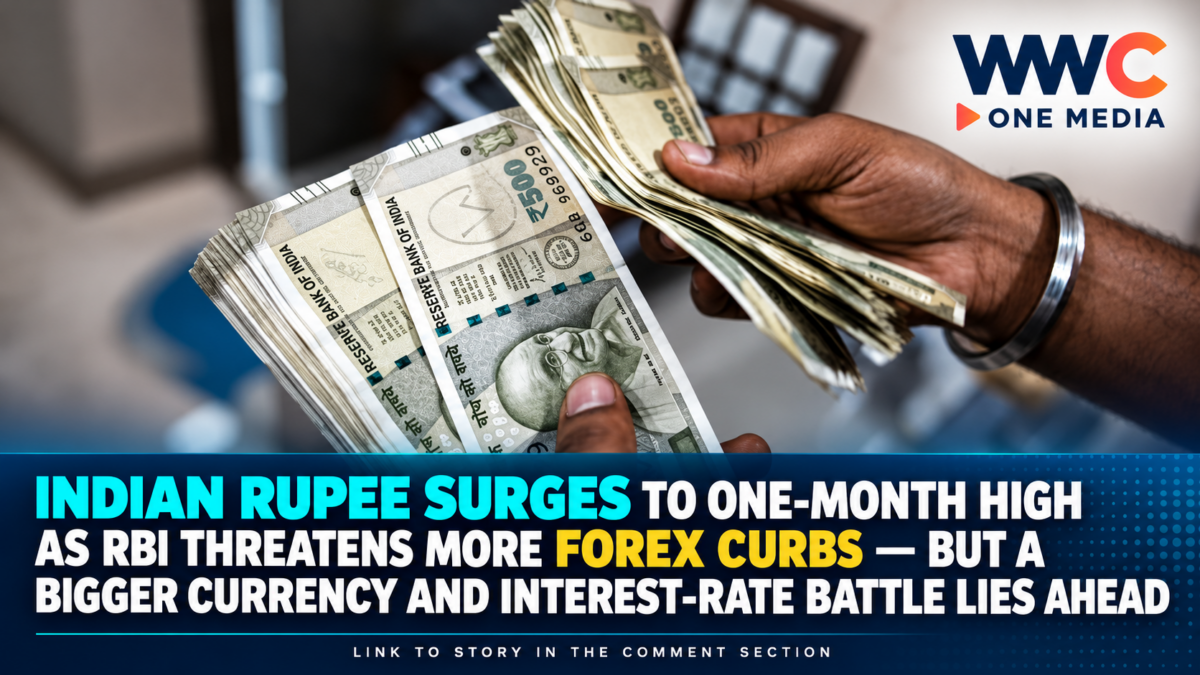
MUMBAI, INDIA — October 14, 2026 — India’s battered rupee has staged a dramatic comeback against the U.S. dollar after the Reserve Bank of India intensified its crackdown on speculative currency trading, but the central bank is warning that more measures could follow if market pressures return.
The Indian currency strengthened for a third consecutive trading session on Wednesday, climbing to an intraday high of ₹94.77 per dollar, its strongest level in more than a month.
The rupee later surrendered part of those gains, closing at approximately ₹95.15 against the dollar, according to Reuters.
Despite the late-session retreat, the currency has gained about 2% this week following an aggressive series of RBI measures aimed at reducing dollar demand and discouraging speculative positions.
The latest rally comes after the rupee approached a record low of approximately ₹96.96 per dollar last week, reflecting pressure from elevated crude oil prices, foreign capital outflows and uncertainty over global interest rates.
But investors are now confronting a more complicated question.
Can India’s central bank turn a short-term currency rebound into lasting stability without placing additional pressure on banks, importers and an economy already facing significant external challenges?
RBI Governor Warns More Currency Measures Could Follow
The rupee’s latest gains followed strong comments from RBI Governor Sanjay Malhotra, who said the central bank remained prepared to intervene further if speculative trading continued to disrupt foreign exchange markets.
In an interview with Moneycontrol published October 13, Malhotra emphasized that the RBI would use available tools to maintain orderly currency-market conditions.
His remarks signaled that the central bank was increasingly concerned about speculative positions amplifying the rupee’s weakness.
The governor also stressed that the RBI’s latest restrictions should not be interpreted as capital controls.
Instead, he explained, the measures are intended to ensure that foreign exchange derivatives are used primarily for legitimate hedging requirements rather than excessive speculative activity.
This distinction matters.
Businesses frequently use currency derivatives to protect themselves against unfavorable exchange-rate movements.
An importer expecting to pay a supplier in U.S. dollars, for example, may buy dollars forward to lock in the cost of a future payment.
Such transactions help companies manage financial risk.
However, regulators become concerned when speculative positions increase pressure on the currency or contribute to disorderly trading.
The RBI is attempting to limit those risks without completely disrupting genuine commercial hedging.
Rupee Rebounds After Approaching Record Low
The Indian rupee faced heavy selling pressure before the latest intervention.
Last week, it approached ₹96.96 against the U.S. dollar, reflecting the combined effects of stronger dollar demand, high oil prices and portfolio investment outflows.
India is particularly sensitive to fluctuations in global crude prices because it imports a substantial share of its petroleum requirements.
When oil prices rise, refiners need more dollars to purchase crude, potentially increasing pressure on the rupee.
Foreign portfolio outflows can create additional demand for dollars when international investors sell Indian assets and move their proceeds overseas.
The RBI’s latest measures have helped reverse part of this pressure.
According to Reuters, the rupee had fallen more than 7% against the dollar during 2026 before the central bank introduced new measures over the weekend.
By October 14, the currency had recovered approximately 2% for the week.
However, the rebound has not erased its earlier annual losses.
RBI Introduces Special Dollar Facility for Oil Companies
One of the most significant steps taken by the central bank involves India’s state-run oil marketing companies.
The RBI introduced a special arrangement allowing these companies to obtain U.S. dollars through designated channels rather than relying entirely on the ordinary spot foreign exchange market.
The move is designed to reduce concentrated dollar demand from oil importers.
Because petroleum purchases are a major source of foreign currency demand, redirecting those transactions can help ease immediate pressure on the exchange rate.
The arrangement does not eliminate India’s underlying requirement to pay for imported oil.
Instead, it changes how a significant portion of that dollar demand is managed.
This can support short-term market stability, but its effectiveness over time will still depend partly on global crude prices and India’s energy import requirements.
Currency Derivative Rules Become Tougher
The central bank has also tightened regulations affecting certain foreign exchange derivative transactions.
Its measures include restrictions intended to reduce speculative positions and additional requirements affecting banks involved in some currency contracts.
The RBI has also introduced a 20% reserve requirement for certain large foreign exchange transactions.
Such rules can make speculative trading more expensive or reduce the amount of liquidity available for particular strategies.
However, they can also increase the cost of hedging for legitimate businesses.
Importers and exporters rely on currency markets to protect their future revenues and expenses from exchange-rate fluctuations.
If hedging becomes significantly more expensive, companies may face additional financial pressure even if the measures contribute to short-term currency stability.
That creates a delicate policy balance for the RBI.
The central bank wants to discourage destabilizing speculation without preventing companies from managing genuine foreign exchange exposure.
Importers Continue Buying Dollars Despite RBI Crackdown
Despite the rupee’s recovery, Indian importers are continuing to purchase dollars in forward markets.
This suggests some businesses remain concerned that the currency could weaken again.
Bloomberg reported on October 14 that average monthly forward dollar purchases by Indian importers had increased approximately 44% this year compared with 2025, reaching about US$64 billion.
The increase illustrates the extent of corporate demand for protection against exchange-rate depreciation.
Importers generally face higher costs when the rupee loses value because they must exchange more rupees for the dollars needed to purchase overseas goods.
Locking in future dollar rates can reduce uncertainty, but it may also contribute to immediate pressure in foreign exchange markets depending on how banks manage their positions.
The RBI’s challenge is therefore no longer limited to discouraging speculative investors.
It must also consider the commercial behavior of companies responding rationally to currency volatility.
Importers may continue hedging even when the rupee strengthens because their priority is protecting future costs rather than predicting short-term market movements.
Why the Rupee’s Rally Stalled Near ₹95
The rupee briefly strengthened to ₹94.77 per dollar during Wednesday’s trading session.
However, it was unable to sustain those gains and finished around ₹95.15.
Reuters attributed the pullback partly to continued dollar demand from importers and foreign portfolio outflows.
The retreat highlights an important distinction between temporary currency support and a durable market recovery.
Central bank measures can change trading conditions, reduce speculative positions and improve investor sentiment.
But they cannot automatically eliminate the broader economic forces driving demand for foreign currency.
Oil prices, international capital movements and U.S. interest rates remain important influences on the rupee.
DBS analysts cautioned that a lasting turnaround would require unfavorable global conditions to ease.
That assessment suggests the RBI’s latest intervention may be necessary to stabilize trading, but not sufficient to guarantee a sustained appreciation.
Interest-Rate Expectations Rise as RBI Defends Currency
The foreign exchange intervention is also influencing expectations for Indian monetary policy.
Reuters reported that rupee swap markets were pricing in approximately 100 basis points of interest-rate increases over the following 12 months.
A basis point is one-hundredth of a percentage point, meaning 100 basis points equals one percentage point.
Higher interest rates can sometimes support a currency by making domestic assets more attractive to investors.
However, rate increases can also raise borrowing costs for businesses and households, potentially slowing economic activity.
Malhotra indicated that while monetary policy is not normally used primarily to address financial stability concerns, the two issues cannot be treated as completely separate.
His comments encouraged traders to consider the possibility of a more restrictive policy environment.
Importantly, market pricing does not mean the RBI has already announced or committed to a full percentage point of rate increases.
Actual policy decisions will depend on inflation, economic growth, financial conditions and the central bank’s assessment of risks.
High Oil Prices Remain a Major Threat
India’s exposure to international oil prices continues to complicate the currency outlook.
Crude oil is generally traded in dollars, so higher global prices can increase India’s import bill.
A weaker rupee can magnify that pressure by increasing the local-currency cost of imported petroleum.
Together, these forces can affect transportation expenses, business costs and inflation.
For the RBI, that creates a difficult situation.
Allowing excessive currency weakness could contribute to imported inflation.
But defending the rupee too aggressively through monetary tightening could also slow domestic economic activity.
The special dollar facility for oil companies addresses part of the foreign exchange market’s immediate demand problem.
However, it does not remove the financial consequences of high international oil prices.
If crude prices remain elevated or rise further, pressure on India’s external accounts could persist.
Foreign Investment Flows Add Another Challenge
Foreign investors are another important influence on India’s currency.
When global investment funds purchase Indian shares or bonds, their transactions can increase demand for rupees.
When they withdraw money, the process can create additional dollar demand.
Movements in U.S. Treasury yields, global risk appetite and international interest-rate expectations can influence these flows.
A stronger dollar or rising global borrowing costs may encourage some investors to shift funds toward dollar-denominated assets.
India’s domestic fundamentals remain important, but external financial conditions can sometimes dominate short-term currency movements.
This is one reason the RBI’s interventions are being closely watched by international investors.
The central bank is attempting to improve market confidence while avoiding the impression that it is defending an inflexible exchange-rate target.
What the Rupee’s Recovery Means for Businesses
A more stable rupee can benefit Indian companies engaged in international trade.
Importers may gain from lower or more predictable foreign-currency costs.
Businesses purchasing overseas machinery, components and raw materials can plan more effectively when exchange rates are less volatile.
However, exporters may experience different effects.
A stronger rupee can reduce the local-currency value of dollar-denominated export revenues, depending on their costs and hedging arrangements.
Information technology companies, manufacturers and other businesses earning substantial foreign revenue can therefore be sensitive to currency appreciation.
For multinational investors, stability is often as important as the exchange rate itself.
Predictable trading conditions can reduce uncertainty surrounding investments and cross-border transactions.
But restrictions that significantly increase hedging expenses or reduce market liquidity could create new concerns.
The long-term outcome will depend on how the RBI balances stability with an efficiently functioning foreign exchange market.
Could Other Asian Economies Feel the Impact?
India’s latest measures are being watched beyond its domestic financial markets.
Emerging Asian economies share several vulnerabilities to global currency volatility, including energy import requirements, foreign capital flows and changes in U.S. interest rates.
Countries such as the Philippines, Indonesia and Thailand may experience similar external pressures, although their exchange-rate regimes, monetary policies and economic circumstances differ.
The RBI’s approach illustrates one possible response to intense currency-market pressure.
Rather than relying solely on interest-rate adjustments, it has used targeted regulations and special dollar-supply arrangements.
However, those measures are tailored to India’s market conditions and should not be interpreted as a policy blueprint automatically suitable for other Asian economies.
For regional investors, India’s experience highlights the importance of monitoring central bank actions alongside global oil prices and financial-market developments.
What Happens Next?
The rupee’s next movements will depend on whether the RBI’s measures continue to discourage speculative selling and whether importer demand for dollars begins to ease.
Investors will also monitor foreign portfolio flows, crude oil prices and upcoming U.S. inflation figures for signals about global interest-rate expectations.
Further RBI action remains possible, but it has not announced a fixed sequence of additional restrictions.
Market participants will therefore be looking for evidence that the recovery can survive without increasingly aggressive central bank support.
The currency’s return from last week’s lows shows that policy intervention can have a powerful short-term effect.
But the retreat from Wednesday’s intraday high demonstrates that underlying demand for dollars has not disappeared.
India’s rupee may have escaped its latest slide toward ₹97 per dollar, but the bigger test is whether the Reserve Bank of India can secure lasting currency stability without triggering higher financing costs, tighter market conditions or new pressure on the economy.