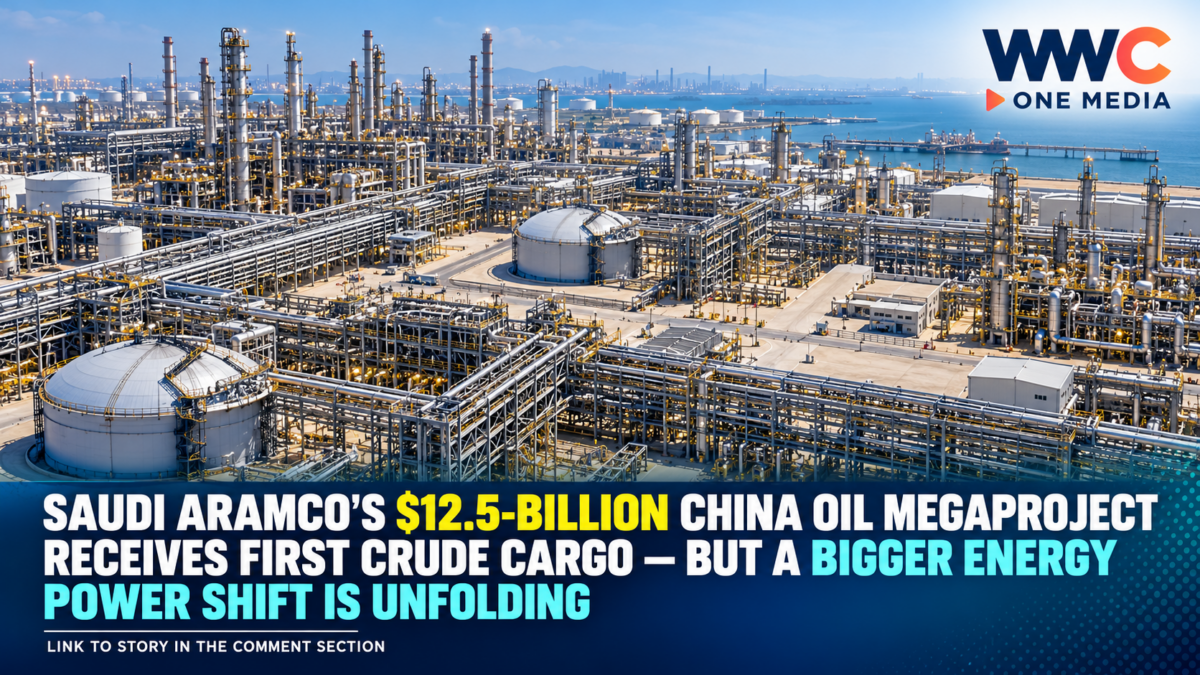
PANJIN, CHINA — October 14, 2026 — Saudi Arabia’s oil giant Saudi Aramco is advancing one of its most strategically important investments in China after its massive refinery and petrochemical joint venture received its first crude oil shipment, marking a significant milestone in a project designed to strengthen energy ties between the two economic powers.
The development at the Huajin Aramco Petrochemical Company (HAPCO) complex in Panjin, Liaoning province, highlights Saudi Arabia’s determination to deepen its presence in the world’s largest crude oil importing market, even as geopolitical tensions, shipping disruptions and volatile energy prices reshape global oil trade.
The project, valued at approximately $12.5 billion, includes a refinery designed to process 300,000 barrels of crude oil per day, alongside major petrochemical production facilities.
The first crude delivery is an important step toward operations, although receiving and storing oil does not necessarily mean that the refinery has begun full-scale commercial production.
A $12.5-Billion Energy Megaproject Takes Shape
The Panjin facility is being developed by HAPCO, a joint venture involving three major companies:
- China’s NORINCO Group — 51% ownership
- Saudi Aramco — 30% ownership
- Panjin Xincheng Industrial Group — 19% ownership
The industrial complex is designed to process crude oil into transportation fuels and petrochemical products used in manufacturing, packaging, textiles and other industries.
At its planned capacity, the project will include a 300,000-barrel-per-day refinery, annual production capacity of approximately 1.65 million metric tons of ethylene, and 2 million metric tons of paraxylene.
Saudi Aramco also has an agreement to supply as much as 210,000 barrels per day of crude oil feedstock to the facility, creating a potentially long-term market for Saudi petroleum.
That arrangement could help the company secure demand for its crude production while expanding into higher-value refined products and chemicals.
First Oil Shipment Signals Progress After Delays
The new refinery has faced a challenging development environment.
Reuters reported in June 2026 that the project had been delayed as disruptions to Middle Eastern oil supplies complicated refinery start-up plans.
Those challenges emerged amid wider regional conflict and uncertainty surrounding the transportation of crude through the Strait of Hormuz, one of the world’s most strategically important oil shipping routes.
A significant infrastructure milestone came in September when the project’s newly developed crude oil terminal at Panjin Port handled its first loaded very large crude carrier.
The vessel discharged crude oil through the new marine facility, with the shipment transferred by pipeline into storage tanks connected to the refinery complex.
The terminal includes a berth approximately 430 meters long, designed to accommodate large oil tankers.
Its operation strengthens the project’s ability to receive imported crude directly, reducing logistical obstacles as commissioning and start-up preparations advance.
However, the next critical milestone will be the refinery’s ability to process crude consistently and safely at commercial scale.
Why Saudi Arabia Is Investing Heavily in China
The Panjin project is part of a much larger Saudi strategy to expand beyond exporting crude oil.
For decades, Saudi Arabia has supplied China with petroleum to support its industrial growth and energy consumption.
But the relationship is evolving.
Instead of simply shipping crude to Chinese buyers, Saudi Aramco is increasingly investing in refining, petrochemicals and industrial partnerships inside China itself.
This gives the Saudi company greater exposure to downstream businesses while helping secure long-term customers for its oil.
China, meanwhile, benefits from additional refining capacity, industrial investment and potentially more predictable crude supply arrangements.
The partnership also complements Saudi Arabia’s wider economic diversification ambitions under Vision 2030, which seeks to develop industries beyond traditional crude oil production.
Middle East Conflict Creates a New Energy Challenge
The timing of the project comes as the global oil industry confronts extraordinary supply uncertainty.
Reuters reported on October 14 that Brent crude climbed to approximately $106.58 per barrel amid renewed concerns over attacks affecting Saudi Arabia and regional energy infrastructure.
The latest tensions have raised questions about shipping security and the reliability of Middle Eastern supply routes.
Reuters also reported that Asian refiners had purchased at least 12 million barrels of Saudi crude for November loading through spot-market transactions, as Aramco sought to expand sales amid shifting shipping conditions.
For Chinese refiners, securing reliable supplies has become increasingly important as Middle Eastern disruptions complicate purchasing decisions.
A new refinery tied to Saudi Aramco could provide an important long-term supply relationship.
Nevertheless, ownership ties and supply agreements cannot completely eliminate exposure to maritime disruptions, geopolitical tensions or global oil price fluctuations.
China’s Refining Industry Faces a Changing Market
The new facility is entering an industry undergoing significant transformation.
China remains the world’s largest crude oil importer and operates one of the biggest refining systems globally.
However, the country’s petroleum sector also faces structural changes.
Growing electric vehicle adoption, shifting transport-fuel consumption and changing industrial demand are influencing how refiners plan their operations.
These developments make petrochemical integration increasingly important.
Rather than depending exclusively on gasoline and diesel production, facilities such as HAPCO can produce chemicals needed in plastics, synthetic fibers, packaging and industrial manufacturing.
The strategy creates opportunities to capture value across a broader range of products.
Still, additional petrochemical capacity could intensify competition in markets already vulnerable to oversupply and fluctuating margins.
Asia’s Growing Influence Over Global Oil Trade
The Panjin development also reflects a broader transformation in global energy markets.
In an October 12 analysis, Reuters highlighted how the center of gravity in oil refining is increasingly moving toward Asia.
China, India, South Korea and Singapore collectively account for a substantial share of global refining capacity, positioning Asian markets to play a greater role in turning crude oil into transportation fuels and petrochemical products.
As disruptions affect refining operations in parts of the Middle East, Asian facilities may become increasingly important to global petroleum supply chains.
For Saudi Arabia, investments in Asian refineries offer a way to build long-term commercial relationships and maintain access to major energy markets.
For China, these partnerships can strengthen industrial infrastructure and diversify crude procurement arrangements.
What Happens Next?
The next major test for Huajin Aramco will be completing commissioning and achieving stable commercial operations.
Investors and energy traders will be watching several developments closely: the refinery’s initial processing volumes, its eventual production ramp-up, the reliability of Saudi crude deliveries, and the profitability of its fuels and petrochemical operations.
The project also faces risks from changes in Chinese petroleum consumption, heightened competition and continued geopolitical instability.
While the successful receipt of crude represents a meaningful advance, full-scale operations will be the stronger measure of whether the investment can deliver its intended commercial benefits.
The Bigger Picture
Saudi Aramco’s expanding partnership with China is about more than building another oil refinery.
It reflects a long-term strategy to secure demand, expand industrial cooperation and strengthen Saudi Arabia’s position in the global energy value chain.
As trade patterns shift and geopolitical tensions threaten traditional shipping routes, investments that connect oil producers directly with major Asian industrial markets could become increasingly significant.
The question now is whether Saudi Aramco’s multibillion-dollar Chinese venture can turn its first crude shipment into a commercially successful operation — or whether supply disruptions, changing fuel demand and petrochemical competition will create a much tougher test.