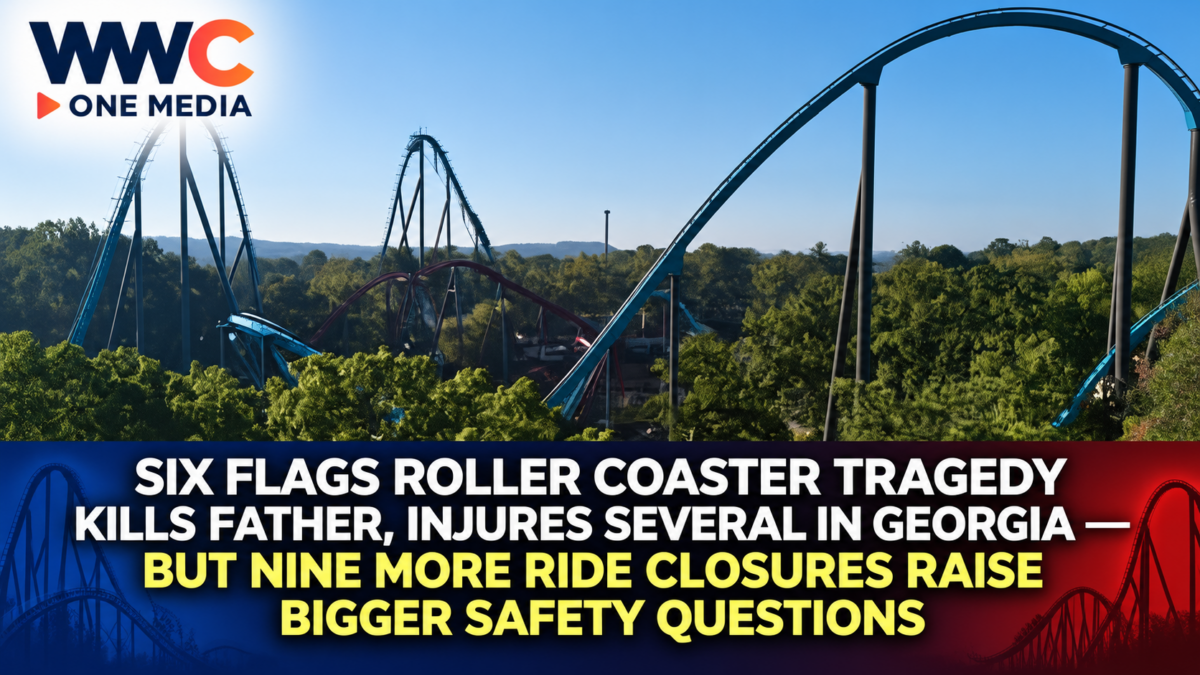
GEORGIA, UNITED STATES — October 14, 2026 — A family visit to Six Flags Over Georgia ended in tragedy when a 42-year-old father was ejected from one of the amusement park’s most popular roller coasters, killing him and injuring several other riders in an incident that has triggered a wider safety investigation across North America.
The victim, identified as Hassan Jihad Ibn Kariem of Atlanta, died following the October 12 incident involving the Goliath roller coaster at Six Flags Over Georgia in Mableton, near Atlanta.
According to the Cobb County Police Department, officers responded at approximately 3:58 p.m. after receiving reports of an incident involving a male passenger.
Preliminary witness and employee interviews indicated that Kariem was thrown from the moving attraction, struck other passengers and fell beneath the ride.
Police found him unresponsive and not breathing.
Several other people were injured during the incident, although authorities have not released the exact number of injured passengers or details about their conditions.
Following the tragedy, Six Flags Entertainment temporarily closed nine similar roller coasters across six other amusement parks in the United States and Canada as a precaution.
The company says it is cooperating with investigators.
The tragedy has raised urgent questions about how a passenger could be ejected from a major amusement-park attraction. But with multiple similar rides now closed across North America, the investigation could have implications far beyond one Georgia theme park.
Police Identify Victim as Hassan Jihad Ibn Kariem
Cobb County police confirmed on October 13 that the deceased rider was Hassan Jihad Ibn Kariem, 42.
Kariem was an information technology manager at Wesley International Academy, an Atlanta charter school.
Colleagues remembered him for his work supporting students and the school community.
People magazine reported that he had been riding the attraction with his son.
His wife and daughter were also visiting the park but were not aboard the roller coaster at the time.
The personal circumstances have added to the grief surrounding the incident, which occurred during what should have been a family outing.
Authorities have notified Kariem’s next of kin.
The investigation remains active.
What Happened on the Goliath Roller Coaster?
Police say the incident occurred shortly before 4 p.m. on Monday.
Officers assigned to the amusement park responded to an emergency involving a guest aboard a roller coaster.
According to the department’s October 13 statement, information from witnesses and employees indicated that Kariem was ejected from the attraction.
During the incident, he struck other patrons before landing underneath the ride.
Emergency responders secured the scene and requested assistance from the department’s Major Crimes Unit.
Witnesses interviewed by ABC News and other outlets described seeing a passenger come out of his seat during the ride.
Their accounts provide important information about what people observed.
But witness statements do not establish the underlying technical cause.
Investigators will need to reconstruct the sequence of events and examine the ride’s safety systems before reaching conclusions.
Several Other Riders Were Injured
The incident also injured several other people.
Authorities have not disclosed the precise number of injured passengers.
They have not provided a comprehensive account of the injuries or confirmed whether those passengers have been released from medical care.
Police indicated that Kariem struck other patrons as he was ejected.
However, it would be premature to attribute every reported injury to a particular impact without official confirmation.
The investigation must establish how the injuries occurred and whether any additional safety issues were involved.
Goliath Is One of Six Flags Over Georgia’s Major Attractions
Goliath is a large steel roller coaster that opened in 2006.
It is classified as a hypercoaster, a category generally associated with large hills, steep drops and high-speed operation.
According to Six Flags’ official specifications, the attraction reaches:
| Ride characteristic | Official specification |
|---|---|
| Maximum height | 200 feet (61 meters) |
| Top speed | 70 mph (113 km/h) |
| First major drop | 170 feet |
| Opening year | 2006 |
| Manufacturer | Bolliger & Mabillard |
| Minimum rider height | 54 inches |
The attraction includes a series of large hills, steep drops and high-speed turns.
It was manufactured by Switzerland-based Bolliger & Mabillard, commonly known as B&M.
The fact that a ride is large and fast does not itself demonstrate that it is unsafe.
Major roller coasters are engineered to operate under substantial forces.
The relevant question is whether all required safety conditions were satisfied during the October 12 incident.
Six Flags Shuts Nine Similar Roller Coasters
The company’s response has extended well beyond Georgia.
Six Flags announced the temporary closure of nine additional roller coasters across six other parks in North America.
The affected attractions include:
| Amusement park | Roller coasters temporarily closed |
|---|---|
| Six Flags Great Adventure, New Jersey | Nitro |
| Six Flags Great America, Illinois | Raging Bull |
| Canada’s Wonderland, Ontario | Behemoth and Leviathan |
| Six Flags Magic Mountain, California | Goliath |
| Carowinds, North and South Carolina | Fury 325 and Thunder Striker |
| Kings Island, Ohio | Orion and Diamondback |
These nine precautionary closures are in addition to the affected Goliath attraction in Georgia.
The company described the measure as a precaution while it investigates.
Importantly, the closures do not mean investigators have determined that the same defect exists on all the rides.
The attractions have different designs, operating conditions and maintenance histories, even where they share a manufacturer or certain design characteristics.
Manufacturer Examines the Incident
Bolliger & Mabillard, the manufacturer of the Georgia Goliath roller coaster, is also examining the fatal incident.
The Swiss company has manufactured numerous major roller coasters around the world.
Its involvement is important because understanding an ejection requires a technical examination of the ride and its operating procedures.
Investigators may need to review restraint systems, inspection records, operator procedures and relevant ride data.
They may also consider witness statements and other available evidence.
However, no official conclusion has been released identifying a manufacturing defect or specific malfunction.
The manufacturer should not be described as responsible for the tragedy merely because it built the attraction.
Responsibility, if established, will depend on the investigation’s findings.
Why Rider Restraints Are Under Scrutiny
One of the most important unanswered questions is how Kariem was able to leave his seat during the ride.
Roller coaster restraints are designed to keep passengers secured while experiencing acceleration, changes in direction and other forces.
Different attractions use different combinations of lap bars, shoulder restraints and other systems.
Safety can also depend on proper restraint engagement, passenger positioning and operating procedures.
But investigators have not publicly established which factor, if any, contributed to the Georgia incident.
It would therefore be inaccurate to report that a safety bar failed, a passenger released a restraint or an employee improperly cleared the ride for operation.
Those remain possible lines of inquiry, not verified explanations.
Police Major Crimes Unit Leads the Investigation
Cobb County’s Major Crimes Unit is investigating the death.
Its involvement reflects the seriousness of the incident.
It does not automatically mean investigators suspect a criminal offense.
Police are gathering witness and employee accounts while examining the circumstances surrounding the fatality.
The department has asked anyone with relevant information to contact its Major Crimes Unit.
The investigation could eventually establish what caused the ejection and whether additional actions are needed.
As of October 14, authorities have not announced a final cause or publicly attributed responsibility.
Six Flags Says It Is Cooperating With Authorities
Six Flags expressed condolences to the victim’s family and said staff and local authorities responded immediately.
The company also said it was supporting guests and employees affected by the incident.
It has described guest and employee safety as a priority.
The temporary closures represent the company’s most visible immediate response.
No reopening date for the affected attractions has been confirmed in the reporting reviewed.
Whether the rides return to service will depend on inspections, the company’s internal decisions and any applicable regulatory requirements.
The Incident Revives Questions About Earlier Roller Coaster Deaths
The Georgia tragedy follows other serious amusement-park incidents in the United States.
The Associated Press reported that at least six deaths had previously been associated with Six Flags Over Georgia, including a separate death on Goliath in 2006.
That earlier case involved a man who reportedly suffered a likely heart attack.
The circumstances are different from the October 12 ejection.
The two incidents should not be presented as evidence of the same defect.
Elsewhere, Six Flags Magic Mountain recently announced the retirement of its X2 roller coaster in California amid lawsuits involving alleged serious injuries.
Six Flags has also settled a wrongful-death lawsuit relating to a passenger who died after riding X2 in 2022.
The company has faced other legal claims involving that attraction.
Those cases involve different rides and circumstances.
They provide background on the industry’s safety challenges but do not determine what happened in Georgia.
Six Flags Faces Financial Pressure Following the Accident
The incident has affected investor confidence.
MarketWatch reported that Six Flags Entertainment shares fell approximately 14.4% on October 13, closing at $10.20.
The decline brought the stock near its lowest levels since 2009.
The company was already facing pressure over operating performance and its efforts to improve financial results following its 2024 merger with Cedar Fair.
Six Flags operates amusement parks across North America and has been reassessing parts of its portfolio.
A fatal incident can create additional financial uncertainty through possible legal expenses, disrupted operations and reputational damage.
However, the stock-price decline should not be presented as proof of a future legal penalty or a permanent loss of business.
The longer-term impact remains uncertain.
What This Means for Amusement Parks Worldwide
The incident highlights the importance of ongoing ride inspections and transparent safety procedures.
Large amusement parks attract millions of visitors, and many operate sophisticated high-speed attractions.
An investigation into a serious incident can help the industry identify whether existing safeguards are sufficient.
Operators may review how restraints are checked, how employees are trained and how unusual operating conditions are handled.
But any specific technical recommendation should follow evidence.
Closing an attraction as a precaution is a safety-management decision, not a finding that its manufacturer or operator violated regulations.
Why Philippine Theme Parks Should Pay Attention
The incident offers lessons for amusement parks and tourism operators in the Philippines and across Asia.
Ride safety depends on equipment maintenance, operating procedures, staff training and clear emergency responses.
Tourists and families also benefit from transparent information about height restrictions, medical cautions and appropriate passenger behavior.
However, the US investigation has not identified a defect affecting attractions in the Philippines.
It would be misleading to suggest that any specific Philippine amusement park or roller coaster is unsafe solely because of the Georgia incident.
The relevant lesson is the importance of precautionary safety reviews and evidence-based investigation.
What Happens Next?
Several developments will determine the next stage of the story.
Police findings: Cobb County investigators must determine the circumstances of Kariem’s ejection.
Medical updates: Authorities may release additional information about injured passengers.
Ride inspections: Six Flags and the manufacturer will assess the affected attraction and similar rides.
Reopening decisions: The company must determine when the temporarily closed roller coasters can safely resume operations.
Regulatory review: Applicable authorities may evaluate whether additional inspections or enforcement measures are necessary.
Potential legal proceedings: Any lawsuits or legal findings would depend on subsequent developments and evidence.
Until those steps are completed, speculation about the cause should be treated with caution.
The Bigger Question: What Went Wrong on Goliath?
The death of Hassan Jihad Ibn Kariem has devastated a family, affected other visitors and prompted an extensive response by one of North America’s largest amusement-park operators.
Police have confirmed that he was ejected from the Goliath roller coaster and that other passengers were injured.
Six Flags has responded by temporarily closing nine additional attractions.
But the central question remains unanswered.
How did a passenger become ejected from a ride designed to keep people secured during extreme motion?
Investigators must determine whether the tragedy resulted from a technical issue, an operating problem, another circumstance or a combination of factors.
The answer may influence safety reviews beyond the Georgia park.
One man is dead, several others are injured and nine additional roller coasters have been temporarily closed across North America. But the biggest question is still unresolved: What caused the fatal ejection on Goliath — and will investigators find a problem that requires wider changes to amusement-park safety?