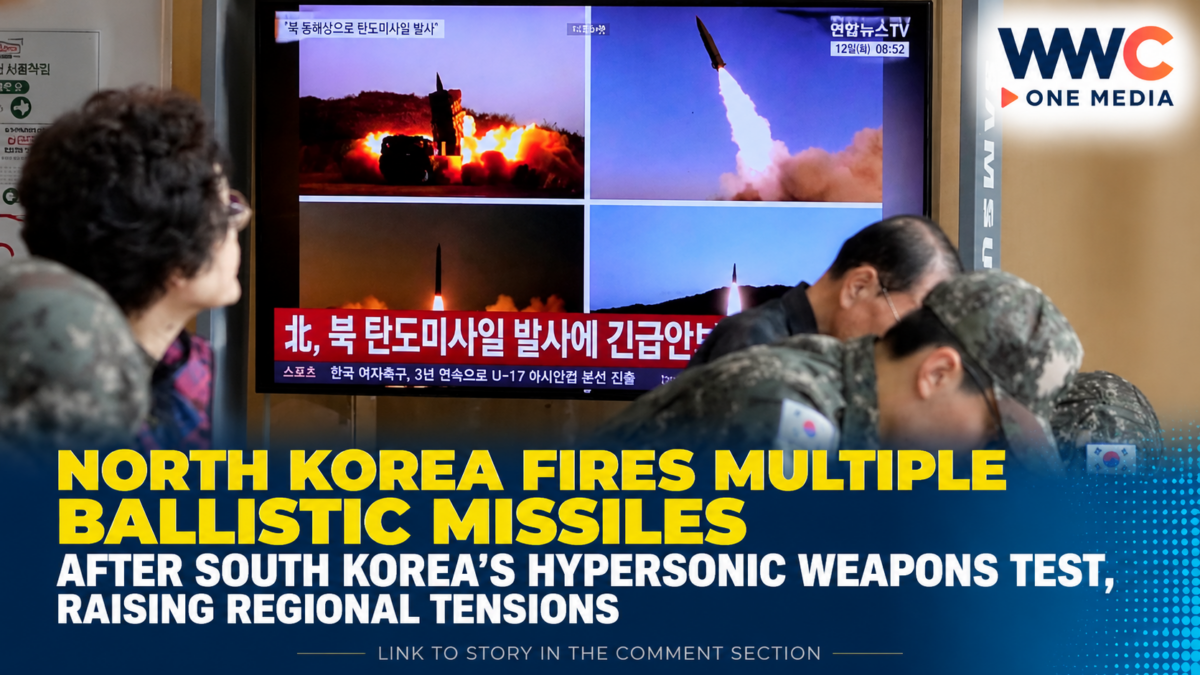
North Korea fired multiple ballistic missiles towards waters off its eastern coast on Monday (Oct 12), escalating tensions on the Korean Peninsula just days after South Korea conducted a test of its own domestically developed hypersonic weapon.
South Korea’s military said the missiles were launched from an area near Pyongyang at around 9.20am local time. At least one travelled more than 900km before landing in the sea, although officials have yet to determine the full specifications of the weapons involved.
The latest launches mark another round of weapons demonstrations by Pyongyang as diplomatic efforts to ease tensions remain stalled.
Japan detects at least two missile launches
Japan’s Deputy Defence Minister Takashi Koyari said Japanese authorities detected at least two missiles launched approximately 17 minutes apart.
The first missile travelled about 220km, while the second flew more than 910km, according to Japanese officials. Both landed outside Japan’s exclusive economic zone, and there were no immediate reports of damage to aircraft or vessels.
The second missile reportedly followed an irregular flight path, a characteristic that Japanese officials have previously associated with hypersonic weapons. However, South Korea’s military said further analysis was needed before the missiles’ exact types could be confirmed.
The launches prompted South Korea’s presidential national security office to condemn the tests and call on Pyongyang to stop its repeated ballistic missile launches, which violate United Nations Security Council resolutions.
Japan also lodged a protest against North Korea through diplomatic channels in Beijing.
North Korea’s latest move follows South Korean weapons test
The missile launches came days after South Korea test-fired its first domestically developed hypersonic glide vehicle on Friday, Oct 9.
South Korean President Lee Jae Myung described the weapon as an important addition to the country’s conventional defence capabilities. Once fully developed, it is intended to travel at least five times the speed of sound and manoeuvre along unpredictable flight paths, potentially making it harder for missile defence systems to intercept.
South Korea’s Joint Chiefs of Staff said North Korea’s latest launches may have been intended both to advance its missile technology and to respond to Seoul’s test.
North Korea has also continued developing weapons designed to carry nuclear warheads. On Oct 3, it launched a missile that its state media described as an intermediate-range strategic weapon equipped with hypersonic technology. Leader Kim Jong Un has repeatedly highlighted the country’s military development programme.
Diplomatic tensions remain unresolved
Relations between the two Koreas have deteriorated amid a prolonged freeze in dialogue and disagreements over security issues.
Tensions rose further after landmine explosions near the heavily fortified border injured three South Korean soldiers last month. South Korea’s military and the United Nations Command concluded that the mines had been deliberately planted by North Korea, which denied responsibility and accused Seoul of making false claims.
North Korea has also rejected US and South Korean overtures to resume broader nuclear negotiations. Pyongyang has demanded that Washington abandon what it calls a hostile policy and drop denuclearisation demands as a precondition for talks.
The latest missile launches add to concerns about the pace of weapons development on both sides of the peninsula.
What happens next?
South Korea and Japan are continuing to assess the latest launches, including the missiles’ flight paths and technical characteristics.
The tests underscore the growing emphasis both Koreas are placing on weapons intended to strengthen deterrence and challenge opposing missile defences.
With diplomatic efforts still stalled and military demonstrations continuing, the latest launches are likely to keep regional security concerns in focus as governments monitor Pyongyang’s next moves.