
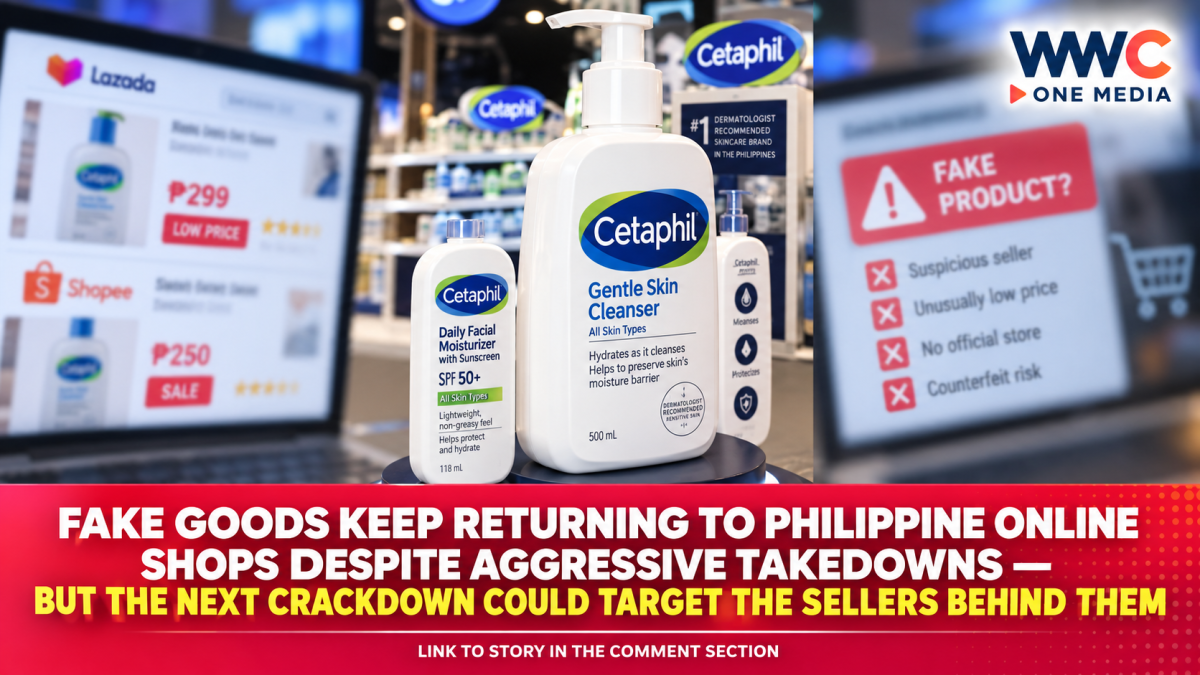
MANILA — Philippine e-commerce platforms are removing counterfeit listings at increasingly high rates. Government agencies are issuing hundreds of takedown orders. Police and Customs are seizing billions of pesos worth of illicit products.
Yet consumer advocates say the fake-goods problem is far from solved.
Consumer advocacy group Malayang Konsyumer has urged the Intellectual Property Office of the Philippines, or IPOPHL, to intensify enforcement against counterfeit and unregulated products sold through online marketplaces, arguing that simply deleting individual listings is not enough when sellers can return, create new accounts or move their operations elsewhere.
The appeal was addressed to newly appointed IPOPHL Director General Teodoro C. Pascua, who took over the agency this year.
And the timing matters.
The Philippine National Police has now joined the push, announcing strengthened intelligence and enforcement operations against online counterfeit networks and promising to coordinate with IPOPHL and the Department of Trade and Industry to identify sellers and build cases for prosecution.
That means the country’s anti-counterfeit campaign may be entering a new phase.
The first battle was taking fake listings down.
The next one may be stopping the same sellers from simply putting them back up.
Lazada and Shopee Are Already Removing Large Numbers of Listings
The Philippines is not starting from zero.
IPOPHL has operated an E-Commerce Memorandum of Understanding against online counterfeiting since 2021, bringing together rights holders, industry associations and major online platforms.
By May 2026, the voluntary arrangement had expanded from just 12 original participants to 119 signatories.
Major marketplace participants have included Shopee, Lazada, Zalora and TikTok Shop, alongside brand owners and business groups.
And according to IPOPHL, platform enforcement has improved significantly.
During the period from June 1, 2024 to May 15, 2025, Lazada said approximately 85.5% of listings it removed for infringement were taken down proactively, meaning the platform detected and removed them without first waiting for a complaint.
Shopee reported an even higher proactive-removal share of 93.6% over the same period.
That sounds impressive.
But there is an important difference between:
“93.6% of removals were proactive”
and
“93.6% of counterfeit products have been removed.”
They are not the same statistic.
The numbers describe how removals occurred, not what percentage of every counterfeit listing circulating on the platform has been eliminated.
That distinction is crucial for an accurate headline.
Hundreds of Government Takedown Orders Have Followed
Malayang Konsyumer also cited Department of Trade and Industry figures showing a rising number of enforcement orders.
According to the group, DTI’s E-Commerce Bureau issued 171 takedown orders and 67 compliance orders from June through December 2025.
During the first six months of 2026, that increased to another 268 takedown orders and 105 compliance orders.
The acceleration suggests regulators are becoming considerably more active.
But the consumer group argues that the persistence of questionable products online means enforcement cannot stop with deleting individual product pages.
Its concern is what happens next.
A seller whose listing disappears today may potentially:
open another account,
change a product description,
alter images,
switch platforms,
or return under another business identity.
That is why stronger seller verification and action against repeat infringers has become one of the main themes emerging from IPOPHL’s own discussions with platforms and rights holders.
At the sixth review of the E-Commerce MOU in May, stakeholders specifically called for tougher seller verification, action against repeat offenders and more intelligence-driven enforcement instead of relying primarily on listing removals.
In other words, even the participants running the existing system acknowledge the next challenge.
The ₱18.64-Billion Number Needs Context
One of the most dramatic numbers circulating in the latest reports is ₱18.64 billion.
But publishers need to handle it carefully.
Malayang Konsyumer’s statement, as repeated by several outlets, attributes ₱18.64 billion worth of counterfeit seizures to the period from June 2024 to May 2025.
IPOPHL’s official data, however, identifies ₱18.64 billion as the value of counterfeit products seized by the National Committee on Intellectual Property Rights from January through September 2025.
The Bureau of Customs accounted for approximately ₱17.21 billion of that amount.
A huge portion came from physical enforcement operations—including a May raid involving warehouses in Divisoria where Customs confiscated about 1.27 million allegedly counterfeit items valued at ₱15.8 billion.
That means this statistic demonstrates the enormous scale of Philippine counterfeit trade generally.
It does not establish that ₱18.64 billion worth of counterfeit products were sold through Shopee, Lazada, TikTok Shop or other online marketplaces.
That would be an unsupported leap.
The Consumer-Safety Issue Goes Beyond Fake Handbags
Counterfeiting is often treated as a luxury-brand problem.
Fake shoes.
Fake bags.
Fake watches.
But the current crackdown is getting more serious because some disputed products fall into categories where authenticity can directly affect safety.
Malayang Konsyumer highlighted medicines, vitamins, supplements, cosmetics, electronics, adhesives and construction-related materials among the products it believes deserve particular scrutiny online.
Those concerns should still be properly qualified: not every counterfeit or unauthorized product has been proven dangerous simply because it is fake.
But regulators have documented genuine health-product risks.
The Philippine Food and Drug Administration recently warned consumers about a counterfeit version of Decolgen Forte, saying counterfeit medicine can pose serious health risks and reminding buyers to purchase medicines only from FDA-licensed establishments.
The FDA has also issued multiple 2026 warnings involving unregistered supplements, medicines and cosmetics discovered through post-market surveillance or online monitoring. Because those products were not authorized, the agency said their quality and safety could not be assured.
This is where the online-counterfeit debate changes.
A fake designer shirt primarily raises trademark and consumer-fraud issues.
A fake pharmaceutical product can become a public-health issue.
A substandard electrical component can potentially become a fire-safety issue.
That raises the stakes for marketplaces and regulators considerably.
IPOPHL Already Has More Power Than Many Consumers Realize
Malayang Konsyumer is not asking IPOPHL to invent an entirely new enforcement system.
Many of the tools already exist.
IPOPHL’s Intellectual Property Rights Enforcement Office can coordinate enforcement with agencies including the PNP, National Bureau of Investigation, Bureau of Customs and local governments.
Rules introduced in 2021 specifically expanded IPOPHL enforcement into electronic, digital and online channels.
Those rules allow the agency, depending on the case, to seek removal or blocking of infringing material, issue cease-and-desist orders, refer permits and licenses for cancellation and conduct motu proprio monitoring—meaning the agency can proactively monitor potential infringement rather than relying entirely on complaints.
Malayang Konsyumer wants those tools used more aggressively.
Among its proposals are proactive online investigations, additional compliance and takedown actions, coordination on site blocking and stronger penalties for repeat offenders.
The key question is therefore not simply whether government possesses enforcement powers.
It is how aggressively—and how consistently—it is prepared to use them.
The PNP Is Now Promising to Go After the Networks
That question received a partial answer this week.
PNP chief Gen. Jose Melencio Nartatez Jr. said police would tighten intelligence gathering against sellers and networks distributing counterfeit and unregulated goods online.
The PNP said it would work with IPOPHL and DTI to identify those responsible and pursue appropriate cases.
This is significant because marketplace takedowns attack the visible end of counterfeit commerce.
Police investigations can potentially attack the infrastructure behind it:
warehouses,
importers,
distributors,
repeat sellers,
payment trails,
and organized networks.
That is exactly the shift rights holders have increasingly been advocating.
IPOPHL’s May review of the E-Commerce MOU noted calls for platforms to cooperate more closely with law enforcement on offline supply networks, rather than viewing the problem purely as an online-listing issue.
Deleting the product page removes the advertisement.
Finding the warehouse can remove the inventory.
Those are very different outcomes.
New E-Commerce Rules Put More Responsibility on Platforms
The legal environment has also changed since the early days of Philippine online shopping.
The Internet Transactions Act of 2023 and its implementing rules created more explicit obligations for online marketplaces and merchants.
Under the implementing rules, e-marketplaces are expected to collect identifying and registration information from online merchants before allowing them to list products, as far as practicable, and ensure transactions comply with applicable Philippine laws and regulations.
That makes seller identification increasingly important.
If the same merchant repeatedly sells infringing products, the question is no longer only whether the offending listing disappeared quickly enough.
Regulators can also ask:
Who is the merchant?
Was the merchant properly verified?
Did the platform know the seller had previously violated the rules?
And why was that merchant permitted to return?
Those questions could become central to the next stage of enforcement.
IPOPHL Says the Existing System Is Producing Results
There is another side to the story.
The latest call for tougher enforcement should not be read as proof that existing anti-counterfeit measures have failed.
IPOPHL itself says its e-commerce partnership has produced measurable improvements.
The agency reported faster coordination between platforms and rights holders, improved complaint resolution and significantly more proactive listing removals.
One participating rights holder said deleted listings in 2025 were more than triple the previous year’s level, contributing to revenue recovery.
The U.S. Chamber of Commerce also highlighted the Philippines’ public-private anti-counterfeiting initiatives in its 2026 International IP Index, including the marketplace MOU and improved detection and seller-verification measures.
So the picture is more complicated than:
“Platforms are doing nothing.”
That would be inaccurate.
The stronger conclusion is:
platform enforcement has improved dramatically, but counterfeit sellers continue adapting faster than a listing-by-listing system can permanently eliminate them.
That is why the debate is moving toward identities, repeat offenders and supply chains.
Why Site Blocking Is Not a Simple Solution
The consumer group has also suggested stronger use of website blocking.
IPOPHL already operates voluntary administrative site blocking for piracy, and the agency said roughly 30 sites had been restricted under those rules by late 2025.
But applying that approach to counterfeit commerce can be more complicated when infringing sellers operate inside legitimate marketplaces.
Blocking an entire platform such as Shopee or Lazada because individual merchants sell fake goods would clearly be disproportionate.
Instead, authorities would need to identify standalone illicit websites, specific accounts or networks and follow applicable legal procedures.
So “site blocking” should not be presented as a universal one-click fix.
The more practical solution for mainstream marketplaces is likely to involve faster seller removal, identity verification, cross-platform coordination and law-enforcement action against the source of the merchandise.
Fake Sellers Are Also Becoming More Sophisticated
The enforcement challenge is partly technological.
Counterfeit traders can constantly change:
store names,
product photos,
spelling,
keywords,
logos,
seller accounts,
and product descriptions.
A listing might avoid using a trademark directly while still showing the branded product in photographs.
Other sellers may operate through livestreams, social-media accounts or messaging applications rather than conventional marketplace listings.
IPOPHL acknowledged in May that repeat infringers are using increasingly sophisticated tactics and said stakeholders want the MOU expanded toward stronger deterrence and intelligence-led enforcement.
That makes automated detection useful.
But it also creates false-positive risks.
Platforms cannot simply remove every cheap product that resembles an expensive one.
Enforcement still requires reliable evidence that a trademark, copyright or other protected right is actually being violated.
Consumers Remain Part of the Enforcement Chain
Government agencies also continue to depend heavily on consumer and rights-holder reports.
IPOPHL allows the public to report online counterfeiting by supplying links, online-store names or other identifying details to its enforcement office.
DTI separately advises online shoppers to use verified sellers, check reviews and return policies, and report problematic sellers to its consumer-enforcement channels.
Those measures cannot replace platform responsibility.
But they matter because counterfeit investigations often begin with evidence supplied by buyers or legitimate brand owners.
And after a fake product arrives at a consumer’s home, the listing that sold it may already have disappeared.
Screenshots, receipts, store names and URLs can therefore become important evidence.
The Bigger Problem Is No Longer Just the Fake Listing
For years, the simplest measurement of online anti-counterfeit enforcement was the number of listings removed.
That metric still matters.
But it may be reaching its limits.
If 10,000 fake listings are deleted but the same network simply creates another 10,000, the platform can produce impressive takedown statistics without permanently disrupting the underlying business.
That is why the next stage of the Philippine crackdown increasingly looks less like content moderation and more like financial and criminal investigation.
Identify the repeat seller.
Verify who owns the account.
Trace where the inventory comes from.
Find the warehouse.
Follow the distributor.
Coordinate among platforms so a banned counterfeiter cannot simply migrate.
And prosecute operators where the evidence supports it.
The Philippines has already built a system capable of making counterfeit listings disappear.
The harder challenge now is making the counterfeit businesses behind those listings disappear with them.
WWC ONE MEDIA M.J.E

Leave a Reply