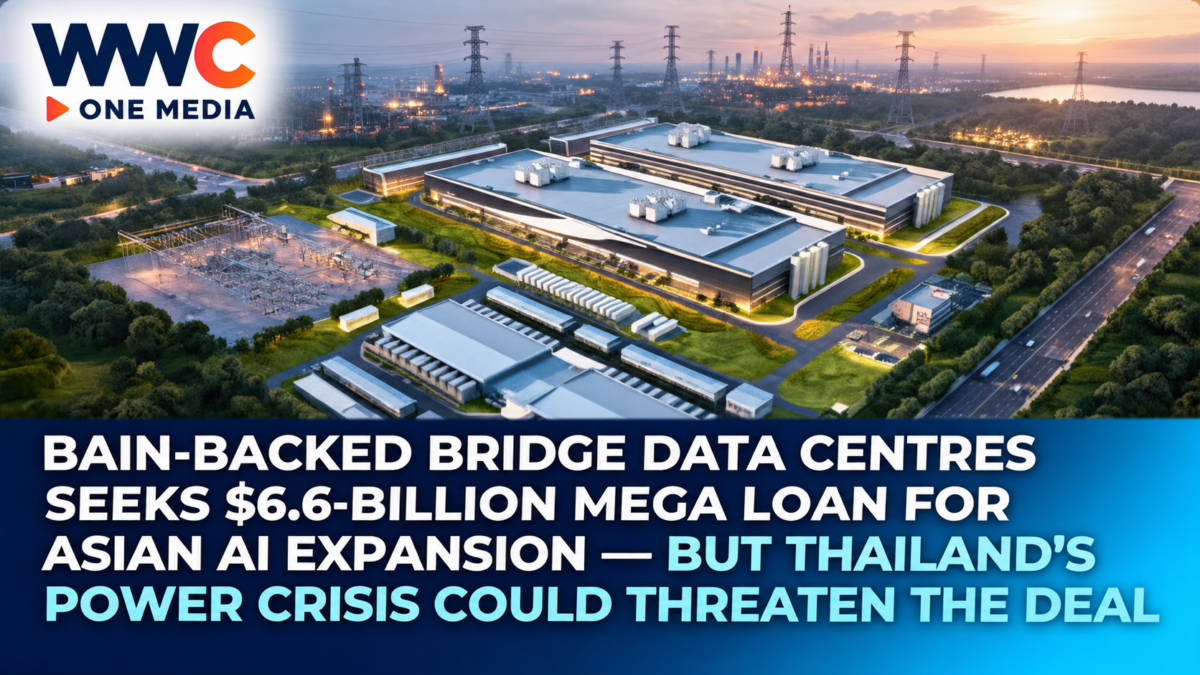
SINGAPORE — October 12, 2026 — Bain Capital-backed Bridge Data Centres is negotiating with banks to expand an existing loan to approximately US$6.6 billion, positioning the Singapore-based company for one of the largest data center financing transactions in Asia.
The proposed deal would more than double the size of Bridge’s US$2.8-billion bank facility secured in 2025, reflecting the enormous amount of capital required to build artificial intelligence and cloud computing infrastructure across Southeast Asia.
According to Bloomberg’s October 12 report, people familiar with the discussions said the expanded financing could be introduced to lenders as early as November.
However, the negotiations remain ongoing, and the proposed borrowing has not been finalized.
The funding push comes as Bridge accelerates plans to develop hyperscale data centers serving international technology companies and cloud providers.
But the latest expansion ambitions are unfolding against a more complicated backdrop.
Thailand has temporarily suspended construction at dozens of data center projects as authorities review the industry’s electricity and water requirements.
And a separate financing plan of as much as US$6 billion associated with Thai data center development has reportedly stalled.
The bigger question is whether Asia’s banks can continue providing billions for AI infrastructure when governments are increasingly concerned about power shortages, environmental pressures and the speed of construction.
Bridge Data Centres Moves Toward a $6.6-Billion Financing Deal
Bridge Data Centres is seeking to increase an existing credit facility from US$2.8 billion to approximately US$6.6 billion.
The proposed increase represents roughly US$3.8 billion in additional financing capacity compared with the original arrangement.
Bloomberg reported that the company was discussing the larger facility with banks and could bring the transaction to the lending market as early as November 2026.
The negotiations follow an earlier effort to increase financing to at least US$5 billion.
If completed at the reported size, the arrangement would rank among the largest debt facilities associated with Asia’s data center industry.
However, several important details remain uncertain.
The final loan amount, participating banks, interest rates, maturity structure and security arrangements have not been publicly confirmed.
The US$6.6-billion figure is a proposed total facility size, not an additional US$6.6 billion on top of the existing loan.
Bridge has declined to comment on unconfirmed market information.
The $2.8-Billion Loan That Started the Expansion
Bridge secured a US$2.8-billion senior secured bank facility in March 2025.
The financing was underwritten and pre-funded by a consortium of international and regional banks.
According to Bridge’s announcement, the transaction was intended to support development of hyperscale campuses in high-growth Asian markets.
Malaysia was a major focus of the financing.
The original facility also helped strengthen the company’s ability to expand into additional regional markets.
The March 2025 agreement demonstrated substantial lender interest in Asian digital infrastructure.
But the company’s proposed expansion to US$6.6 billion would represent a major increase in financial exposure.
For lenders, the central question is whether the underlying assets, customer contracts and expected cash flows can support substantially larger borrowing commitments.
Bain Capital Bets on Asia’s AI Infrastructure Boom
Bridge Data Centres is backed by Bain Capital, one of the world’s major private investment firms.
Its development strategy focuses on large-scale data centers designed for cloud computing, artificial intelligence and other data-intensive services.
These facilities require significant investment in land, buildings, networking equipment, electrical systems and cooling technology.
Demand is being driven partly by technology companies expanding computing capacity across Asia-Pacific.
Singapore, Malaysia, Thailand and India have become important destinations for digital infrastructure investment.
For private equity investors, hyperscale data centers can potentially provide long-term revenue through contracts with cloud and technology customers.
However, the projects require substantial capital before all facilities become operational.
Construction costs, electricity availability and customer demand can influence returns.
The combination of attractive long-term opportunities and heavy upfront spending helps explain Bridge’s pursuit of larger financing facilities.
Thailand’s Data Center Restrictions Create a New Obstacle
The proposed financing is attracting attention because Thailand has recently imposed restrictions on data center construction.
On September 4, Thai authorities announced a temporary pause affecting 49 projects already under construction.
Another 117 proposed projects awaiting approval were also placed on hold.
The measures were introduced while the government developed new industry regulations covering electricity consumption, water use, locations and environmental safeguards.
The restrictions reflect concerns that rapid data center development could strain local infrastructure.
High-density AI facilities can require substantial electricity supplies and sophisticated cooling systems.
Some projects may also depend on significant water resources.
Thailand’s government has emphasized that the temporary restrictions are intended to establish clear standards rather than permanently reject foreign investment.
Nevertheless, the policy uncertainty has complicated financing and development decisions.
Bloomberg’s October 12 reporting indicates that a separate Thai data center financing plan of up to US$6 billion has stalled.
The reports do not establish that all of Bridge’s Thai projects have been canceled.
The precise exposure of individual developments to the government’s restrictions remains important.
Why Electricity Is Becoming the Biggest AI Bottleneck
Artificial intelligence infrastructure depends on more than advanced semiconductor chips.
Data centers need reliable electricity to operate servers, networking equipment and cooling systems continuously.
As AI computing systems become more powerful, their electricity requirements can increase substantially.
Developers must therefore secure dependable power connections before major facilities can operate at full capacity.
In regions with limited grid infrastructure, the process can delay construction and commissioning.
Building new electricity substations, transmission connections and generation capacity can require major investments.
Water availability and environmental approval may create additional constraints.
The result is a shift in the industry’s priorities.
Technology companies and investors increasingly need to assess power availability alongside land costs, customer demand and financing.
For Bridge, successful expansion will depend on securing not just capital but also the energy infrastructure needed to support new facilities.
Singapore Remains Central to Bridge’s Growth Strategy
Bridge is also investing heavily in Singapore.
In March 2026, the company announced plans to invest between S$3 billion and S$5 billion in next-generation digital infrastructure and artificial intelligence initiatives.
The investment program includes research and development involving power systems, cooling technology and data center operations.
Bridge said it aims to reach approximately 2 gigawatts of regional data center capacity by 2030.
That target reflects a long-term development ambition rather than currently operational capacity.
Singapore remains an important technology and financial hub, but data center development is constrained by land availability, energy requirements and environmental considerations.
This has encouraged providers to expand into nearby markets while maintaining operational and commercial relationships in Singapore.
Malaysia and Thailand have become major destinations for this cross-border development model.
The strategy offers access to land and infrastructure but also exposes operators to different regulatory requirements and utility conditions.
Malaysia’s Data Center Boom Draws Global Capital
Malaysia has become one of the leading destinations for data center investment in Southeast Asia.
Johor, located near Singapore, has attracted major international developers because of its proximity to Singapore’s technology ecosystem and access to land.
Foreign cloud providers and infrastructure companies have announced substantial investments in the country.
Bridge has been developing hyperscale facilities in Malaysia and used its original financing to support regional expansion.
However, the rapid growth of data centers has created questions about infrastructure readiness.
Developers must compete for electricity connections, reliable water supplies and suitable industrial sites.
Government agencies also need to ensure that new projects deliver economic benefits without placing excessive pressure on surrounding communities.
For Malaysia, the opportunity includes investment, construction activity and stronger digital connectivity.
The challenge is balancing those benefits against the energy and environmental requirements of large computing facilities.
India’s AI Expansion Faces Similar Infrastructure Pressures
Bridge also has operations and development interests in India.
The country is attracting growing investment from global technology companies seeking additional computing capacity.
However, rapid development has triggered concerns in some communities.
Reuters reported on October 9 that residents near planned facilities had raised objections involving land use, water resources and electricity demand.
These disputes demonstrate that infrastructure constraints are becoming a regional issue rather than a problem limited to Thailand.
For data center developers, obtaining financing is only one part of the process.
They must also secure government approvals, local acceptance and access to essential utilities.
A project may have financial backing but still face significant delays if those requirements are not satisfied.
Bain Has Explored Selling a Stake in Bridge
Bridge’s funding efforts come alongside reported interest from major international investors in acquiring an ownership stake.
In July 2026, Bloomberg reported that Sixth Street Partners, SK Telecom, Singapore sovereign wealth investor GIC and Canadian pension investor La Caisse were among the parties considering a significant stake in Bridge.
Bain Capital was reportedly exploring a transaction that could involve selling approximately half the business while retaining an ownership interest.
The discussions suggest that private investors continue to see opportunities in Asian digital infrastructure.
An equity transaction could provide another source of capital alongside bank borrowing.
However, discussions over a potential stake sale are separate from the proposed US$6.6-billion loan expansion.
No completed sale to those bidders was established by the available October 12 reporting.
Debt financing and equity investment also have different financial consequences.
A larger loan increases repayment obligations, while an equity sale changes ownership and can dilute existing shareholders.
DayOne Shows How Large Asia’s Financing Race Has Become
Bridge is not alone in pursuing multibillion-dollar financing.
Singapore-based rival DayOne Data Centers has also been seeking to expand its borrowing arrangements.
Earlier reporting indicated that DayOne was exploring a loan facility that could reach approximately US$7 billion.
The competition illustrates the growing scale of debt financing in Asia’s hyperscale data center industry.
Large operators need substantial funds to develop campuses before they reach their full revenue-generating potential.
Banks and institutional investors are increasingly participating in these projects.
However, competition for financing can also raise concerns about underwriting standards and the concentration of credit exposure.
Lenders must assess whether future customer demand, lease contracts and operating income will justify the size of the debt.
The AI Funding Boom Faces Greater Investor Scrutiny
The proposed Bridge financing comes at a time when investors are becoming more selective about artificial intelligence infrastructure.
In Australia, Nvidia-backed Firmus recently canceled a multibillion-dollar initial public offering after struggling to attract sufficient demand at its proposed valuation.
The failed listing affected sentiment toward companies with financial exposure to Firmus’s development plans.
The situation demonstrates that enthusiasm for AI infrastructure does not automatically guarantee access to capital on attractive terms.
The global industry continues attracting major investment, but financial institutions are increasingly examining project economics.
Important factors include financing costs, customer commitments, operating margins, construction schedules and long-term demand.
For debt-funded projects, the ability to generate sufficient cash flow to meet repayment obligations is especially important.
Bridge’s proposed transaction will therefore test lenders’ appetite for large Asian data center exposures.
Could Data Center Debt Become a Bigger Financial Risk?
Large-scale data center development creates potential benefits for investors and technology companies.
But high borrowing levels also introduce risks.
If construction costs rise or projects are delayed, developers may need additional capital.
If customer demand grows more slowly than expected, revenue may fall short of forecasts.
Higher interest rates can increase the expense of refinancing debt.
Regulatory restrictions may also delay the completion of facilities.
These issues are particularly important for projects that require substantial upfront spending.
However, large borrowing amounts do not automatically mean a project is financially unsustainable.
Debt risk depends on the structure of the financing, cash-flow coverage, collateral, maturity dates and the creditworthiness of customers.
A facility supported by long-term contracts with strong counterparties may have a different risk profile from a speculative project without committed tenants.
Without disclosure of the proposed Bridge facility’s final terms, its precise refinancing and credit risks cannot be established.
What the Financing Means for Southeast Asia
The proposed US$6.6-billion transaction reflects Southeast Asia’s growing position in the global digital economy.
Singapore provides financial, technological and commercial expertise.
Malaysia offers expanding hyperscale campuses and access to regional infrastructure networks.
Thailand presents opportunities for development but is tightening oversight of resource-intensive projects.
India provides another large potential market for computing capacity.
For the Philippines, the expansion of regional data centers could support demand for better digital infrastructure and related services across ASEAN.
But the economic effects would depend on where facilities are built, how networks connect and whether Philippine businesses secure contracts or investment.
The broader lesson is that Asia’s AI infrastructure ambitions will increasingly depend on coordinated investment in electricity, telecommunications and financing.
The Bigger Question: Can Asia Finance Its AI Boom Without Overstretching Its Resources?
Bridge Data Centres’ proposed loan expansion reflects enormous confidence in the future of artificial intelligence and cloud computing.
If completed, the US$6.6-billion facility would provide a major financing platform for the company’s regional growth plans.
The deal could also establish another important benchmark for the scale of bank lending available to Asian data center developers.
But important uncertainties remain.
Thailand is reviewing the electricity and water demands of new facilities.
Major construction projects require reliable power connections and regulatory approval.
Banks must assess whether future operating cash flows justify large financial commitments.
And investors are questioning whether every ambitious AI project deserves the valuations and financing structures being sought.
The challenge for Bridge is not simply securing the largest possible loan. It is ensuring that financing, construction schedules, customer demand and infrastructure availability remain aligned.
For Bain Capital, the proposed transaction could strengthen its ability to expand one of Asia’s major digital infrastructure platforms.
For lenders, it represents an opportunity to participate in a rapidly growing market.
For governments, it highlights the pressure to support technological development without overwhelming energy and water systems.
Bain-backed Bridge Data Centres is seeking a US$6.6-billion loan to power its Asian expansion — but the bigger test is whether the region can build enough electricity and digital infrastructure to turn billions in AI financing into profitable, operational data centers.