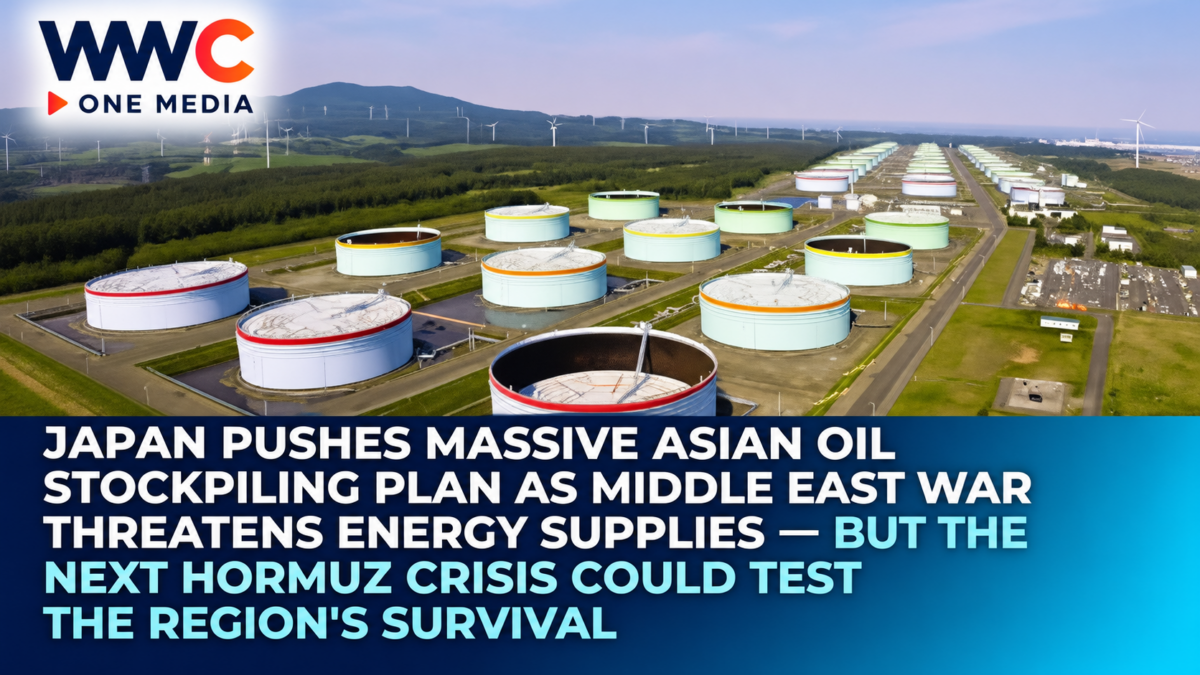
TOKYO, Japan — October 12, 2026 — Japan is calling for stronger oil stockpiling systems, expanded energy infrastructure and closer cooperation between petroleum-producing and consuming nations as the continuing Middle East conflict exposes dangerous weaknesses in Asia’s energy security.
Japanese Economy, Trade and Industry Minister Ryosei Akazawa urged governments to improve their ability to withstand oil supply disruptions during an online appearance at the International Energy Forum ministerial meeting.
The appeal comes as attacks on commercial vessels, disruptions to petroleum shipments and volatility in international oil prices raise concerns about the reliability of energy supplies flowing from the Middle East to Asia.
According to Bloomberg’s October 12 report, Akazawa emphasized that stronger cooperation and investment in oil storage and supply infrastructure are essential to protecting economies from future shocks.
Japan is now seeking to take a leadership role in building a more resilient regional energy system.
But the bigger question is whether Asian governments can establish enough emergency reserves and alternative supply routes before another disruption threatens fuel availability, transportation costs and economic growth.
Japan Calls for a Stronger Asian Oil Security Network
Speaking at the International Energy Forum, Akazawa called for closer cooperation between oil-producing and consuming countries.
He emphasized the importance of increasing petroleum stockpiles and strengthening energy infrastructure across Asia.
The minister argued that the Middle East conflict has made energy security an increasingly urgent concern.
Japan wants countries to move beyond short-term responses and invest in systems that can reduce their vulnerability to future supply emergencies.
The International Energy Forum brings together more than 60 major energy-producing and consuming countries to discuss energy security, trade, investment and market stability.
For Tokyo, such meetings provide an opportunity to coordinate policy with both Asian importers and Middle Eastern suppliers.
Akazawa also outlined Japan’s intention to act as a bridge between the two regions.
The objective is to improve information sharing, emergency planning and access to reliable energy supplies.
POWERR Asia Becomes Japan’s Main Energy Security Strategy
Japan’s proposal builds on its Partnership on Wide Energy and Resources Resilience Asia initiative, known as POWERR Asia.
Introduced in April 2026, the initiative aims to strengthen the region’s capacity to respond to disruptions in energy and other critical resource supplies.
Its priorities include developing oil stockpiling systems, improving supply chains and expanding emergency cooperation.
Japan wants to share its experience in maintaining strategic reserves with countries that have less developed storage infrastructure.
The strategy also involves closer coordination with oil-producing countries.
The Middle East remains an essential source of petroleum for many Asian economies, making relationships with major producers such as Saudi Arabia and the United Arab Emirates particularly important.
However, the initiative does not mean that a fully operational regional oil reserve already exists.
Individual countries must still establish financing, storage facilities, legal arrangements and practical procedures for sharing supplies during emergencies.
Strait of Hormuz Crisis Exposes Asia’s Greatest Energy Weakness
The urgency behind Japan’s plan is closely connected to the Strait of Hormuz.
The narrow waterway links the Persian Gulf with international shipping routes and is one of the world’s most important petroleum transportation corridors.
The conflict involving Iran has disrupted commercial shipping and increased risks for tankers.
Attacks on vessels and concerns about maritime security have complicated the movement of crude oil and refined petroleum products.
Even when alternative routes allow some exports to continue, higher transportation costs and insurance expenses can affect buyers.
Asian economies are especially vulnerable because many rely heavily on Middle Eastern energy supplies.
A prolonged disruption can affect fuel availability, industrial production, transportation and government finances.
The problem is not simply that oil prices may rise.
Countries must also ensure that physical supplies can reach refineries, distribution terminals and consumers.
This distinction helps explain why Japan is emphasizing storage and infrastructure rather than relying exclusively on market-price measures.
Japan Has Already Released More Than 100 Million Barrels
Japan has extensive experience managing emergency petroleum inventories.
Following the outbreak of the Middle East energy crisis, Tokyo authorized releases from its strategic reserves to stabilize domestic supply.
In March, the Ministry of Economy, Trade and Industry announced plans to release national crude oil stocks equivalent to approximately one month of supply.
It also temporarily reduced private-sector stockholding requirements.
Further reserve releases followed as the government responded to continuing uncertainty.
In October, Japan’s Foreign Ministry stated that the country had already released more than 100 million barrels of oil during the crisis.
Tokyo also supported the International Energy Agency’s coordinated emergency stock release totaling more than 400 million barrels.
The measures demonstrated the value of strategic reserves during a severe supply disruption.
But emergency inventories are not unlimited.
Every barrel released reduces the amount immediately available for a future emergency unless the stocks are replenished.
That creates a difficult policy challenge: governments must support current fuel supplies while preserving adequate protection against additional disruptions.
Japan Says No New Reserve Release Is Currently Planned
Despite heightened Middle East tensions, Japan has not announced a fresh national oil-stock release as part of the October 12 proposal.
On October 5, Chief Cabinet Secretary Minoru Kihara said the government had no plans for additional releases from national petroleum reserves at that time.
The statement came after Japan had already contributed substantial volumes during earlier emergency measures.
This distinction is important.
Akazawa’s latest announcement concerns strengthening regional stockpiling and cooperation over the longer term.
It should not be confused with an immediate decision to release more crude oil into the market.
Japan’s challenge is to balance present supply stability with the need to rebuild preparedness for future emergencies.
ASEAN Countries Race to Build Emergency Oil Reserves
Japan’s regional strategy is also gaining importance across Southeast Asia.
Reuters reported on October 8 that ASEAN countries were accelerating plans to strengthen oil reserves and expand renewable energy systems in response to the Iran war.
Nine Southeast Asian countries, together with Japan and Australia, committed to advancing national and regional stockpiling arrangements.
The effort reflects a growing recognition that individual national inventories may not be sufficient during prolonged disruptions.
Regional cooperation could help countries coordinate emergency supplies and share information about market conditions.
However, creating a joint stockpile would involve difficult decisions.
Governments would need to agree on who contributes oil, where it is stored, when it can be released and how the costs are divided.
Countries with limited storage facilities or financial resources may require additional assistance.
Japan’s technical expertise and existing relationships with oil producers could help address some of those challenges.
Philippines Plans Its Own Oil Reserve by 2027
The Philippines could become an important participant in this regional effort.
As ASEAN chair in 2026, Manila has supported discussions aimed at improving regional energy resilience.
Reuters reported that the Philippines plans to establish a national petroleum reserve by 2027, potentially contributing to wider regional stockpiling arrangements.
The plan comes after the Middle East conflict exposed the country’s dependence on imported petroleum products.
Fuel supply uncertainty can affect transportation costs, electricity generation, agriculture and consumer prices.
For Filipino households, prolonged increases in diesel and gasoline prices can also influence the cost of food and other essential goods.
A national petroleum reserve could provide an emergency buffer against supply interruptions.
However, the effectiveness of the plan will depend on the volume of fuel stored, the speed of implementation, financing and clear rules governing emergency releases.
The 2027 target is a plan, not confirmation that the proposed reserve is already operating.
Japan Wants Closer Ties With Saudi Arabia and the UAE
Japan’s energy security strategy also emphasizes stronger cooperation with major oil producers.
Saudi Arabia and the United Arab Emirates are important sources of crude for Japanese refineries.
Tokyo is seeking to deepen its relationships with these suppliers while supporting wider stockpiling cooperation in Asia.
Such arrangements could improve planning and make emergency supply coordination more effective.
Japan has also been exploring alternative procurement routes to reduce reliance on shipments passing through the Strait of Hormuz.
But geographical diversification can be costly.
Longer voyages, different crude grades, transportation limitations and more expensive freight can affect procurement decisions.
For governments and refiners, the challenge is balancing the efficiency of established supply relationships with the resilience offered by alternative routes.
Oil Stockpiles Cannot Fully Replace Working Supply Chains
Emergency reserves can help countries withstand short-term shortages.
They may allow refineries to keep operating even when shipments are delayed or disrupted.
But stockpiles have limitations.
Countries need storage terminals, pipelines, ports, transport networks and distribution systems capable of delivering fuel when it is needed.
An oil reserve located far from affected consumers may provide limited immediate relief if transportation infrastructure is damaged or congested.
Governments must also consider which petroleum products are most urgently needed.
Crude oil requires refining before it becomes gasoline, diesel or other fuels.
Countries with limited domestic refining capacity may need access to reserves of finished products rather than crude alone.
This is why Japan’s proposal emphasizes broader energy infrastructure development alongside stockpiling.
The objective is not only to hold more oil but also to ensure that energy supplies can move reliably during a crisis.
Renewable Energy and Power Grids Offer Another Defense
Japan’s strategy is connected to a wider shift in Asia’s approach to energy resilience.
Southeast Asian countries have also pledged to accelerate renewable energy deployment and develop stronger regional electricity connections.
Reuters reported that ASEAN countries are targeting renewable energy shares of 30% of primary energy and 45% of power capacity.
The proposed regional power grid could help countries exchange electricity and reduce some exposure to fossil fuel supply disruptions.
However, renewable electricity cannot immediately replace oil in every sector.
Road transport, aviation, shipping and certain industrial activities remain heavily dependent on petroleum.
The transition will also require substantial investment in electricity networks, storage technology and supporting infrastructure.
For Japan and ASEAN, the emerging strategy combines immediate petroleum security with longer-term energy diversification.
Oil Prices Remain Above $100 Despite Monday’s Decline
International energy markets remain volatile.
On October 12, Reuters reported that Brent crude fell approximately 1.3% to $103.38 per barrel during Asian trading.
The decline followed renewed diplomatic developments surrounding Russia and Ukraine.
However, the Middle East conflict continued to create concerns about petroleum supply reliability.
A temporary price decline does not eliminate the possibility of another disruption.
Attacks on commercial vessels, higher freight costs or renewed restrictions on key maritime routes could quickly affect market conditions.
That uncertainty reinforces Japan’s argument for stronger emergency preparations.
Governments cannot rely on favorable market movements to guarantee physical supplies.
The Bigger Question: Can Asia Survive the Next Oil Supply Shock?
Japan’s call for expanded stockpiling represents a shift from responding to individual emergencies toward building long-term regional resilience.
Tokyo has already demonstrated the importance of emergency inventories by releasing more than 100 million barrels during the current crisis.
Now it wants to help neighboring countries strengthen their own capacity to withstand disruptions.
The approach could reduce the economic damage caused by future energy shocks.
But establishing reserves will require substantial investment, political cooperation and time.
Countries must also improve ports, transportation networks, refining capacity and access to alternative suppliers.
For Asia, the long-term challenge is balancing petroleum security with efforts to reduce dependence on imported fossil fuels.
The Middle East conflict has demonstrated that oil-producing regions and consuming economies remain deeply connected — and that a disruption thousands of kilometers away can quickly affect fuel supplies, inflation and economic stability across Asia.
Japan believes regional cooperation can reduce that vulnerability.
But the effectiveness of its strategy will depend on whether governments move beyond diplomatic commitments and deliver functioning storage facilities, emergency agreements and reliable supply networks.
Japan is urging Asia to stockpile more oil before the next supply emergency — but the bigger question is whether the region can build enough protection before another Strait of Hormuz crisis threatens its economic lifeline.