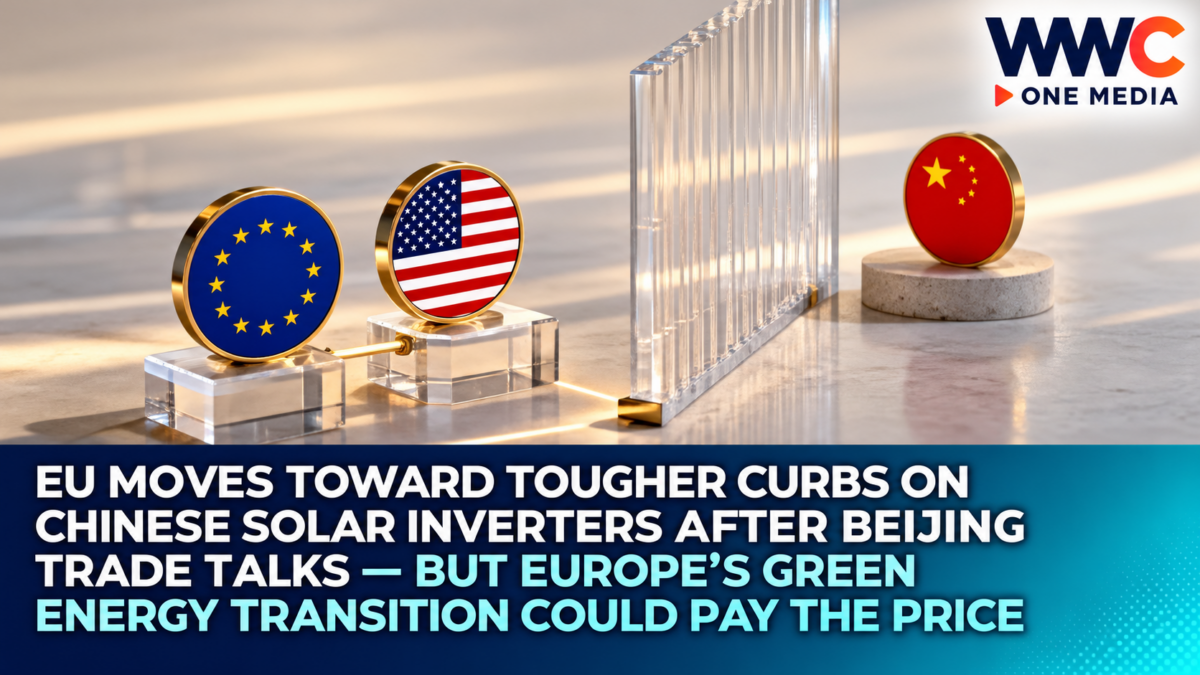
BRUSSELS, Belgium — The European Union is moving toward another potential confrontation with China over critical energy technology as officials agree to discuss further restrictions on Chinese-made solar inverters following high-level trade negotiations in Beijing.
The development, reported by Bloomberg on October 12, 2026, comes as Brussels seeks to reduce its dependence on Chinese equipment used in renewable energy projects while addressing concerns about cybersecurity and foreign influence over European electricity infrastructure.
At the center of the debate are solar inverters — essential devices that convert electricity generated by solar panels into power that homes, businesses and national grids can use.
Although far less visible than solar panels, these devices have become strategically important because many modern inverters are connected to the internet and can be monitored or managed remotely.
European officials fear that inadequate cybersecurity protections or dependence on suppliers subject to foreign-government influence could create vulnerabilities across the continent’s electricity networks.
But restricting Chinese suppliers creates another major problem.
China dominates the global solar equipment supply chain, and its manufacturers have helped lower the cost of renewable energy installations.
Any additional restrictions could force developers to find alternative suppliers, increase equipment costs and potentially delay the continent’s transition away from fossil fuels.
The emerging question is whether Europe can strengthen energy security without undermining the affordable renewable power it needs.
EU-China Trade Talks Open Another Front in Solar Energy
The latest solar inverter discussions follow two days of high-level negotiations in Beijing involving European Trade Commissioner Maroš Šefčovič and Chinese Commerce Minister Wang Wentao.
The meetings, held on October 8 and 9, focused on longstanding trade disagreements involving Chinese industrial exports, European market access, critical materials and competition.
The two sides reached a preliminary understanding on measures intended to moderate Chinese hybrid vehicle exports to Europe.
The discussions also addressed broader trade issues, including access to rare-earth materials and efforts to reduce commercial tensions.
According to Bloomberg’s October 12 headline, the European Union has now agreed to discuss curbs on Chinese inverters following the trade meeting.
That development does not establish that a new blanket ban has been approved.
The scope, timing and legal structure of any additional measures still require clarification.
The distinction is significant because Europe already has targeted restrictions affecting Chinese-made inverters in certain publicly funded clean-energy projects.
Further negotiations could determine whether additional safeguards are needed and how far they should extend.
Why Chinese Solar Inverters Have Become a Security Concern
Solar inverters serve a critical role in renewable energy systems.
Solar panels produce direct-current electricity, which must be converted into alternating current for most electrical networks.
Inverters perform this conversion while helping regulate how solar installations interact with the power grid.
Advanced models also support remote monitoring, software updates and grid-management functions.
Those features improve operational efficiency but create potential cybersecurity risks.
If a connected inverter is inadequately protected, an attacker could potentially gain unauthorized access to operational functions or interfere with a solar installation.
A coordinated disruption involving large numbers of devices could create greater risks for electricity networks.
European regulators are particularly concerned about reliance on equipment from suppliers that may be exposed to geopolitical pressure.
However, the existence of remote-control capabilities does not prove that Chinese manufacturers have deliberately interfered with European electricity networks.
Cybersecurity concerns are based on potential vulnerabilities, supplier concentration and the consequences of unauthorized access.
Chinese Manufacturers Control a Major Share of Europe’s Inverter Market
The scale of Europe’s dependence is substantial.
According to European Commission research published in 2026, approximately 70% of solar inverters installed in Europe in 2023 originated from Chinese vendors.
Between 2015 and 2023, Chinese companies supplied approximately 225 gigawatts of the 350 gigawatts of photovoltaic inverter capacity shipped to Europe.
Huawei alone accounted for roughly 114 gigawatts during that period.
The same Commission assessment reported that two Chinese suppliers had remote-access capabilities associated with approximately 168 gigawatts of photovoltaic capacity in Europe.
These figures explain why governments increasingly view solar inverters as strategic infrastructure rather than ordinary consumer electronics.
The concentration of equipment among a limited number of suppliers could create systemic risks if widespread vulnerabilities were discovered.
It also complicates attempts to rapidly replace existing technology.
Solar installations typically operate for many years, meaning equipment decisions made today can influence electricity infrastructure security well into the future.
EU Restrictions Could Affect More Than 14 Gigawatts of Solar Projects
Europe has already introduced measures designed to reduce exposure to Chinese inverter technology.
In June 2026, Reuters reported that an EU restriction preventing certain publicly supported clean-energy projects from using Chinese-made inverters could affect more than one-fifth of new solar installations.
The estimated exposure was at least 14 gigawatts of capacity.
The restrictions were introduced amid concerns that connected power equipment from high-risk suppliers could create vulnerabilities through remote software or firmware access.
For solar developers, the rules present practical challenges.
Chinese manufacturers have established extensive distribution networks, technical support operations and competitive pricing structures.
Alternative suppliers may need time to expand manufacturing capacity and provide equivalent installation and maintenance services.
Industry participants have warned that abrupt restrictions could raise costs and delay projects.
However, the existing public-funding restrictions should not be confused with a universal prohibition on all Chinese inverters already operating in Europe.
The policy’s effects depend on the specific funding arrangements and applicable rules.
Huawei and Sungrow Face Growing European Scrutiny
Chinese technology companies Huawei and Sungrow are among the most prominent suppliers in Europe’s inverter market.
Their position reflects years of investment in power electronics, manufacturing scale and international distribution.
Inverters supplied by companies such as these are used across residential, commercial and utility-scale renewable energy installations.
European authorities are now examining whether greater restrictions are needed for suppliers considered high-risk.
For Chinese manufacturers, tighter rules could threaten access to an important export market.
For European solar developers, the consequences could include changes in procurement strategies and additional cybersecurity compliance requirements.
At the same time, European manufacturers such as Germany’s SMA Solar Technology and Austria’s Fronius could benefit from policies that encourage greater supplier diversification.
However, alternative manufacturing capacity cannot necessarily expand immediately to replace established supply chains.
A successful transition would require adequate production, technical compatibility, competitive prices and reliable after-sales services.
European Researchers Find Thousands of Exposed Renewable Energy Systems
Fresh cybersecurity research has added urgency to the debate.
On October 6, Reuters reported that Dutch researchers had identified 8,547 vulnerable wind and solar energy systems across 35 European countries.
The research, conducted by security specialists from Modat and the Dutch National Cyber Security Centre, found that some renewable energy installations had exposed administrative or operational interfaces accessible through the internet.
Approximately 181 sites were identified as potentially allowing attackers extensive operational control, including the ability to switch certain generation equipment on or off.
The findings demonstrated how internet-connected renewable infrastructure can create significant security risks when access controls are poorly configured.
Spain, Greece and Germany were among the countries with substantial numbers of exposed systems.
However, the research did not establish that all the vulnerable equipment was Chinese-made.
Nor did it demonstrate that the Chinese government had exploited the identified vulnerabilities.
The findings highlight a wider European cybersecurity challenge that extends beyond the nationality of individual equipment suppliers.
Solar Industry Calls for Stronger Cybersecurity Standards
European renewable energy representatives have also warned that modern electricity systems require stronger cybersecurity protections.
In April 2025, SolarPower Europe published research commissioned from DNV examining cybersecurity risks associated with solar installations.
The organization recommended industry-specific security controls, stronger rules for remote access and improved cybersecurity management for connected photovoltaic infrastructure.
The report reflected a growing recognition that the transition toward decentralized renewable energy increases the number of digitally connected devices interacting with electricity networks.
Unlike traditional power systems dominated by fewer large generating plants, renewable energy networks can include thousands of smaller installations.
This creates additional technical and regulatory challenges.
Industry-wide security standards could help reduce vulnerabilities regardless of where equipment is manufactured.
However, some policymakers argue that technical safeguards alone may be insufficient where dependence on particular foreign suppliers creates geopolitical risks.
The debate is therefore about both cybersecurity engineering and strategic control over critical infrastructure.
Europe Faces a Wider Trade Confrontation With China
The solar inverter issue is emerging alongside growing concern over Chinese industrial exports.
France and Germany have called for stronger EU mechanisms to protect domestic industries against what they regard as unfair competition and excessive import dependence.
The European Union has been examining trade pressures affecting automotive manufacturing, chemicals, steel and renewable energy equipment.
China’s manufacturing scale and relatively low production costs have increased competition for European companies.
However, Chinese imports have also benefited European consumers and businesses by lowering prices for equipment and industrial components.
That creates an economic dilemma.
Measures that protect European manufacturers may increase costs for downstream industries that depend on imported materials and technology.
In renewable energy, those costs could ultimately affect the pace and affordability of new projects.
The recent EU-China understanding on hybrid vehicle exports demonstrates that the two sides remain willing to negotiate.
But the solar inverter dispute shows that broader disagreements over technology, industrial policy and economic security remain unresolved.
Could Europe’s Energy Security Strategy Slow Its Climate Goals?
The European Union is attempting to achieve several difficult objectives simultaneously.
It wants to expand renewable energy, reduce fossil fuel dependence, improve electricity security and strengthen European industrial capacity.
Reducing reliance on high-risk equipment suppliers could support those objectives over the long term.
But replacing affordable and widely available technology too quickly could create immediate challenges.
Solar developers may face higher procurement expenses, uncertainty over approved equipment and potential delays in construction.
If developers postpone projects, the region could experience slower additions of renewable electricity capacity.
That would complicate efforts to reduce reliance on imported fossil fuels.
The trade-off is particularly important as European economies confront geopolitical instability and volatile energy markets.
A durable strategy may require phased restrictions, clear technical standards, expanded European manufacturing and predictable implementation schedules.
Such an approach could give businesses time to adapt while improving cybersecurity protections.
Why the Dispute Matters Beyond Europe
The consequences could extend across global renewable energy markets.
China plays a dominant role in solar manufacturing, while Europe remains an important destination for clean-energy technology exports.
If European buyers shift toward alternative suppliers, manufacturers in other countries could gain opportunities.
At the same time, changes in supply chains could affect equipment availability and prices worldwide.
For Southeast Asian markets, including the Philippines, the dispute highlights the growing importance of cybersecurity in renewable energy development.
As more solar installations, battery systems and smart-grid devices become connected to the internet, governments and electricity operators must consider digital security alongside equipment costs and performance.
The European debate does not establish that Chinese inverters installed in Asia are inherently unsafe.
But it illustrates why utilities and regulators may increasingly examine supplier access, software-update controls, security testing and emergency response procedures when procuring renewable energy equipment.
These considerations could become more important as countries expand renewable generation and modernize electricity networks.
The Bigger Question: Can Europe Reduce China’s Influence Without Raising Energy Costs?
The latest discussions over Chinese solar inverters reveal how clean energy has become a major issue in international trade and national security.
Renewable technology is no longer viewed solely through the lens of carbon emissions and electricity costs.
Governments are increasingly examining who manufactures the equipment, who controls software updates and whether foreign suppliers could influence critical infrastructure.
For European policymakers, reducing dependence on Chinese technology may strengthen strategic resilience.
For solar developers, however, the same restrictions could create supply-chain difficulties and increase project expenses.
China’s manufacturers have established a powerful position through production scale, competitive prices and extensive international operations.
Europe’s challenge is to build alternative capabilities without slowing the renewable energy expansion it needs.
The EU’s willingness to discuss additional curbs on Chinese solar inverters marks another development in its effort to strengthen energy security. But the real test will be whether policymakers can reduce cybersecurity risks without making the green transition slower and more expensive.
As Brussels and Beijing continue negotiating their increasingly complicated trade relationship, solar inverters could become another symbol of the struggle between economic efficiency and strategic independence.
Europe wants greater control over its electricity infrastructure — but the next question is whether it can afford to loosen China’s grip on the technology powering its clean-energy future.