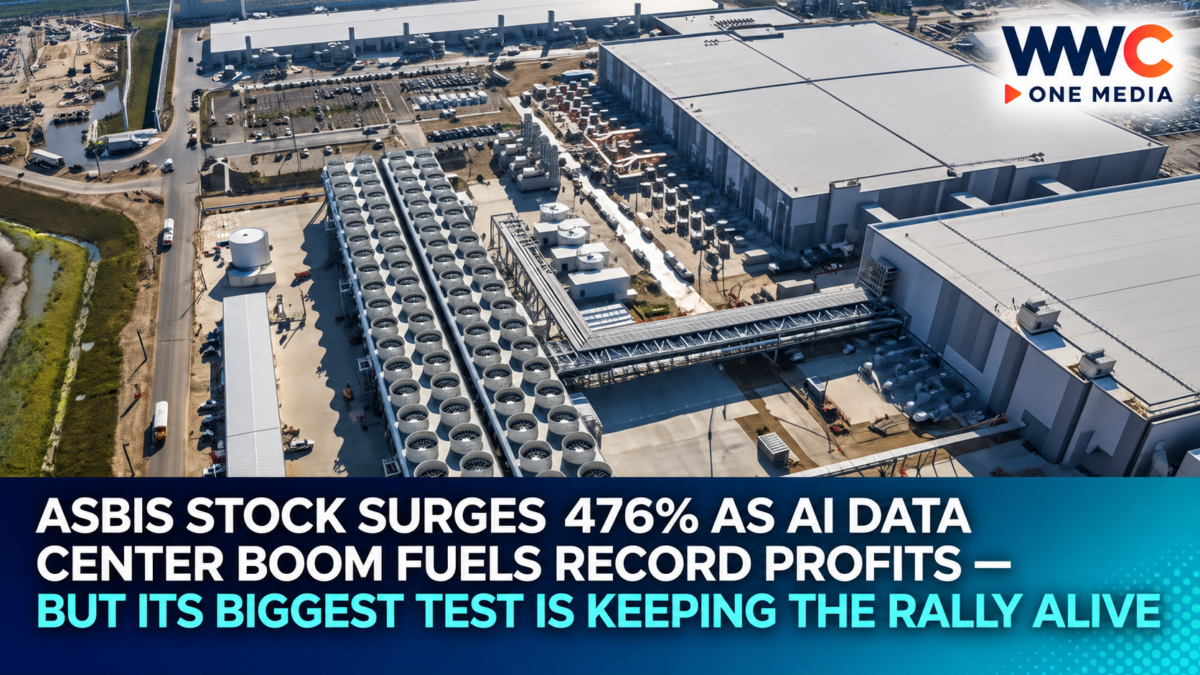
LIMASSOL, Cyprus — A technology distributor that once operated largely outside the global artificial intelligence spotlight is attracting major investor attention after a spectacular stock-market rally, as booming demand for AI servers and data center infrastructure transforms its business.
ASBISc Enterprises Plc, a Cyprus-based technology distributor listed on the Warsaw Stock Exchange, is seeking to capitalize on the worldwide expansion of artificial intelligence computing infrastructure after its shares recorded a reported 476% rally, according to Bloomberg’s October 12, 2026 coverage.
The company, which distributes technology products and provides specialized solutions across Europe, the Middle East and Africa, is benefiting from demand for servers, advanced processors, memory, storage and other components essential to AI data centers.
But the dramatic share-price performance is creating a new challenge.
Investors are no longer simply asking whether ASBIS can benefit from the AI boom. They want to know whether its earnings, project pipeline and expansion strategy can justify the market’s rapidly increasing expectations.
ASBIS Emerges as a Major Beneficiary of the AI Infrastructure Boom
The artificial intelligence investment wave is creating opportunities beyond the world’s largest semiconductor manufacturers and cloud computing companies.
As businesses and governments expand AI infrastructure, they need more than graphics processing units.
They also require servers, storage systems, networking equipment, processors, memory and technical support.
That is where companies such as ASBIS are finding significant opportunities.
ASBIS operates as a value-added technology distributor and solutions provider, connecting global hardware manufacturers with customers and system integrators in numerous markets.
Its business spans enterprise technology, consumer electronics, information technology components and other specialized products.
The company has relationships with major technology suppliers, including NVIDIA, AMD, Intel, Micron, Seagate, Toshiba and Supermicro.
These partnerships position ASBIS to participate in the expansion of AI computing infrastructure without necessarily designing or manufacturing the underlying chips itself.
The distinction is important.
ASBIS is primarily a distributor and technology solutions provider, not a direct equivalent of semiconductor designers such as NVIDIA.
Its commercial opportunity comes from supplying hardware and solutions to organizations building or upgrading their computing capacity.
AI Demand Pushes First-Half Revenue to Nearly $3 Billion
ASBIS’s financial results demonstrate how rapidly demand for its products has increased.
According to its official August 6 earnings announcement, first-half 2026 revenue rose 76% from a year earlier to approximately $2.97 billion.
Net profit increased 315% to $80.6 million, compared with $19.4 million in the corresponding period of 2025.
The performance was particularly remarkable because the company’s first-half earnings had already exceeded its entire 2025 net profit of $60.2 million.
Its second quarter was the strongest in the company’s history.
Quarterly revenue surged 79% to approximately $1.70 billion, while net profit increased to $44.3 million.
The results suggest that ASBIS is benefiting from more than short-lived speculation surrounding artificial intelligence.
The company has reported substantial revenue growth alongside sharply improved profitability.
However, exceptionally high growth rates can become difficult to repeat once a company is comparing its results against much stronger previous periods.
That creates a potential challenge for future earnings expectations.
More Than $860 Million in Server Projects Supports Expansion
One of the most important indicators of ASBIS’s business momentum is its large server-project order book.
In August, the company disclosed that it had secured multiple significant server projects with a combined value exceeding $860 million.
The projects are connected to growing demand for computing infrastructure capable of supporting AI workloads.
For investors, the order book provides visibility into potential future revenue.
It also suggests that ASBIS is becoming increasingly involved in large technology infrastructure deployments rather than relying exclusively on smaller product-distribution transactions.
However, the order book should not be confused with cash already received or revenue fully recognized.
Project execution, customer acceptance, delivery schedules and other contractual conditions can affect when orders are converted into reported sales and profit.
The company must also manage component availability, logistics and working capital requirements as project values increase.
These factors will be important in determining whether the server business can remain profitable at a larger scale.
CEO Serhei Kostevitch Bets on Sustained AI Infrastructure Spending
ASBIS founder and Chief Executive Officer Serhei Kostevitch has repeatedly identified artificial intelligence infrastructure as a major driver of the company’s growth.
Following its first-half results, management said demand for AI data centers had become a core component of its sales offering.
The company also highlighted its ability to expand business with technology vendors and serve customers across multiple geographic markets.
Management’s strategy involves leveraging its existing distribution network, technical relationships and regional operations to capture additional AI infrastructure spending.
Rather than concentrating on a single country, ASBIS operates across markets in Central and Eastern Europe, the Commonwealth of Independent States region, the Middle East and Africa.
This geographic reach creates opportunities to participate in different stages of AI infrastructure adoption.
It also exposes the company to exchange-rate volatility, political risks, trade restrictions and changes in regional customer demand.
Kostevitch’s challenge is to maintain growth while managing these increasingly complex operations.
Kazakhstan, Ukraine and Other Markets Drive Growth
ASBIS’s expanding revenue base includes several fast-growing markets.
In the second quarter of 2026, the company reported substantial sales increases in Kazakhstan, Ukraine, Azerbaijan and Uzbekistan.
Uzbekistan recorded growth of more than 600% from a relatively smaller comparison base, while Ukraine’s revenue increased by more than 100%.
Kazakhstan remained one of ASBIS’s most important markets.
The company’s August trading update identified Ukraine, Kazakhstan and the United Arab Emirates as its three largest markets for that month.
Strong demand for AI infrastructure and consumer technology contributed to this performance.
However, the company’s exposure to Ukraine and other geopolitically sensitive markets creates additional uncertainty.
Supply disruptions, sanctions, international trade rules, financing conditions and currency movements could affect its operations.
The Middle East also remains an important market, even as regional conflict complicates business conditions.
Geographic diversification may reduce dependence on any single economy, but it does not eliminate the risks associated with international expansion.
ASBIS Reports Another Sales Record in August
The strong earnings trend continued beyond the first half of the year.
On September 21, ASBIS announced preliminary consolidated revenue of approximately $604 million for August 2026.
That represented a 91% increase from $316 million in August 2025.
The company described the performance as its strongest August on record.
July had also been exceptional, with preliminary revenue reaching $531 million, an 89% year-over-year increase.
The figures indicate that ASBIS entered the second half with considerable sales momentum.
Management attributed the growth to strong demand for AI infrastructure alongside healthy sales of consumer technology products.
Smartphones remained an important contributor, showing that the company is not dependent exclusively on AI-related hardware.
However, preliminary monthly sales figures do not provide a complete picture of profitability.
Investors will need to examine the company’s upcoming quarterly financial statements to determine whether strong sales are translating into sustained margin improvements.
NVIDIA Partnerships Strengthen ASBIS’s AI Position
Relationships with major global technology companies are central to ASBIS’s strategy.
In May 2026, the company highlighted a series of AI-focused roadshows conducted with partners including NVIDIA and Supermicro.
The events were designed to help enterprises, engineers and technology integrators understand how AI infrastructure can be deployed in practical business environments.
ASBIS has also received recognition through NVIDIA’s partner programs.
These activities demonstrate the company’s efforts to move beyond conventional technology distribution toward supporting complex AI infrastructure projects.
The opportunity includes helping customers access the hardware and technical knowledge required for computing-intensive applications.
But supplier relationships do not guarantee exclusive access to products, protected margins or future sales.
Competition among distributors and system integrators remains an important factor.
Why the AI Data Center Boom Is Creating New Winners
The global AI investment cycle has increased demand across the technology supply chain.
Training and operating advanced AI models requires extensive computing capacity.
That capacity depends on data centers equipped with specialized processors, memory, high-speed networking equipment, storage and power infrastructure.
As investment in AI expands, suppliers operating at different points in the chain may benefit.
Chip designers, server manufacturers, memory companies, infrastructure specialists and technology distributors can all experience higher demand.
ASBIS’s recent results illustrate how the AI boom can generate substantial business for companies outside the most widely followed US technology stocks.
But the market is increasingly distinguishing between companies with actual revenue growth and businesses whose valuations depend primarily on future expectations.
ASBIS has reported significant earnings growth, yet the durability of that performance remains the central question.
A 476% Stock Rally Raises Valuation Questions
The reported 476% advance in ASBIS shares is a striking indication of investor enthusiasm.
Such a large rally can reflect improving earnings, stronger growth expectations and greater market interest.
However, a rising share price also increases the financial expectations placed on a company.
Even a profitable business can experience a sharp correction if its results fall short of what investors have already priced in.
For ASBIS, several questions are particularly important.
Can large AI server orders continue at their current pace?
Will margins remain strong as competitors pursue the same opportunities?
Can the company finance larger projects without putting excessive pressure on working capital?
And will customers maintain infrastructure spending if economic conditions become more difficult?
The company may also face fluctuations in product availability and prices, particularly for high-demand processors and memory.
These factors could affect profitability even if underlying AI adoption continues to expand.
Importantly, the reported 476% increase refers to the stock-market rally cited in Bloomberg’s report, not a comparable increase in revenue or net profit.
The precise share-price measurement period should be confirmed against market data before presenting the figure as a year-to-date or twelve-month return.
Higher Interest Rates Add Pressure to Technology Stocks
ASBIS’s rally is occurring against a wider financial backdrop in which investors are increasingly sensitive to interest rates and the valuations of AI-related businesses.
Reuters reported on October 9 that US technology stocks had played a leading role in the broader bull market, supported by heavy investment in AI infrastructure.
However, rising Treasury yields and concerns about market concentration are creating potential risks.
Higher interest rates can make bonds more attractive relative to equities and affect the valuation of companies expected to deliver strong future earnings growth.
This does not mean every AI-related stock will decline when interest rates rise.
But companies that have already recorded large share-price increases can become especially sensitive to disappointing earnings or changes in investor sentiment.
For ASBIS, solid financial performance may help support confidence, but it cannot guarantee immunity from a broader technology-sector correction.
The Bigger Question: Can ASBIS Turn the AI Boom Into Lasting Growth?
ASBIS’s transformation illustrates how artificial intelligence is reshaping the global technology supply chain.
A business historically associated with IT distribution is increasingly benefiting from demand for servers and other hardware essential to AI computing.
The company’s first-half earnings, record monthly sales and substantial server-project order book suggest that the opportunity is already generating meaningful commercial results.
Yet the next stage may be more demanding than the initial surge.
Maintaining exceptional revenue growth requires a continuing stream of projects, reliable access to products and effective execution.
Protecting profitability requires disciplined pricing, cost management and careful control of operational risks.
And justifying a dramatic stock-market rally requires investors to believe that the company’s expansion is not merely temporary.
ASBIS has demonstrated that it can capitalize on the global AI infrastructure boom. But after a reported 476% rally, the challenge is no longer simply delivering growth — it is delivering enough sustainable earnings to meet dramatically higher expectations.
The coming financial results and future project announcements will be important indicators of whether that momentum can continue.
For investors, ASBIS is becoming a compelling example of how AI spending can transform an established technology distributor. But the real test is whether the company can turn today’s exceptional demand into a durable business advantage before competition and market expectations catch up.