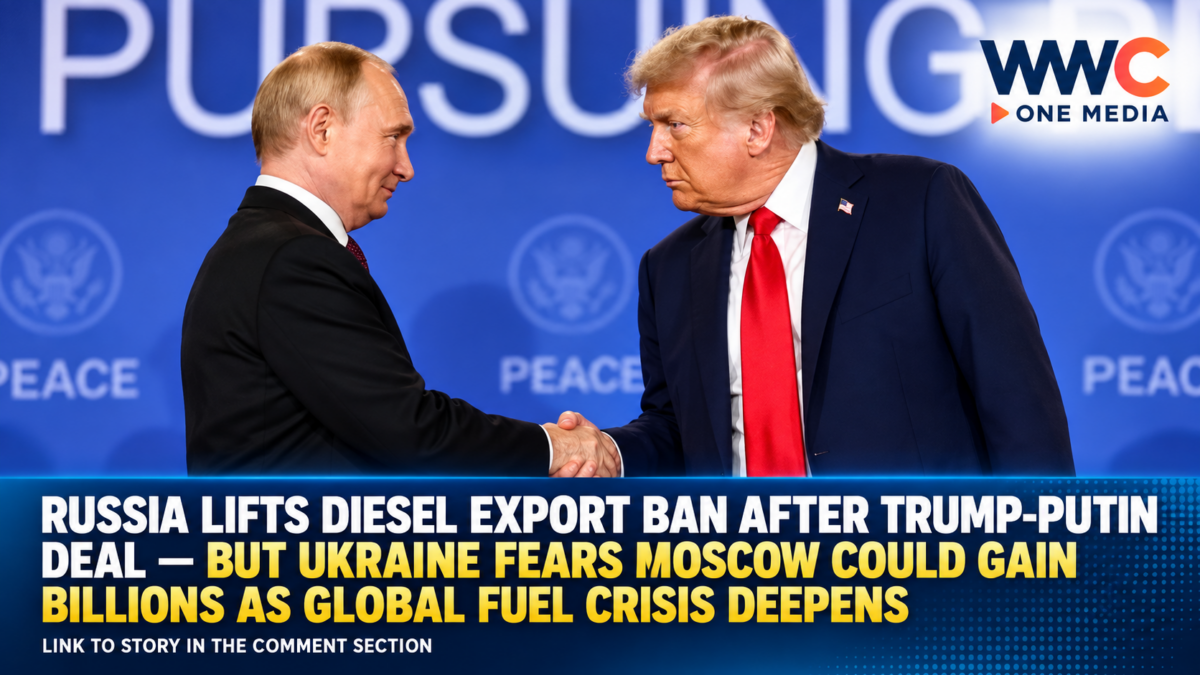
MOSCOW, RUSSIA — Russia has partially lifted its ban on diesel exports following a controversial agreement between President Vladimir Putin and U.S. President Donald Trump, reopening a crucial source of global fuel supplies while triggering fresh fears that Moscow could gain additional revenue to finance its continuing war against Ukraine.
The Russian government announced on Saturday, October 10, that it would ease diesel export restrictions with immediate effect, reversing part of an earlier policy designed to protect domestic fuel supplies amid refinery disruptions and mounting pressure on the country’s energy industry.
According to Bloomberg News, the initial decision would allow approximately 500,000 metric tons of diesel to reach international markets, with Russian oil companies preparing to negotiate new export contracts in coordination with government authorities.
The move followed Trump’s October 9 announcement that Washington and Moscow had reached an agreement intended to increase international diesel supplies and ease soaring fuel prices.
But what began as an attempt to relieve pressure on consumers has quickly developed into a much larger geopolitical controversy.
Ukraine and several Western politicians warn that relaxing restrictions on Russian energy could provide Moscow with additional income at a time when Russian forces continue attacking Ukrainian cities.
The central question is whether the agreement will meaningfully reduce fuel costs — or simply strengthen Russia’s financial position without resolving the underlying global supply shortage.
Russia Reopens Diesel Exports After Months of Restrictions
Russia’s decision represents a significant policy reversal.
The country had restricted diesel exports to protect its domestic market following repeated Ukrainian drone strikes against Russian refineries and disruptions to fuel production.
According to S&P Global Commodity Insights, Russia had been one of the world’s largest diesel exporters before the restrictions substantially reduced its ability to supply international buyers.
Russia had extended restrictions on exports by producers through the end of October, while separate restrictions affecting non-producers were scheduled to remain in place longer.
However, after Putin’s discussions with Trump, Moscow authorized a partial reopening ahead of schedule.
Russian Deputy Prime Minister Alexander Novak said the country’s refining industry had sufficient production capacity to satisfy domestic demand while supplying the newly permitted export volumes.
The government indicated that Russian oil companies could immediately begin negotiating contracts with international customers.
Bloomberg reported that the initial authorization covered around 500,000 metric tons.
However, the Russian government had not provided a definitive shipping timetable or confirmed whether additional export volumes would be approved.
That distinction matters because authorization to export fuel does not necessarily mean the entire amount has already been shipped or delivered.
Trump Announces Major Russian Diesel Supply Agreement
The Russian decision followed an October 9 announcement by Trump that he had reached an agreement with Putin to release Russian diesel into American and international markets.
According to Reuters and the Associated Press, Trump’s proposed supply schedule included:
- More than 300,000 metric tons of diesel for immediate supply.
- An additional 500,000 metric tons during November.
- Another 1 million metric tons thereafter.
- A further 3 million metric tons within an unspecified period.
Together, the announced volumes exceed 4.8 million metric tons.
However, those figures represent the broader supply commitments described by Trump, not shipments independently confirmed as delivered.
Russia’s initial 500,000-ton export authorization is also distinct from the larger volumes outlined by the American president.
The U.S. administration argues that additional Russian fuel entering international markets could help ease shortages and reduce costs for American consumers.
Diesel is a critical fuel for trucking, agriculture, construction, manufacturing and international shipping.
Its price affects not only transportation expenses but also the broader cost of moving goods through the global economy.
However, the actual impact of Russia’s renewed exports will depend on how much additional fuel becomes available, how quickly shipments can move and whether existing customers simply receive supplies that would otherwise have gone elsewhere.
Washington Temporarily Eases Sanctions on Russian Diesel
The agreement also involves an important change in U.S. sanctions policy.
The Trump administration issued a temporary authorization allowing certain Russian diesel transactions that would otherwise have faced U.S. restrictions.
According to Reuters and the Associated Press, the measure provides sanctions relief through April 2027 under specified conditions.
The arrangement marks a notable departure from Washington’s earlier efforts to restrict Russian energy revenues following Moscow’s full-scale invasion of Ukraine in February 2022.
For years, the United States and European allies have attempted to limit Russia’s ability to use oil and gas exports to support its military operations.
The new diesel arrangement demonstrates how rising fuel costs are creating tensions between energy security and geopolitical objectives.
Washington wants to increase available fuel supplies.
Ukraine wants the international community to maintain economic pressure on Moscow.
Those competing priorities now threaten to complicate relations between the United States and its European partners.
Importantly, the temporary diesel authorization does not mean all American sanctions on Russia have been removed.
Ukraine Condemns Deal as Potential Financial Lifeline for Moscow
Ukrainian President Volodymyr Zelenskyy sharply criticized the agreement, warning that increased Russian energy exports could provide additional revenue to support the Kremlin’s military campaign.
Zelenskyy described the decision to ease sanctions as weak, arguing that relaxing financial pressure on Russia risks prolonging the war rather than bringing it closer to an end.
His objections reflect a central element of Ukraine’s strategy.
Kyiv has repeatedly targeted Russian refineries and other energy infrastructure in an effort to disrupt fuel supplies supporting Moscow’s military operations and weaken revenue-generating industries.
Russian refining capacity has suffered significant disruptions because of repeated attacks.
But these strikes have also contributed to uncertainty in global diesel markets.
Trump has criticized Ukraine’s attacks on Russian oil infrastructure, arguing that they worsen international fuel shortages.
On October 10, the American president also suggested Ukraine should elect a new leader, intensifying tensions with Zelenskyy.
The dispute highlights a widening disagreement over how to pressure Moscow into ending the war.
Ukraine argues that weakening Russia’s energy economy is necessary to limit its military capabilities.
Trump’s administration is prioritizing additional fuel supplies as a means of addressing high energy costs.
Why Diesel Prices Have Become a Political Crisis for Trump
The deal comes at a sensitive moment for the United States.
American diesel prices have climbed sharply amid disruptions to global refinery operations, reduced fuel availability and instability in major energy-producing regions.
According to The Washington Post and The National, U.S. diesel prices were averaging approximately $6.27 to $6.28 per gallon around October 9, compared with roughly $3.67 to $3.68 a year earlier.
Those increases have placed considerable pressure on American businesses and consumers.
Trucking companies face higher operating expenses.
Farmers depend on diesel for agricultural machinery and transportation.
Construction companies use diesel-powered equipment, while manufacturers and retailers must absorb higher freight costs.
The situation has become politically sensitive ahead of the November 3 U.S. congressional midterm elections.
The Trump administration is under pressure to demonstrate that it can reduce energy costs without worsening economic uncertainty.
Opening additional Russian supplies offers one potential response.
However, energy analysts have warned that the volume of additional diesel may be too small to produce a substantial or lasting reduction in prices.
Will Russian Diesel Actually Lower Global Fuel Prices?
Despite the agreement’s political significance, its economic effectiveness remains uncertain.
Reuters reported that diesel prices initially declined after Trump’s announcement, but analysts questioned whether the agreement would provide enough additional supply to keep prices lower.
The Washington Post cited energy experts who argued that redirecting Russian fuel toward American buyers might simply force existing customers to obtain diesel from other suppliers.
In that scenario, international trade routes could change without a significant increase in total global supply.
Russia’s export capacity also remains constrained by refinery damage, operational disruptions and the need to maintain domestic fuel availability.
The timing of actual deliveries is another important factor.
Fuel must be produced, stored, transported, insured and delivered before it can significantly affect physical markets.
Shipping costs, refinery output and sanctions compliance requirements may influence how quickly buyers can receive Russian diesel.
A sustained reduction in prices would likely require broader improvements in global supply conditions, not simply an announcement of additional shipments.
Russia’s Refinery Problems Complicate the Agreement
Russia had previously restricted diesel exports partly because its refining industry was struggling to maintain stable domestic supplies.
Ukrainian drone attacks have damaged petroleum infrastructure and disrupted operations at several Russian facilities.
Before the Trump-Putin agreement, Russian officials had indicated that restrictions could be eased if production recovered sufficiently to create a surplus.
On October 2, Novak said Moscow could consider partially lifting its export ban if refinery production exceeded domestic demand.
The eventual October 10 decision therefore followed both discussions about domestic supply conditions and the new political agreement with Washington.
Russia now faces the challenge of fulfilling international commitments without creating shortages at home.
Novak has insisted that the new export volumes will not undermine domestic consumers.
Whether Russia can sustain larger shipments will depend on refinery capacity, infrastructure security and the frequency of further attacks.
Europe Faces a New Sanctions Dilemma
The agreement is also likely to create difficult questions for European governments.
Since Russia’s invasion of Ukraine, European countries have imposed extensive restrictions designed to reduce dependence on Russian energy and limit Moscow’s export revenue.
A U.S. decision to ease restrictions on Russian diesel could complicate efforts to maintain coordinated international pressure.
European policymakers must now balance concerns about energy affordability with their continued commitment to supporting Ukraine.
If Washington pursues greater energy cooperation with Russia while European sanctions remain more restrictive, differences in policy could become increasingly visible.
However, Europe’s sanctions framework remains separate from the U.S. measures, and the American agreement does not automatically authorize Russian diesel imports into European markets.
Any substantial change in European policy would require separate decisions by the relevant authorities.
What the Diesel Deal Means for the Philippines and Southeast Asia
The decision also has potential implications for the Philippines and other Asian economies that depend heavily on imported energy.
Diesel powers freight trucks, buses, agricultural machinery, fishing vessels and industrial equipment throughout Southeast Asia.
Higher international diesel prices can raise transportation expenses, increase agricultural production costs and contribute to broader inflationary pressure.
For the Philippines, additional international fuel supplies could provide indirect relief if they lead to lower refined petroleum prices in Asian markets.
However, domestic pump prices are influenced by several factors, including regional fuel benchmarks, peso-dollar exchange rates, taxes and local pricing adjustments.
Russia’s decision does not guarantee an immediate reduction in Philippine diesel prices.
Singapore, a major regional energy trading and refining hub, could also experience changes in trading flows if more Russian fuel enters international markets through permitted channels.
Meanwhile, shipping companies and industrial businesses across Asia will be watching whether the new supplies provide meaningful relief from elevated fuel costs.
For emerging markets, the stakes extend beyond transportation.
Higher energy import bills can increase pressure on trade balances, government budgets and household purchasing power.
The Bigger Picture: A Fuel Deal With Major Geopolitical Consequences
The partial reopening of Russia’s diesel exports is more than an energy-market development.
It represents a significant diplomatic decision that could influence relations between Washington, Moscow, Kyiv and European governments.
For Trump, the agreement offers a chance to demonstrate action on fuel prices before an important election.
For Putin, renewed access to international diesel markets could provide additional commercial opportunities and reduce some of the economic pressure imposed by Western sanctions.
For Zelenskyy, the deal raises fears that Russia could benefit financially while continuing its military operations in Ukraine.
For global consumers, the outcome will depend on whether additional fuel supplies genuinely ease shortages and reduce prices.
And for the international energy industry, the agreement raises a difficult question about whether governments can maintain economic sanctions while simultaneously seeking supplies from the countries they are attempting to isolate.
Russia has reopened part of its diesel export market, but the biggest unanswered question is whether this deal will ease the world’s fuel crisis — or give Moscow a new financial advantage while the Ukraine war continues.
With shipments still to be completed and sanctions policies under scrutiny, the full impact of the Trump-Putin agreement remains uncertain.
What is already clear is that diesel has become far more than a transportation fuel.
It is now a powerful bargaining tool in the struggle over energy security, economic stability and the future of the Russia-Ukraine war.