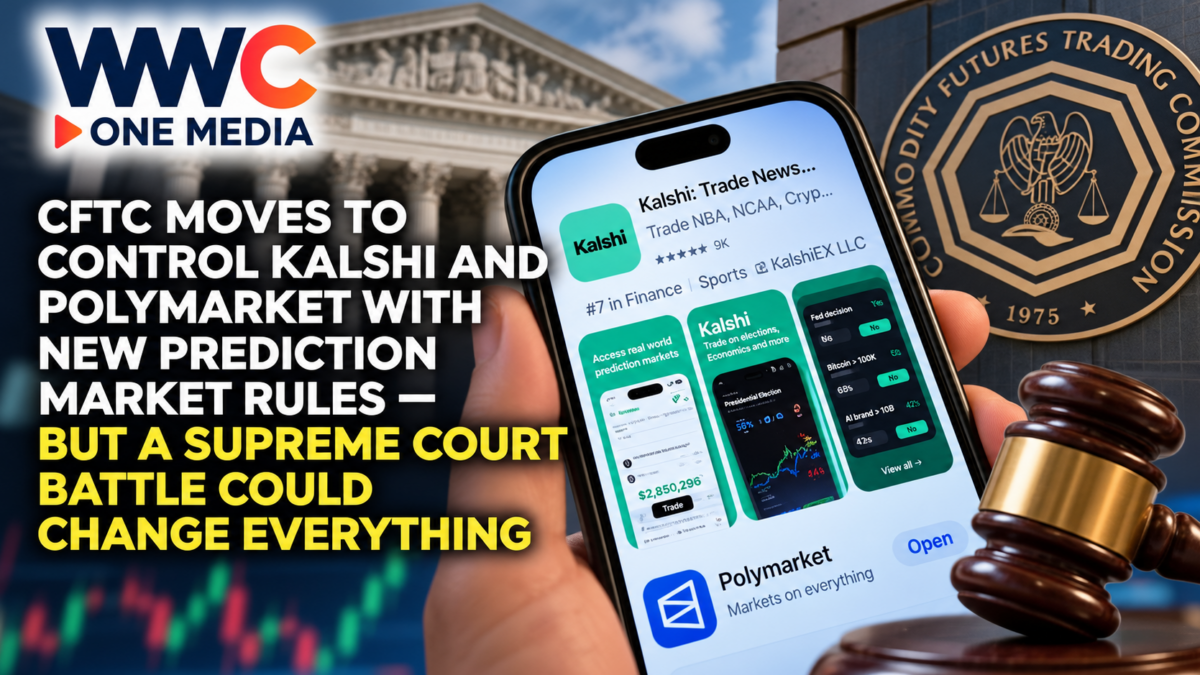
WASHINGTON, United States — October 10, 2026 — America’s booming prediction markets industry is facing a critical legal turning point after the country’s top derivatives regulator proposed new rules defining event-based contracts as financial swaps, a move that could strengthen federal oversight of platforms allowing people to trade on everything from election results to professional sports.
The Commodity Futures Trading Commission announced the proposed regulatory changes on October 9, seeking to clarify that certain contracts tied to sports, politics, culture and weather fall within its jurisdiction under the Commodity Exchange Act.
The decision places the agency directly at odds with states and tribal gaming authorities that argue many of these products are effectively gambling contracts operating outside traditional state betting laws.
Platforms including Kalshi and Polymarket have expanded their businesses by offering markets in which participants trade contracts based on the outcome of future events.
Supporters say the products are legitimate financial instruments that help aggregate information and forecast outcomes.
Critics argue that some contracts are nearly indistinguishable from sports bets and can bypass safeguards required of licensed gambling operators.
The CFTC’s proposal could help determine the future of one of the fastest-evolving segments of financial technology.
But the bigger question is whether Washington can establish exclusive authority over these contracts — or whether the US Supreme Court will ultimately allow states to treat them as gambling.
CFTC Proposes a New Definition of Financial Swaps
The CFTC published a notice of proposed rulemaking on October 9 seeking to clarify how event contracts fit within federal derivatives law.
The proposal would expressly include certain event-based contracts within the regulatory definition of a swap.
Swaps are financial derivatives whose value depends on another variable, asset, benchmark or event.
In traditional finance, businesses use derivatives to manage exposure to changes in interest rates, currencies, commodities and other risks.
Prediction markets apply a similar concept to events that may or may not occur.
A contract could pay a specified amount depending on the outcome of an election, a sporting event or a weather occurrence.
CFTC Chairman Michael S. Selig said event contracts can serve purposes ranging from hedging to speculation and forecasting.
The commission argues that qualifying products belong under federal derivatives regulation rather than being treated automatically as conventional gambling.
However, the new swap definition remains a proposal.
It has not yet become a finalized rule.
What Are Prediction Markets?
Prediction markets allow participants to buy and sell contracts linked to the outcome of a future event.
Many use a simple yes-or-no structure.
For example, a contract might ask whether a particular candidate will win an election or whether a city will experience a specified weather event.
The price of the contract can reflect how traders collectively assess the likelihood of that outcome.
Prices can change as new information becomes available.
Supporters argue that these markets provide useful signals because participants have a financial incentive to make accurate forecasts.
They can potentially help businesses, researchers and the public interpret expectations about future events.
However, market prices are not guaranteed probabilities.
They can be influenced by limited liquidity, concentrated positions, speculative activity and the design of individual contracts.
Participants can also lose the money they commit.
The economic characteristics of prediction markets therefore resemble aspects of both financial trading and wagering.
That overlap is at the center of the regulatory dispute.
Kalshi and Polymarket Are at the Center of the Fight
Two of the best-known companies in the sector are Kalshi and Polymarket.
Both operate event-based trading businesses, although their products, corporate arrangements and regulatory structures have evolved over time.
Kalshi has argued that contracts listed on its federally regulated exchange are financial derivatives subject to CFTC oversight.
Polymarket has also defended prediction markets as mechanisms for price discovery and information aggregation.
Supporters of the federal approach say a unified national system can offer consistency across state borders.
That could allow regulated exchanges to offer standardized products without obtaining a separate gambling authorization in every state.
But state officials and gaming interests dispute whether federal registration should permit platforms to offer contracts that closely resemble sports wagering.
They argue that calling a product a derivative should not automatically exempt it from gambling protections.
The legal outcome could significantly influence where and how prediction market platforms operate.
The CFTC Makes an Important Distinction Between Event Contracts and Casino Gambling
The commission announced two related measures on October 9.
The first is the proposed clarification concerning event contracts classified as swaps.
The second is an interim final rule excluding conventional casino-style gambling products from the swap definition.
That exclusion covers traditional sportsbook wagers and casino games.
This distinction is essential because the regulator is not claiming that every type of gambling belongs under federal derivatives law.
Instead, it is attempting to separate products offered as qualifying financial derivatives from conventional betting activities.
Under the commission’s framework, a financial event contract may be regulated differently from a traditional sportsbook wager even when both involve an outcome in professional sports.
That distinction is precisely what state regulators are challenging.
They contend that the economic substance of certain sports contracts is what matters, not simply the exchange or label used.
The CFTC’s separate measures are intended to clarify its position, but they may not settle the dispute.
States Say Sports Prediction Contracts Are Gambling
State regulators argue that sports-related event contracts can resemble the wagers already regulated under state gaming laws.
Those laws often establish rules involving licensing, advertising, consumer protection, permissible betting activities and responsible gambling.
The states maintain that allowing federally regulated prediction exchanges to bypass these requirements could undermine their established regulatory systems.
They also raise concerns about lost tax revenue and unequal treatment between licensed sportsbooks and prediction-market operators.
Supporters of the federal model disagree.
They contend that Congress has given the CFTC jurisdiction over qualifying derivatives and that states should not impose conflicting requirements on federally regulated products.
The dispute therefore involves more than consumer preferences.
It is a contest over the boundaries of federal and state authority.
The outcome could affect the legal structure of an industry operating across the United States.
A Federal Appeals Court Has Added to the Uncertainty
The regulatory battle has intensified because federal courts have reached different conclusions about prediction-market jurisdiction.
Reuters reported that a ruling by the US Court of Appeals for the Sixth Circuit allowed Ohio and Tennessee to regulate certain event contracts under gambling laws.
Other judicial decisions have been more favorable to arguments supporting federal oversight.
The resulting disagreement creates uncertainty for market operators and regulators.
A product that can be offered under one court’s interpretation may face restrictions under another.
This is why the dispute is increasingly viewed as a potential US Supreme Court case.
A definitive ruling could clarify how federal commodities law interacts with state gaming legislation.
However, the Supreme Court has not yet issued a final decision resolving the nationwide dispute.
NFL Pushes the Supreme Court to Intervene
The National Football League has become an important participant in the debate.
On October 8, the NFL supported New Jersey’s request for the Supreme Court to review the jurisdictional dispute.
The league argues that sports-related prediction markets require stronger protections against insider trading, manipulation and other conduct threatening sporting integrity.
It also contends that the CFTC lacks the specialized resources and oversight structures traditionally used by gaming regulators.
According to Associated Press reporting, approximately $1.8 billion in prediction-market trading volume was recorded on the NFL season’s opening Sunday.
That figure illustrates the scale of interest in sports-linked event contracts.
However, trading volume is not the same as industry revenue or customer losses.
A large amount of contracts changing hands does not establish that operators earned an equivalent amount.
The NFL’s intervention underscores how closely the prediction-market debate is now tied to professional sports.
Thirty-Eight States Back New Jersey’s Position
The Supreme Court dispute has attracted support from a broad coalition of states.
Associated Press reported that 38 states have backed New Jersey’s position seeking review.
The support reflects concerns extending across different political and regulatory jurisdictions.
States argue that their authority to oversee gambling would be weakened if exchanges could transform sports wagers into federally regulated derivatives simply through contract design.
The CFTC and prediction-market companies maintain that applicable federal law already gives the agency authority over qualifying event contracts.
The conflict raises a question of statutory interpretation.
Did Congress intend the Commodity Exchange Act to cover these products, including sports-related contracts?
And if it did, how much room remains for states to enforce their own gambling rules?
The courts will ultimately have to weigh those competing arguments if the case proceeds.
Tribal Gaming Authorities Also Have Major Concerns
Native American tribal gaming organizations have joined the debate.
Tribal governments operate gaming businesses under legal frameworks involving tribal sovereignty, federal law and agreements with states.
Some tribal gaming representatives argue that federally regulated prediction markets threaten established rights and sources of revenue.
They worry that platforms may offer products competing with tribal gaming operations without being subject to the same requirements.
However, tribal positions are not uniform.
Recent reporting indicates that several tribes have entered partnerships with Kalshi to develop prediction-market offerings.
That divergence shows that some tribal operators see the industry as a competitive threat while others view it as a new business opportunity.
The regulatory outcome could influence both perspectives.
Why the CFTC Wants Exclusive Jurisdiction
The Commodity Futures Trading Commission oversees major parts of US derivatives markets.
Its responsibilities include regulating designated contract markets and preventing manipulation and abusive trading practices.
The agency argues that qualifying event contracts are financial derivatives under the Commodity Exchange Act.
It also maintains that a single national framework can avoid inconsistent state restrictions on products listed through federally regulated exchanges.
This view reflects a broader effort to clarify the boundaries of modern financial markets as technology creates new kinds of trading activity.
CFTC Chairman Selig has emphasized that prediction-market contracts can serve legitimate functions beyond speculation.
Businesses can potentially use event contracts to hedge risks associated with uncertain outcomes.
But not every event contract has the same commercial purpose.
A weather-linked contract may help a business manage exposure to a natural event, while a sporting-event contract may primarily attract speculative trading.
Whether those distinctions require different treatment remains part of the regulatory debate.
The Proposal Opens a Public Comment Period
The CFTC has invited public feedback on its proposed rule.
Interested parties must submit comments within 30 days of the proposal’s publication in the Federal Register.
This means the deadline depends on the official Federal Register publication date, not simply the October 9 announcement.
Comments may address the legal definition of swaps, market oversight and the treatment of event contracts.
The commission can consider those submissions before adopting a final rule.
Its separate interim final rule concerning conventional casino-style gambling has a different procedural status.
That measure is intended to become effective immediately upon publication in the Federal Register while also allowing public comments.
The distinction matters.
The swap-definition proposal is not currently a final binding clarification, while the casino-style exclusion is being issued through an interim final rule process.
New Rules May Not End the Court Fight
Even if the CFTC finalizes the proposal, the legal battle may continue.
State governments could argue that the agency lacks the statutory authority to classify certain contracts in the manner it proposes.
Federal courts may then be asked to determine whether the interpretation is consistent with the Commodity Exchange Act.
An agency cannot expand its legal jurisdiction beyond authority granted by Congress simply by changing regulatory wording.
Conversely, federal regulators may legitimately clarify how existing statutory provisions apply to new financial products.
The disagreement is therefore likely to focus on the meaning of the law and the economic characteristics of the contracts.
The eventual Supreme Court decision, if the court accepts review, could become more consequential than the rulemaking itself.
That uncertainty will remain important for prediction-market businesses and investors.
Insider Trading and Market Manipulation Are Another Major Concern
Legal jurisdiction is only one part of the broader debate.
Lawmakers, sports organizations and consumer advocates are also concerned about the integrity of event-based trading.
Potential problems include traders using confidential information, attempting to influence outcomes or exploiting weaknesses in monitoring systems.
For example, a contract connected to a sporting event may create concerns if a participant has access to nonpublic information affecting the result.
A contract tied to government policy may raise similar questions if officials trade using information unavailable to the public.
Prediction-market platforms say they monitor activity and enforce rules against misconduct.
Critics argue that the effectiveness of those safeguards must be demonstrated through rigorous oversight.
The CFTC’s proposal does not by itself resolve every concern involving consumer protection or trading integrity.
Prediction Markets Are Also Becoming a Political Issue
Contracts based on election results and government decisions have attracted their own controversy.
Supporters say these markets can provide useful information about expectations.
They argue that prices may incorporate views more quickly than some traditional forecasting methods.
Opponents question whether trading on political outcomes creates inappropriate financial incentives.
There are also concerns about the appearance of conflicts of interest when elected officials, government employees or people with access to confidential information participate.
Some US lawmakers have proposed restrictions on election and government-event trading.
Those proposals form a separate legislative debate from the CFTC’s October 9 rulemaking.
A decision to classify an event contract as a swap does not necessarily mean every imaginable event contract must be permitted.
Other legal restrictions and public-interest requirements may still apply.
What the New Rules Could Mean for Kalshi and Polymarket
A finalized federal rule explicitly covering qualifying event contracts could strengthen the legal position of companies operating CFTC-regulated prediction markets.
It could provide greater clarity for product development, compliance and expansion.
But the benefits would not be automatic.
The industry would still face judicial review, enforcement obligations and potential legislation.
Platforms could also be required to adjust their systems to comply with future regulations.
For businesses, uncertainty over jurisdiction complicates long-term investment decisions.
Companies must determine which markets they can legally enter, which products they can offer and what safeguards they must maintain.
The proposed CFTC clarification is therefore commercially significant even before its final outcome is known.
Why This Matters for the Philippines and Southeast Asia
The regulatory debate has implications beyond the United States.
Online prediction markets can attract attention across national borders, particularly when contracts involve global sports, elections, cryptocurrency or major economic developments.
But federal authorization in the United States does not automatically make a product legal in the Philippines or elsewhere in Asia.
Each jurisdiction applies its own financial, gaming and consumer-protection laws.
For Philippine regulators, the US debate illustrates the difficulties involved in distinguishing financial derivatives from gambling-like products.
For consumers, it reinforces the need to understand the nature of a contract, the platform’s legal status and the possibility of losing money.
A platform operating under US federal oversight should not be assumed to have permission to solicit customers in every foreign jurisdiction.
That distinction will become increasingly important as event-based trading grows internationally.
The Bigger Picture: Who Controls the Future of Event Trading?
The prediction-market dispute demonstrates how technological innovation can challenge regulatory categories developed for older industries.
Traditional gambling regulation and financial derivatives regulation have different histories and objectives.
Prediction markets now operate in the space between them.
Their supporters emphasize information aggregation, risk management and market transparency.
Their critics emphasize gambling risks, consumer protection and potential manipulation.
The CFTC has chosen to clarify its authority rather than leave the question entirely to the courts.
State governments and sports organizations are seeking a different interpretation.
The result could determine whether prediction markets grow primarily as federally regulated financial exchanges, remain subject to extensive state gambling rules, or develop under a more complex combination of legal requirements.
THE BOTTOM LINE
The US Commodity Futures Trading Commission has proposed explicitly including certain prediction-market event contracts within the definition of financial swaps.
The October 9 proposal covers contracts associated with sports, political, cultural and weather-related events.
At the same time, the commission issued a separate interim final rule excluding conventional sportsbook and casino gambling products from the swap definition.
The moves reinforce the CFTC’s position that qualifying event contracts belong under federal derivatives oversight.
But states, tribal gaming authorities and the NFL continue arguing that many sports-related products should be regulated under gambling laws.
A pending Supreme Court petition could determine how those competing claims are resolved.
The biggest question is whether the CFTC’s new definition can secure federal authority over prediction markets — or whether the Supreme Court will draw a different boundary between financial trading and gambling.
For Kalshi, Polymarket and the wider industry, the next major contest may not be about predicting election results or sports scores. It may be about who gets to write the rules of the market itself.