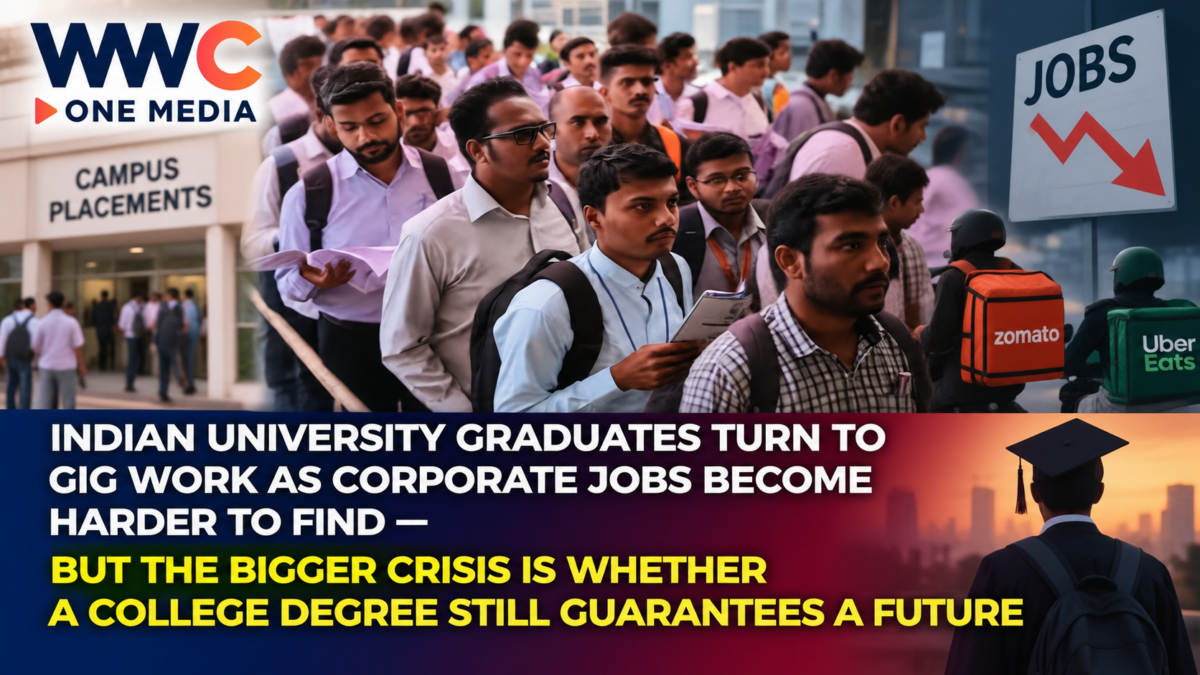
NEW DELHI, India — October 10, 2026 — India’s rapidly growing gig economy is opening new ways for millions of people to earn money, but a troubling question is emerging as more educated young workers struggle to secure stable careers: What happens when a university degree no longer leads to the professional opportunities graduates were promised?
A Bloomberg story published October 9, titled “An Indian University Graduate Turns to Gig Work,” draws attention to the changing employment landscape confronting India’s younger generation.
Behind that experience lies a broader economic challenge.
India has invested heavily in expanding education, technology and digital services. Yet many young jobseekers face intense competition for formal positions, while app-based delivery, ride-hailing and other short-term jobs remain comparatively accessible sources of income.
These platforms can help people earn money when conventional employment is difficult to find.
But they do not always provide the stable salaries, benefits or career development associated with traditional professional jobs.
Independent research from the International Labour Organization and India’s own economic assessments shows how rapidly platform employment is expanding.
The biggest question is whether India’s gig economy is becoming a stepping stone toward better jobs — or a long-term destination for graduates unable to find work that matches their qualifications.
University Degrees Are No Longer a Straightforward Ticket to Employment
For generations, higher education has been viewed by Indian families as a way to secure better wages, greater stability and upward mobility.
Parents often invest substantial household savings in tuition and living expenses because they expect a degree to improve their children’s career prospects.
But entering the workforce has become increasingly difficult for some graduates.
Channel NewsAsia reported in August on young Indians with university qualifications struggling to obtain jobs matching their educational backgrounds.
One master’s degree holder interviewed by the broadcaster described being unable to secure stable employment years after completing his studies.
The available alternatives included call-center and data-entry jobs offering relatively low pay.
That experience reflects a wider problem: the number of graduates seeking professional positions may exceed the opportunities available to them in certain occupations and locations.
A degree can improve a person’s qualifications without guaranteeing that employers have suitable vacancies.
Why More Young Indians Are Considering Gig Work
App-based platforms have made it possible to find work without going through conventional corporate recruitment.
Delivery services, ride-hailing platforms and online freelance marketplaces allow people to earn income through individual tasks.
Some workers value the flexibility.
Others use the work temporarily while studying, searching for employment or managing family responsibilities.
For graduates facing prolonged job searches, the attraction can be immediate income.
A platform worker may be able to start earning more quickly than someone waiting through months of interviews and selection processes.
But access to work is only one consideration.
Earnings can fluctuate with demand, working hours and platform payment arrangements.
Workers may also have to pay for transportation, fuel, equipment, mobile data and maintenance.
Consequently, gross earnings do not necessarily represent the amount of money a worker takes home.
India’s Gig Workforce Has Expanded Rapidly
India’s Economic Survey 2025–26 reported that the country’s gig workforce increased by approximately 55% between fiscal years 2021 and 2025.
The expansion reflects growth in digital commerce, consumer services and app-based business models.
Earlier estimates cited by the International Labour Organization put India’s gig workforce at approximately 7.7 million in 2020–21.
The same projections suggested that the sector could reach 23.5 million workers by 2029–30.
Those figures illustrate the scale of the opportunity.
However, the 23.5 million number is a forecast, not a completed workforce count for 2026.
The estimate also comes from an earlier methodology and should not be directly compared with narrower counts of monthly active app workers.
Research by Redseer in July 2026 estimated that India’s consumer-internet gig workforce included more than six million monthly active workers.
The different numbers measure different populations and levels of activity.
Gig Platforms Can Create Opportunities for People Previously Without Paid Work
Gig work should not be portrayed as inherently unsuccessful or inferior employment.
Digital platforms can provide genuine opportunities for people who have difficulty entering the conventional labor market.
Redseer’s 2026 research estimated that approximately 54% of workers in its surveyed gig-internet workforce had no paid employment before joining.
That suggests the industry can provide an important first source of earnings.
The research also reported that more than 90% of workers in its study used platforms on a part-time basis.
Those findings demonstrate that gig workers are not one uniform group.
Some are students earning supplementary income.
Others are experienced workers combining different opportunities.
Some use platform employment because it provides flexibility unavailable in traditional jobs.
And others may participate because they cannot obtain the stable employment they prefer.
Good public policy needs to distinguish among these groups rather than assume that every gig worker faces the same circumstances.
The Bigger Concern Is Job Quality
The expansion of employment opportunities does not automatically mean that job quality is improving.
The International Labour Organization has warned that many platform workers face unstable earnings, uncertain working conditions and limited social protection.
Some workers may not receive conventional employee benefits such as paid leave, employer-supported health coverage or retirement contributions.
Others face income variability caused by fluctuating demand or changes in platform algorithms.
Workers can also experience challenges when accounts are suspended or when payment systems change.
These problems are especially serious for individuals who depend on gig work as their principal source of income.
For university graduates hoping to establish long-term careers, unpredictable earnings can complicate saving, housing decisions and family planning.
The central policy challenge is not simply creating more gigs.
It is ensuring that employment provides sufficient income security, reasonable conditions and opportunities for advancement.
India’s Overall Unemployment Rate Does Not Tell the Whole Story
Government labor statistics show that India’s overall unemployment rate fell to 5.1% in July 2026, according to the Periodic Labour Force Survey.
The rate was lower than the 5.5% recorded in June.
At first glance, the figures suggest an improving employment picture.
But national unemployment rates do not fully describe whether workers are employed in jobs that match their skills or earnings expectations.
A university graduate working a few hours through a delivery platform may count as employed under the relevant survey definitions.
That does not necessarily mean they have found the professional career they sought.
Similarly, national averages can conceal differences between younger and older workers, men and women, and urban and rural populations.
Assessing graduate employment therefore requires looking beyond unemployment alone.
Other useful indicators include wages, hours worked, underemployment, job security and the proportion of graduates entering occupations aligned with their education.
Graduate Unemployment Has Been a Longstanding Problem
An India employment analysis discussed by the Financial Express in October cited a graduate unemployment rate of 29.1% in 2022.
That historical figure is substantially higher than the overall unemployment rate.
However, it is important not to present the 2022 figure as the verified graduate unemployment rate for October 2026.
Different studies also use varying age groups, definitions and survey periods.
Still, the figure helps explain why graduate employment has remained an important concern.
The supply of formal career opportunities has not always kept pace with the expansion of higher education.
Employers may also require skills or experience that are not consistently developed through classroom instruction.
At the same time, some industries can attract far more applicants than they can hire.
The result is a difficult transition from education into work.
Artificial Intelligence Is Adding New Pressure to Entry-Level Hiring
The employment challenge is being intensified by the growing adoption of artificial intelligence.
Bloomberg reported on October 7 that newly qualified engineering graduates are finding it harder to secure entry-level positions at technology centers operated by international financial firms in India.
Some employers are automating tasks that previously supported junior roles.
AI can help businesses improve productivity and handle routine work more efficiently.
But it can also change the number and nature of positions available to inexperienced employees.
This does not mean artificial intelligence has eliminated all graduate opportunities.
Demand continues for specialized technology skills, engineering, business services and roles requiring human judgment.
The impact varies significantly across industries.
Nevertheless, the concern is that traditional entry-level jobs may become harder to obtain just as more young people complete higher education.
That could make the transition from university to stable employment even more competitive.
India’s Technology Sector Is Also Moving Toward Higher-Value Work
India remains a major center for information technology and business services.
The industry’s future is not necessarily one of widespread job losses.
In September, Bloomberg reported an assessment by ING indicating that India’s outsourcing sector is moving toward more sophisticated services that are harder to automate.
These include engineering, financial analysis, research and specialized business operations.
Such work could create opportunities for highly skilled employees.
But there is a potential gap between the qualifications required for these positions and the capabilities of jobseekers who have not received relevant training.
If demand moves rapidly toward specialized skills, graduates without practical experience may struggle to enter the industry.
The challenge for universities is preparing students for the jobs employers are actually creating.
That requires stronger partnerships with businesses, applied learning and practical work experience.
Families Bear the Financial Risk of the Education-to-Employment Gap
Graduate underemployment affects more than individual careers.
Households may make significant sacrifices to finance higher education.
Some students also take on debt or rely on relatives to cover expenses.
When graduates cannot find adequate employment, the expected return on those investments becomes uncertain.
Families may postpone other financial priorities while waiting for young people to become economically independent.
A graduate earning irregular gig income may contribute to household expenses without achieving the stability originally expected from their education.
This creates a broader economic challenge.
Education is still valuable for developing knowledge and capabilities.
But its social and financial benefits can be weakened when suitable employment opportunities are insufficient.
That is why job creation and education policy need to be developed together.
Gig Work Also Faces a Global Debate Over Worker Rights
The issues confronting India’s platform workforce are part of an international discussion.
In June 2026, the International Labour Organization agreed on new international employment standards for platform workers.
The standards address questions involving pay, working conditions, social protection and how workers are classified.
They also seek greater transparency around automated systems that influence job allocation and compensation.
However, international labor standards are not automatically enforceable in every country upon adoption.
Their practical effects depend on ratification, domestic legislation and implementation.
India has already taken steps toward recognizing gig and platform workers within its social-security framework.
The challenge is turning that legal recognition into protections that are accessible and effective for workers.
For platform operators, policymakers must also consider the economic implications of new obligations and the importance of maintaining opportunities for flexible work.
Can Gig Work Become a Stepping Stone Instead of a Dead End?
An important question is whether gig employment helps workers move into more stable occupations.
In some cases, the answer may be yes.
Platform work can provide income while someone searches for a better position.
It can also help individuals develop practical skills such as customer interaction, scheduling, digital payments and basic business management.
But the benefits depend on the worker’s circumstances and the type of work performed.
Someone spending most of their time completing repetitive deliveries may find it difficult to undertake additional professional training.
Long working hours can also leave little opportunity for internships, interviews or career development.
Policies that connect gig workers with education, professional certifications and employment placement services could improve mobility.
Employers, universities and technology platforms all have potential roles to play.
The goal should be to ensure that gig work remains a meaningful choice rather than an unavoidable destination.
Why India’s Demographic Dividend Is at Stake
India has one of the world’s largest young populations.
That demographic structure offers significant economic potential.
A growing working-age population can support production, consumption and innovation.
But a demographic advantage does not automatically generate prosperity.
Young people need productive jobs that make effective use of their skills.
The International Labour Organization has emphasized the importance of improving employment quality as India seeks to benefit from its demographic profile.
If too many educated workers remain underemployed, the country risks failing to use an important part of its human capital.
That can limit income growth and weaken the economic returns from investments in education.
For policymakers, the challenge is developing industries capable of employing workers across different skill levels.
Technology and platform businesses can be part of the solution, but they cannot replace the need for broader productive employment.
What This Means for the Philippines and Southeast Asia
India’s experience offers lessons for other Asian economies.
The Philippines also has a large young workforce and an expanding digital-services industry.
Graduates entering the labor market face changing employer expectations, increasing competition and the growing use of AI.
Meanwhile, app-based delivery, ride-hailing and freelance platforms offer alternative earning opportunities.
These developments create both possibilities and risks.
Flexible work can help individuals enter the workforce or supplement their income.
But long-term economic development depends on the availability of productive jobs, appropriate wages and reliable worker protections.
For the Philippines, the broader lesson is the importance of aligning education, vocational training and investment policy with real labor-market demand.
The aim should not be to discourage gig employment.
It should be to ensure that graduates can choose among genuinely attractive career paths.
The Bigger Picture: Economic Growth Must Translate Into Better Employment
India’s challenge illustrates the difference between economic expansion and broad-based opportunity.
A country can experience strong growth in technology, digital payments and consumer services while some educated workers struggle to secure stable careers.
The gig economy can help absorb workers and provide income.
But its rapid expansion is not automatically proof that the traditional employment system is functioning effectively.
The quality of available jobs matters as much as the number.
For young graduates, the decisive questions concern income, career development and financial security.
For employers, the challenge is identifying and developing skills that complement new technology.
For the government, the priority is creating conditions for productive employment while improving protections for workers in nontraditional arrangements.
THE BOTTOM LINE
Bloomberg’s October 9 story about an Indian university graduate turning to gig work highlights a wider challenge confronting the country’s labor market.
India’s platform economy has expanded rapidly, with its Economic Survey reporting approximately 55% growth in the gig workforce between fiscal years 2021 and 2025.
The sector offers accessible earning opportunities, including for workers who previously had no paid employment.
However, university graduates continue to face competition for stable positions, particularly as businesses adopt automation and demand more specialized skills.
Independent research also raises concerns about unpredictable earnings and limited protections in parts of the gig economy.
The bigger question is whether India can create enough secure, productive and well-paid jobs for its growing number of graduates — or whether an increasing number will have to accept work that falls short of their qualifications and career ambitions.
A university degree still represents an important investment in the future. But for India’s next generation, the real test is whether that investment can lead to more than temporary work and uncertain income.