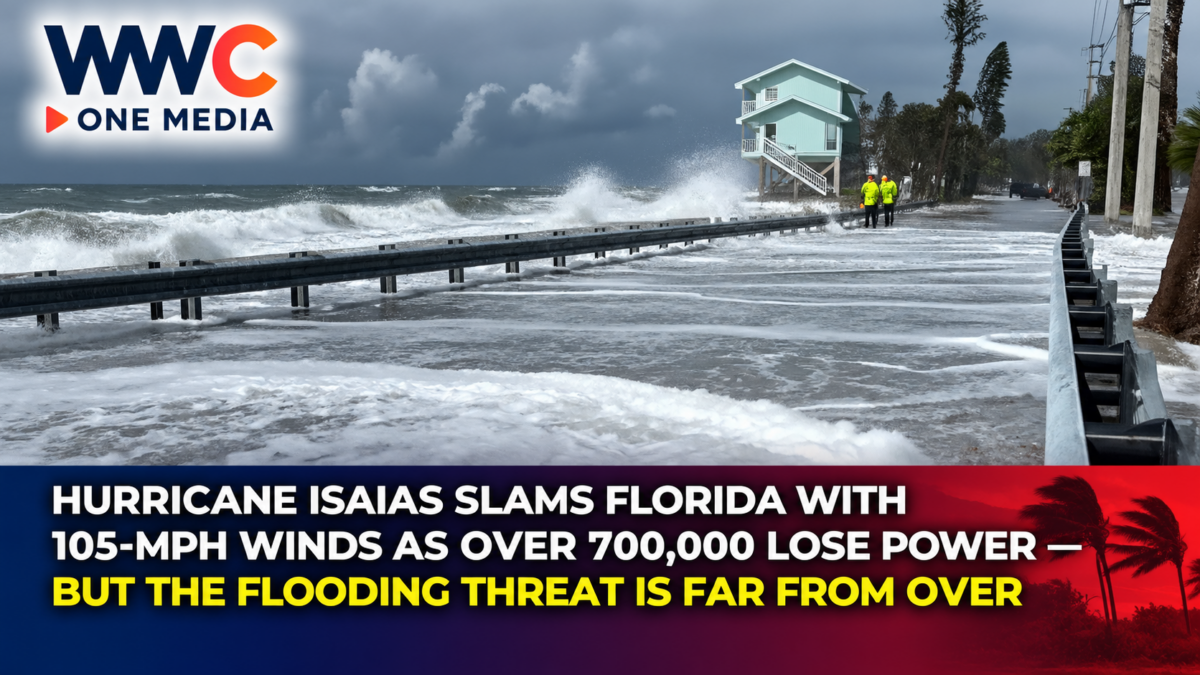
FLORIDA, United States — October 10, 2026 — Hurricane Isaias has battered the Florida Panhandle with destructive winds, intense rainfall and dangerous coastal flooding, leaving hundreds of thousands of homes and businesses without electricity and triggering emergency operations across the southeastern United States.
The hurricane made landfall near Destin, Florida, on Friday night, October 9, as a powerful Category 2 storm with maximum sustained winds of approximately 105 miles per hour.
Trees were uprooted, power lines collapsed, roads flooded and buildings sustained damage as the storm moved inland toward Alabama.
According to Reuters and the Associated Press, the hurricane weakened substantially after landfall and was subsequently classified as a post-tropical cyclone.
But the reduction in its wind strength does not mean the danger has passed.
The National Hurricane Center warned that heavy rainfall, flash flooding, hazardous winds and possible tornadoes could continue affecting communities well beyond the immediate landfall area.
Power outages across Florida and Alabama were reported to have affected more than 726,000 customers as conditions worsened.
The biggest question is not whether Hurricane Isaias has lost its hurricane strength — but how much damage its remaining rainfall and flooding could cause as the storm moves farther inland.
Isaias Makes Landfall Near Destin, Florida
Hurricane Isaias came ashore near Destin in the Florida Panhandle after intensifying over the warm waters of the Gulf of Mexico.
The storm had reached Category 3 strength earlier on October 9, according to the National Hurricane Center, before weakening to Category 2 ahead of landfall.
At landfall, maximum sustained winds were estimated at approximately 105 mph, strong enough to damage roofs, snap trees and disrupt electricity networks.
The western Florida Panhandle and southern Alabama were among the hardest-hit areas.
In Pensacola, strong winds scattered debris across roads and damaged buildings.
Storm conditions also affected coastal communities, transportation routes and essential services.
Emergency authorities urged residents to remain indoors while hazardous weather continued.
The immediate focus has shifted from preparing for landfall to identifying damaged areas, restoring critical services and protecting communities from flooding.
More Than 700,000 Power Outages Reported
One of the storm’s most widespread impacts has been electricity disruption.
Associated Press and Reuters reported that more than 430,000 customers in Florida and nearly 297,000 in Alabama were without power in their respective reporting snapshots.
Combined, those figures represented more than 726,000 customer outages.
The number can change rapidly as utilities restore service and additional failures are identified.
A customer outage generally refers to an affected electricity account, not necessarily one individual person.
The number of people experiencing disruption may therefore be considerably larger than the number of customer accounts.
Fallen trees, damaged distribution lines and flooding have complicated restoration work.
Utility companies are mobilizing crews, but some repairs cannot begin until roads become accessible and weather conditions are safe.
For affected families, prolonged outages can disrupt refrigeration, telecommunications, medical equipment and access to essential information.
Restoring electricity is likely to remain one of the most urgent priorities in the immediate aftermath.
Hurricane Weakens — But Dangerous Conditions Continue
The National Hurricane Center reported that Isaias weakened to a post-tropical cyclone after moving inland.
At one stage after landfall, maximum sustained winds remained near 65 mph as the system moved across southern Alabama.
Although that is below hurricane strength, winds of that magnitude can still bring down damaged trees and power lines.
Heavy rain can also continue long after a storm’s strongest winds have diminished.
This is why emergency agencies warn against treating a hurricane downgrade as an all-clear signal.
Residents may encounter flooded roads, weakened structures and dangerous debris even as skies begin to improve.
Rainfall can also accumulate in rivers, streams and drainage systems, creating new flooding away from coastal areas.
The threat therefore extends beyond locations directly struck by the hurricane’s center.
Flash Flooding Becomes the Next Major Threat
Forecasters expect significant rainfall across parts of Florida, Alabama, Georgia and surrounding areas as the remnants of Isaias continue moving inland.
Associated Press reported forecasts of roughly four to eight inches of rain across several affected regions during the weekend.
Some earlier forecasts warned that isolated locations could receive substantially higher totals.
Heavy rain over a short period can overwhelm drainage systems and rapidly flood low-lying roads.
Communities near rivers and creeks may also experience rising water levels after the strongest winds have passed.
Emergency authorities are advising motorists to avoid driving through flooded streets.
Floodwater can conceal damaged pavement, downed electrical equipment and dangerous currents.
The danger is especially serious during nighttime conditions, when the depth and movement of water are difficult to judge.
Storm Surge Threatened Coastal Communities
Before landfall, the National Hurricane Center issued warnings about life-threatening storm surge along portions of the northern Gulf Coast.
Storm surge occurs when strong winds and atmospheric conditions push seawater inland.
It can flood coastal roads, damage buildings and isolate neighborhoods.
Forecasts before landfall indicated that some locations could experience several feet of water above normally dry ground.
The precise height of flooding varies depending on coastal geography, the tide and the hurricane’s track.
Storm surge should not be confused with ordinary rainfall.
A community can experience coastal inundation even when relatively little rain falls directly overhead.
Likewise, inland flooding can occur far from the ocean when heavy rainfall overwhelms rivers and drainage systems.
Both hazards have been major concerns during Isaias.
Alabama Reports Widespread Damage
The storm’s impact has extended well beyond Florida.
In Alabama, emergency authorities reported fallen trees, damaged power lines and road closures as the system moved inland.
Houston County was among the areas reporting significant disruption.
Some roads were closed to protect motorists and allow crews to assess damage.
Alabama authorities urged residents to avoid unnecessary travel and give emergency personnel room to operate.
The situation illustrates how hurricanes can produce severe impacts after crossing the coastline.
Inland communities may face dangerous winds, flash flooding and isolated tornadoes even when the storm is no longer classified as a hurricane.
Damage assessments remain preliminary, and the final financial cost has not yet been established.
Florida and Alabama Activate Emergency Measures
Authorities in affected states declared emergencies and mobilized response resources ahead of and following the hurricane.
Florida Governor Ron DeSantis urged residents to follow local instructions, remain off hazardous roads and prepare for interruptions to essential services.
Florida also mobilized thousands of National Guard personnel to assist with emergency operations.
State and federal agencies have coordinated supplies, rescue support and recovery planning.
Emergency declarations can help governments access resources and streamline response activities.
However, declaring an emergency does not guarantee that every affected community will immediately receive assistance.
Road damage, flooding and continuing hazardous weather can delay access to the hardest-hit locations.
The response will evolve as officials identify the areas requiring the most urgent support.
Flights and Travel Disrupted Across the Gulf Coast
Air transportation has also been affected.
Storm conditions forced airlines and airports in parts of the region to suspend or adjust operations.
Strong winds, heavy rain and infrastructure concerns can make airport operations unsafe.
Travelers may experience delays even after weather conditions improve because aircraft and crews must be repositioned.
Road closures and damaged transportation infrastructure can create additional difficulties for passengers.
Officials are advising travelers to check directly with airlines, airports and local transportation agencies for updated information.
Flight schedules and road-access conditions can change quickly during storm recovery.
Hurricane Isaias Disrupts US Oil and Gas Production
The hurricane has also affected energy operations in the Gulf of Mexico.
Ahead of the storm, energy companies evacuated offshore personnel and suspended production at numerous facilities.
Financial Times reporting indicated that more than half of US offshore oil production in the Gulf was temporarily shut in during preparations.
The disruption highlights the vulnerability of energy infrastructure to major storms.
Offshore platforms, pipelines, ports and refineries form part of an interconnected supply network.
Even when equipment escapes severe damage, operators must complete safety inspections before restarting production.
A prolonged shutdown can reduce available supply and affect energy-market expectations.
However, temporary production suspensions do not automatically translate into higher retail gasoline or diesel prices.
The actual effect depends on the duration of disruption, inventories, refinery activity and broader market conditions.
The First Hurricane of a Quiet Atlantic Season
Isaias is notable for becoming the first Atlantic hurricane of the 2026 season unusually late in the year.
The storm developed after a relatively quiet period of hurricane activity.
Forecasters have linked part of the season’s subdued activity to El Niño conditions, which can increase wind shear and interfere with tropical cyclone formation over the Atlantic.
But a quiet season does not mean individual storms cannot become dangerous.
Isaias demonstrated how quickly a tropical system can intensify when atmospheric and ocean conditions become favorable.
Before reaching Florida, the storm strengthened into a major hurricane over the Gulf.
Its rapid development left authorities preparing for a range of hazards, including destructive winds and coastal flooding.
The episode underscores why seasonal forecasts cannot replace storm-specific warnings and local emergency preparedness.
Recovery May Take Days or Longer
For many communities, the greatest challenge now is recovery.
Utility crews must restore electricity, transportation agencies must clear roads, and local authorities must inspect buildings for damage.
Flooded areas may remain inaccessible after rainfall stops.
Businesses can also face interruptions because of damaged premises, equipment failures or reduced access for employees and customers.
The length of recovery will vary widely.
Some neighborhoods may regain power quickly, while others could face delays because of extensive infrastructure damage.
Officials have not yet established the storm’s final economic cost.
Likewise, early photographs and reports cannot provide a complete picture of the damage across every affected county.
More reliable estimates will emerge after emergency crews complete assessments.
What Residents Should Do After the Storm
Authorities recommend continued caution even in places where the most intense weather has ended.
Residents should follow local emergency bulletins and avoid traveling through flooded or debris-covered roads.
Downed power lines should always be treated as energized.
Generators should only be operated outdoors, away from windows and doors, because they produce dangerous carbon monoxide.
People returning to damaged properties should check for structural hazards before entering.
Those in areas still under evacuation instructions should wait for official clearance before returning.
Residents should also be alert to changing flood warnings as heavy rain moves farther inland.
The weakening of Isaias does not remove these hazards.
Why Hurricane Isaias Matters Beyond the United States
Although the storm is affecting the United States, its consequences may extend into international business and energy markets.
Disruptions to Gulf oil production, ports and supply routes can affect companies connected to global petroleum trade.
Insurance companies may also face claims arising from wind, flood and property damage.
However, it is too early to determine the storm’s final impact on energy prices, insurance losses or the broader American economy.
For the Philippines and other countries frequently exposed to tropical cyclones, Isaias provides another reminder that storm preparedness must consider flooding and post-landfall conditions as well as wind strength.
A hurricane’s category describes its maximum sustained wind speed.
It does not measure every danger posed by the storm.
THE BOTTOM LINE
Hurricane Isaias struck Florida near Destin on October 9 as a Category 2 storm, with maximum sustained winds of approximately 105 mph.
The hurricane caused extensive power outages, downed trees, damaged buildings and flooded roads across the Florida Panhandle and parts of Alabama.
More than 726,000 customers were reported without electricity in Florida and Alabama, although outage totals continue to change.
The National Hurricane Center subsequently classified Isaias as a post-tropical cyclone as it weakened inland.
But flooding, dangerous winds and the possibility of tornadoes remain serious concerns across the Southeast.
The biggest question is no longer how powerful Hurricane Isaias was at landfall — but how much additional damage its rain, flooding and disrupted infrastructure could cause before recovery begins in earnest.
For communities in Florida and Alabama, the hurricane’s strongest winds may have passed. The harder battle may now be restoring power, reopening roads and protecting families from the dangers left behind.